
Thread Lift in Bangalore
A thread lift uses fine dissolvable threads placed under the skin to lift and support areas that have begun to sag, and to stimulate collagen as the threads break down. It is a minimally invasive alternative to a surgical facelift, not a replacement for one.
Is this you?
What it does for you
Lifts sagging skin without surgery
Threads are anchored under the skin and used to reposition tissue that has descended, which is why the lift is visible at the end of the appointment.
Stimulates collagen as they dissolve
The threads are absorbable. As they break down they provoke a collagen response along their path, so firmness can continue improving for some weeks after the lift itself.
A subtler change than a facelift
The degree of lift a thread can achieve is modest by design. For patients with mild to moderate laxity, that is the point — the result reads as rested rather than altered.
Minimally invasive, with local anaesthetic only
No incisions of the kind a surgical lift requires, no general anaesthetic, and no overnight stay. Recovery is measured in days, not weeks.
Doctor-planned placement
Where a thread enters, the vector it follows and how many are used are anatomical decisions. They are made by a doctor here, and they are what separates a good thread lift from a visible one.
How the treatment works
Assessment and honest suitability check
The doctor establishes whether your laxity is in the range threads can treat. Beyond that range, a thread lift disappoints, and you should be told so before you book.
Choosing the thread type and planning the vectors
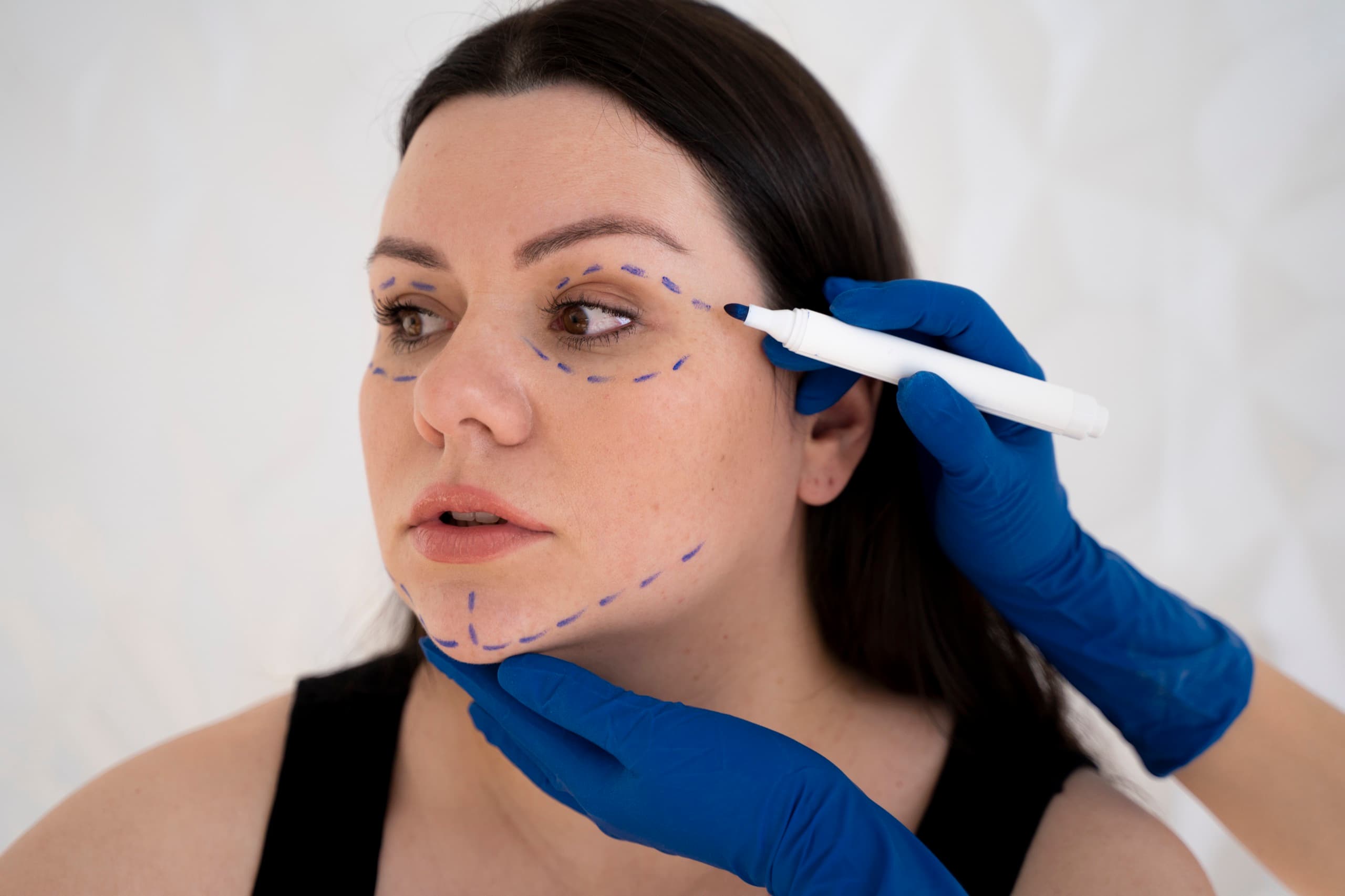
Entry points and the direction of each thread are marked on the skin, and the doctor decides which threads the plan needs — smooth mono threads where the aim is firmness, barbed cog threads where tissue has to be lifted and held. This is the plan for where the tissue will end up.
Placement
Under local anaesthetic, threads are introduced with a fine needle or cannula and drawn to lift the tissue into position.
Recovery and review
Aftercare is explained, and you are reviewed once the swelling has settled so the final position can be assessed properly.
See the Treatment in Action
The procedure, straight from the clinic's own channel.
Sculpt Your Face Without Surgery
Thread lifts, explained
Side effects, honestly
Most patients experience none of these. Some patients, in rare cases, may notice the following — listed because you deserve the full picture before you decide.
Swelling and bruising
Common in the first days after the procedure and generally resolves within about a week.
Tightness or a pulling sensation
Normal in the first days as the tissue settles into its new position, and it eases as swelling reduces.
Puckering or dimpling of the skin
Small irregularities can appear along a thread's path early on. They usually settle, but tell your doctor if they persist rather than waiting.
Infection or thread extrusion
Uncommon, but possible. Contact the clinic if you develop increasing pain, redness or discharge at an entry point rather than managing it at home.
Circulation problems, particularly in the nose
Rare, but the reason a nose thread lift is a doctor's procedure. Threads on the nasal bridge sit close to the vessels that supply the overlying skin, and a compromised blood supply can damage tissue. Severe pain, blanching or a dusky colour change after treatment should be reported to the clinic straight away rather than left to see if it settles.
Not suitable for everyone
Threads are not advised during pregnancy or breastfeeding, with an active skin infection, or where there is skin cancer or significant laxity better served by a different approach.
About this treatment
The useful question at consultation is not whether threads work, but whether they work for the amount of laxity you have. That answer should come before any discussion of booking.
The types of thread, and what each one is for
"Thread lift" describes a family of procedures rather than a single one, and most of the confusion patients arrive with comes from that. Two things vary: what the thread is made of, and what shape it is.
The material determines how long it lasts. PDO — polydioxanone — is the most widely used and has a long history as a surgical stitch material; it absorbs over roughly six months. PLLA (poly-L-lactic acid) and PCL (polycaprolactone) are absorbable too but break down more slowly. In every case the thread itself is temporary. What lasts is the collagen your skin lays down along the thread's path while it dissolves.
The shape determines what the thread can actually do:
- Mono threads are smooth along their whole length. With nothing to grip the tissue they cannot reposition it, so they are not a lifting thread. They are placed in a mesh to firm skin and provoke collagen, and they are a skin quality treatment.
- Cog threads, also called barbed threads, carry small backward-facing anchors. Those anchors hold tissue where the doctor has moved it, which is what makes a visible lift possible. When a thread lift is described as lifting the cheek or the jawline, cog threads are what is meant.
- Screw threads are two strands wound around each other and are used to add a little support where tissue has hollowed.
A plan frequently uses more than one. Cog threads along the vectors that need lifting, mono threads across an area where the skin itself has thinned, is a common combination.
Where threads are placed
The mid-face and cheek are the areas threads are best suited to: as the cheek pad slides downward it flattens the cheekbone and deepens the fold beside the mouth, and a cog thread can carry it back along a planned line. The jawline is the other common request, where lifting softened tissue back toward the angle of the jaw restores the border between face and neck. Threads are also used to lift the brow area and to tighten under the chin.
Two areas are asked about by name. A nose thread lift — the hiko lift — runs threads along the bridge to straighten and define the profile and give the tip a little support; it is the non-surgical answer to a dorsal hump or a slightly flat bridge, within modest limits. A fox eye lift anchors threads above the brow to raise the brow tail and elongate the outer eye. Both are short procedures under local anaesthetic, and both are temporary.
What matters more than the list of areas is the honest limit. Threads treat laxity. They do not remove fullness, they do not replace lost volume, and past a certain amount of descent they will disappoint against a surgical lift. A consultation that tells you which of those you actually have is worth more than one that books you in.
Questions patients ask
How long does a thread lift last?
Is it painful?
Is a thread lift the same as a facelift?
Am I a suitable candidate?
What is the downtime?
What happens to the threads afterwards?
Can threads be combined with other treatments?
What are PDO threads?
What is the difference between mono, cog and screw threads?
Which type of thread will I need?
Can a thread lift lift the mid-face and cheeks?
Can threads define the jawline and under the chin?
Can threads lift the nose? What is a hiko nose lift?
Can threads give a fox eye lift?
How is the cost of a thread lift worked out?
What are MINT, Silhouette InstaLift or other branded threads?
Related at The Aesthetic Edge
Get a doctor's read before you decide anything
₹500 consultation, waived off against your treatment. Indiranagar or Bellandur — closed Wednesdays.
General information, not medical advice — your treatment is decided at an in-person consultation. Terms & Conditions