
MNRF for Acne Scars — Why It Suits Indian Skin
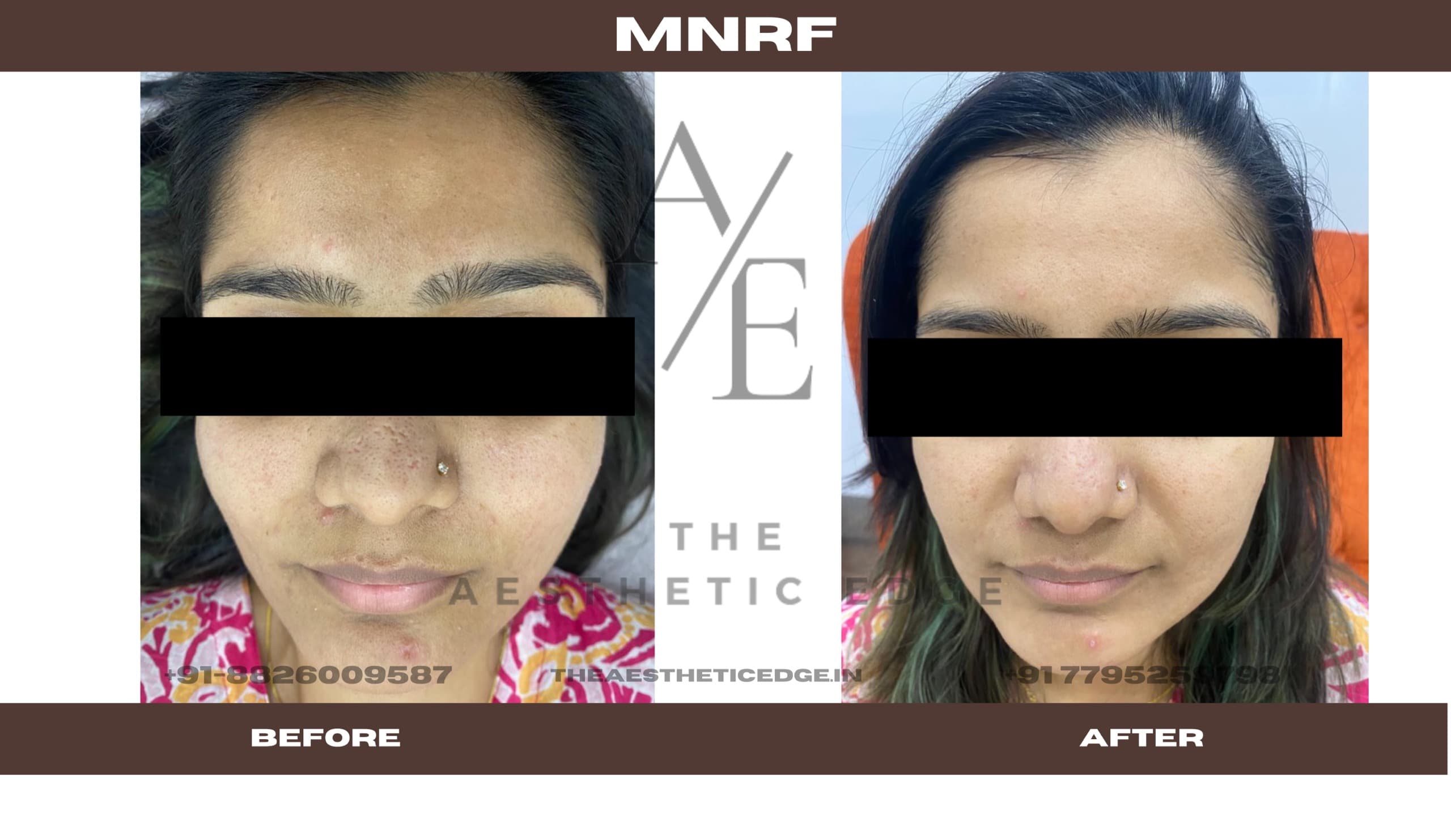
If you grew up with acne in India, you have probably been told two things that sit awkwardly together: that laser resurfacing is the treatment for acne scarring, and that laser resurfacing is risky on your skin. Both were broadly true, and microneedle radiofrequency is a large part of why that tension has eased.
The two mechanisms, and what the RF adds
Microneedling creates controlled micro-injuries, and the repair response lays down collagen. That is covered in more detail in microneedling — depth is the treatment.
MNRF sends radiofrequency energy through those needles once they are at depth. The needle is the delivery route; the energy is released at the tip, inside the dermis. That produces controlled thermal injury in a small zone around each tip, and thermal injury is a much stronger stimulus for collagen remodelling than mechanical injury alone.
On most systems the needles are insulated along their shaft, so energy is released only at the tip. That detail is the whole safety argument: the epidermis is punctured but not heated.
Why that matters on skin that pigments
Ablative resurfacing lasers work by removing the top layer of skin across the treated area. They are effective and they have a long track record — and on skin with more melanin they carry a meaningful risk of post-inflammatory hyperpigmentation, where the treatment leaves the skin darker than it started. For a patient treating acne scars, trading texture for pigmentation is not a trade worth making.
MNRF is non-ablative and fractional: the surface is left essentially intact, and only small columns of tissue are treated, with untreated skin between them to drive healing. Less epidermal disruption means less inflammation at the surface, and less inflammation at the surface means less pigment response.
This is why MNRF has become a default rather than a novelty in clinics treating Indian skin. It is not that it is more powerful than an ablative laser — it generally is not. It is that it is usable.
The risk is reduced rather than removed. Sun protection afterwards still does more to prevent pigmentation than anything else you will be asked to do.
Which scars respond, and which do not
Acne leaves several different kinds of scar, and they do not respond alike. Being told which you have is more useful than being sold a package.
| Scar type | What it looks like | Response to MNRF |
|---|---|---|
| Rolling | broad, shallow, wave-like undulation | good — often the best responder |
| Boxcar | wider depressions with defined edges | moderate to good, edges soften |
| Ice pick | narrow, deep, like a puncture | poor — needs a different technique |
| Hypertrophic / keloid | raised, thickened | not suitable; different treatment entirely |
Ice pick scars are narrow and extend deep; a fractional treatment cannot reach the base of them meaningfully. They are usually addressed with TCA CROSS or punch techniques instead.
Deep, tethered rolling scars often need subcision — releasing the fibrous bands anchoring the scar from below — either before or alongside MNRF, because no amount of collagen stimulation lifts a floor that is tied down.
Most real faces carry a mixture, which is why an honest scar plan is usually a combination rather than a single device, staged over months.
What else it treats
Beyond scarring: textural irregularity, enlarged-looking pores, fine lines, and mild to moderate laxity, since the same dermal heating causes tightening. That last one makes it a reasonable option for someone in their late thirties or forties who wants texture and firmness addressed together. For laxity alone without a texture problem, HIFU targets deeper tissue and may suit better.
Some systems are also used for underarm sweating and for acne itself, targeting the sebaceous glands — a different protocol to the one described here.
The session, and the days after
Numbing cream first, and it needs a proper thirty to sixty minutes to work — do not let anyone rush it, because this treatment is more uncomfortable than plain needling. The handpiece is then stamped across the area, with depth and energy adjusted per zone: the cheek where the scars are is treated differently from the skin around the eye.
Afterwards, expect redness, swelling and a sunburn-like feeling for two to four days. A grid pattern of small marks is often visible for 24 to 48 hours, matching the needle array. It is normal, it is temporary, and it is worth knowing about before you book anything social for the next evening.
Aftercare is the same principle as any barrier-breaking treatment: nothing on the skin but what you are given for the first day, no actives for about a week, no sweating or swimming for a couple of days, and rigorous sun protection.
The timeline, honestly
This is a slow treatment.
Typically three to six sessions, four to six weeks apart. Improvement is gradual and continues developing for three to six months after the last session, because collagen remodelling runs long after the treatment ends.
Realistic expectations for established scarring are meaningful improvement, not erasure — often described in the region of a significant but partial reduction in how visible the scars are, varying considerably by scar type and by person. Anyone promising clearance of deep scarring is overselling.
Photographs in the same light at each visit are worth taking. Skin changes too slowly to judge from the mirror, and people routinely underestimate their own progress.
When it is not suitable
Active inflammatory acne in the area. Active skin infection or cold sores. A history of keloid scarring. Recent isotretinoin — leave the interval your doctor advises. Pregnancy. And an implanted electronic device such as a pacemaker, which is specific to radiofrequency treatments and must be disclosed.
Where to start
With a diagnosis, not a package. Ask which scar types you have, which of them this treatment will help, what else is needed for the ones it will not, and how many sessions the plan runs to.
Book a consultation at Indiranagar or Bellandur. Acne scarring is one of the concerns where a well-sequenced plan across a year beats any single treatment, and the appointment that maps it is the one that matters.