
PRP for Hair Loss — Why Timing Decides the Result
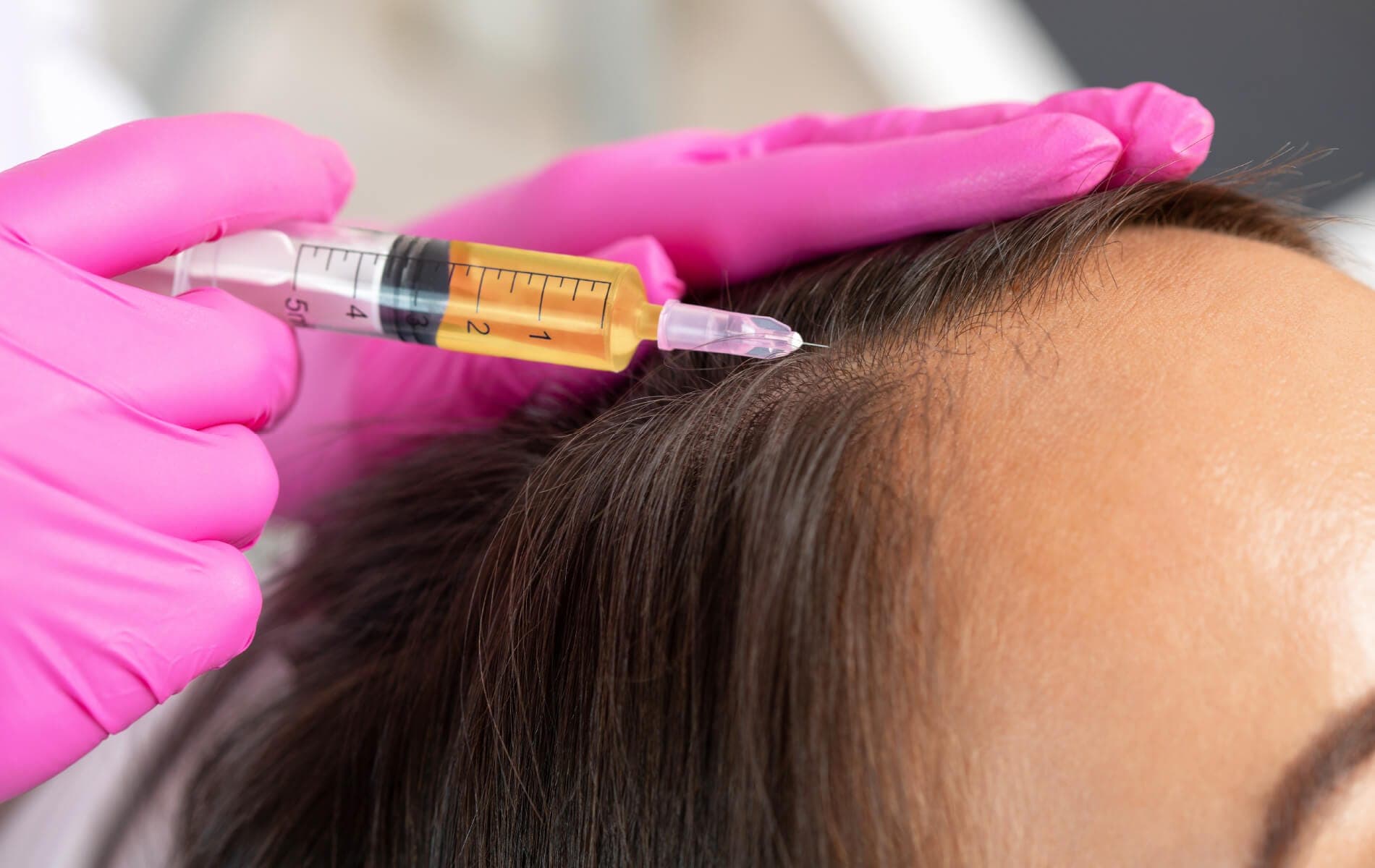
Two people can have the same treatment, the same number of sessions, from the same hands, and get completely different outcomes. With PRP for hair, that is not luck. It is almost entirely a question of what state the follicles were in before anyone started.
What PRP does to a follicle
A small volume of your blood is drawn and spun to concentrate the platelets. The resulting plasma is injected into the scalp. Platelets carry growth factors that the body uses in repair and signalling, and in the scalp they act on follicles that are still present but underperforming — pushing follicles that have slipped into a resting phase back toward active growth, and improving the calibre of hair that is growing thin.
Read that again, because the whole article is in it: PRP acts on follicles that are still there. It does not create new ones.
Miniaturisation, and why early is different from late
Pattern hair loss does not work like a light switch. Affected follicles miniaturise — each growth cycle produces a slightly finer, shorter, less pigmented hair than the last, until what is produced is barely visible, and eventually the follicle stops producing at all.
A scalp that looks thin usually holds a large population of miniaturised follicles that are alive and capable. That scalp responds to PRP. A scalp that has been bald in an area for years holds mostly follicles that have stopped, and no growth factor reaches something that is not there. That scalp does not respond, however many sessions are bought.
The question is not "how bad is it". It is "how much is still alive". Those are not the same question, and only one of them predicts the result.
This is why the least commercial advice in hair medicine is also the most useful: if you are noticing loss now, this is the cheapest your treatment will ever be, and the most likely to work.
What should happen before anyone injects you
Hair loss has causes, and several of the common ones are treatable without any procedure at all. Injecting plasma into a scalp that is thinning because of an untreated thyroid problem or low ferritin is treating a symptom and leaving the engine running.
A proper work-up looks at:
- thyroid function — both over- and under-active thyroid cause diffuse loss
- iron stores — ferritin, not just haemoglobin; you can be non-anaemic and still iron-deficient enough to shed
- vitamin D and B12
- for women, hormonal factors including PCOS
- recent illness, surgery, crash dieting, pregnancy or severe stress, any of which can trigger a temporary shedding phase that recovers on its own
- medication history, since several common drugs cause shedding
And the scalp itself should be examined, not glanced at — the pattern of loss distinguishes androgenetic thinning from telogen effluvium from scarring conditions, and those need different treatment entirely.
If a clinic proposes a PRP package before it has done any of that, it is selling a procedure rather than treating hair loss.
The session, and the course
The session itself is short and undramatic. Blood draw from the arm, centrifugation, then injections across the affected areas with a fine needle, usually with topical anaesthetic. Most people go straight back to their day. Scalp tenderness for a day or two is common.
A course is typically several sessions spaced a few weeks apart, followed by maintenance. The interval and number should come from your scalp, not from a package.
Expect the timeline to test your patience. Reduced shedding usually comes first — often the earliest sign anything is working. Visible density takes months, because you are waiting on the hair growth cycle, and that cycle runs at its own speed regardless of what you paid. Some people also notice a brief increase in shedding early on as resting follicles are pushed into a new cycle; it is not the treatment failing.
Photographs under fixed lighting at each visit are worth more than memory here. Hair changes too slowly for anyone to judge it from the mirror.
PRP, GFC, QR678 — what is the difference?
You will be offered several injectables that all involve growth factors, and the marketing around them is not always illuminating. Broadly: PRP is prepared from your own blood at the time of treatment. GFC is a growth-factor concentrate, also derived from your own blood but processed differently. QR678 is a formulated product rather than a blood derivative.
They differ in preparation, cost and session schedule. Rather than accept a claim that one is simply better, ask what is being proposed for your pattern of loss and why — and what the plan is if three months brings no change. A clinic that has an answer to the second question has thought about your case.
The honest summary
PRP is one of the better-established non-surgical options for early to moderate thinning, in someone whose underlying causes have been investigated and addressed, who will complete a course and maintain it. It is not a rescue for long-established baldness, and it is not a substitute for finding out why your hair is falling.
Book a consultation at Indiranagar or Bellandur, and expect the first appointment to involve more questions and possibly blood tests than treatment. That is the appointment doing its job.