
The Carbon Peel Does Not Peel — Here Is What It Does
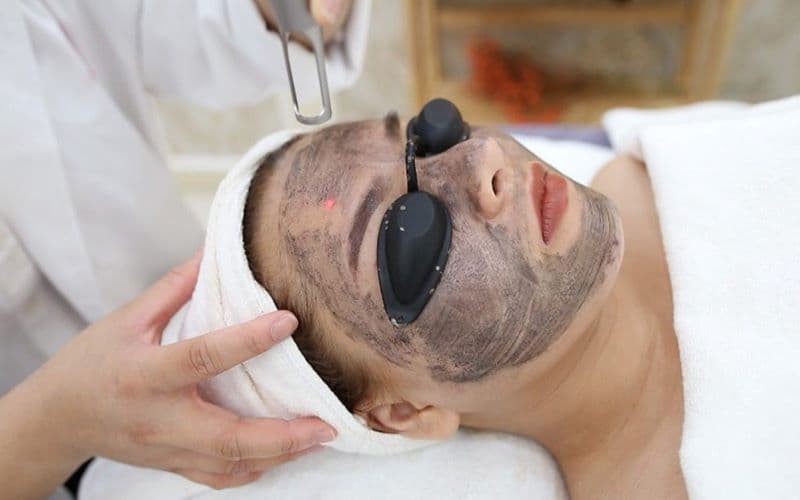
Almost every question we get about the carbon peel comes from its name. People book it expecting to peel, worry when they do not, and assume something went wrong. Nothing went wrong — the treatment is not a peel in the sense that a chemical peel is a peel, and the two are not close relatives.
What actually happens
A thin layer of medical-grade liquid carbon is painted onto the skin. It settles into the pores and binds to oil and debris. A Q-switched laser is then passed over the surface.
Here is the part that explains everything else. A laser needs something to absorb its energy — a target. The carbon is that target: an artificial one, applied deliberately, sitting on the surface and in the pores. The laser pulse is absorbed by the carbon, which is vaporised along with whatever it has bound to, and the small amount of heat released passes into the upper skin.
So the "peel" is the carbon being removed, not your skin. And the laser is working at low energy against a surface target rather than at treatment energy against a target inside your skin. That is the whole difference between this and a resurfacing treatment, and it is why it has essentially no downtime.
It is sometimes called the China doll facial or the Hollywood peel. Same thing.
Carbon peel versus chemical peel
| Carbon peel | Chemical peel | |
|---|---|---|
| Mechanism | laser vaporises applied carbon | acid dissolves bonds between skin cells |
| Do you visibly peel? | no | often, depending on depth |
| Downtime | none to a few hours of redness | a day to over a week by depth |
| Depth reached | superficial | superficial to deep, by formulation |
| Best for | oil, congestion, dullness, pore appearance | pigmentation, texture, acne, scarring by depth |
They are not competitors so much as different tools. A patient with congested, oily skin and a wedding on Saturday wants the first. A patient with melasma or post-acne marks wants the second, and will need to plan around the recovery.
What it does well
- Oily, congested skin. The strongest case. It genuinely clears pores of oil and debris, and the effect on how oily the skin feels tends to last a few weeks.
- The look of enlarged pores. Emptied pores look smaller. This is real and it is temporary.
- Dullness. Removing surface debris and dead cells makes skin reflect light better. This is the "glow", and it is why the treatment is popular before events.
- Mild active acne, as an adjunct. Reducing surface oil and bacterial load can help alongside a proper acne plan. It is not an acne treatment on its own.
- Very superficial unevenness, over a course.
What it does not do
It does not treat acne scarring. It does not clear melasma or deep pigmentation. It does not tighten lax skin, and the collagen contribution from a low-energy surface pass is modest — real, but not a substitute for a treatment designed to build collagen.
If those are your concerns, Q-switch laser for pigment, needling or a medium-depth peel for texture, or an energy device for laxity are the honest recommendations, and a consultation should say so rather than selling you a course of facials.
If a treatment has no downtime, it has not changed anything structural. That is a trade, not a flaw — but you should know which side of it you are buying.
The session
Thirty to forty-five minutes, including preparation. You will feel warmth and a light snapping sensation as the laser passes; most people find it easily tolerable without anaesthetic. Eye protection is worn throughout — yours and the operator's — and this is not optional at any energy.
Afterwards the skin usually looks brighter immediately, sometimes with mild redness for an hour or two. You can wear makeup the same day, though giving it a few hours is better.
A course of several sessions a few weeks apart gives more than a single treatment, with occasional maintenance. Being told you need a large package before anyone has assessed your skin is a reason to ask why.
When it should be postponed
- active inflammatory acne — treating through a flare can aggravate it
- recent isotretinoin use — leave the interval your doctor advises
- photosensitising medication, including some antibiotics — this must be disclosed
- a recent tan or sunburn, which changes how your skin absorbs laser energy
- active infection in the treatment area, including cold sores
- pregnancy, by convention
As with any laser on Indian skin, sun protection afterwards is the step that prevents unwanted pigmentation. It is the least glamorous instruction and the one that most affects whether you are pleased in a month.
The honest summary
The carbon peel is an excellent thirty-minute treatment for oily, congested, dull skin, with a visible same-day result and no recovery. It is a very good refresh and a poor repair. Bought for what it is, people are consistently happy with it; bought as a fix for scarring or melasma, they are consistently not.
Book a consultation at Indiranagar or Bellandur if you are not sure which of the two you need — that is a question worth answering before booking a course of anything.