
Are You Actually a Candidate for a Thread Lift?
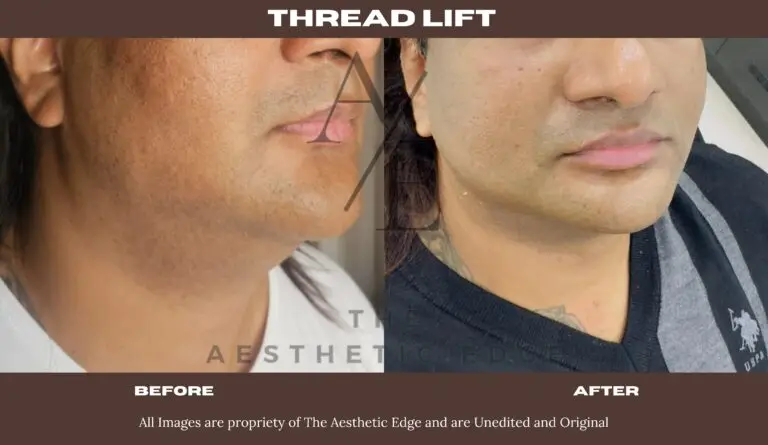
A large share of the people who walk in asking for a thread lift do not need one. That is not a sales problem, it is a diagnosis problem: the face they see in the mirror at forty looks fallen, and "lift" is the obvious word for it. But a face can look fallen for two quite different reasons, and only one of them responds to threads.
Laxity and volume loss are not the same problem
Laxity is skin and its underlying tissue having lost tension — the sheet has stretched. Pull it and it moves; let go and it settles back slowly.
Volume loss is the scaffolding underneath having shrunk. Fat pads in the mid-face thin and descend, bone remodels, and the same amount of skin is now draped over a smaller structure. Nothing has stretched. There is simply less to hold it up.
They produce a similar-looking result and need opposite treatments. Threads reposition and support tissue that has slackened. Applied to a face that has actually lost volume, they pull a hollow face tighter — which reads as gaunt, not younger. That is the single most common way a thread lift disappoints someone, and it is decided at consultation, not in theatre.
If your face looks better when you lie down, that is volume loss talking. Gravity is not your problem; the missing structure is.
A rough self-test before your appointment: look at yourself lying flat, and then leaning forward. Laxity looks dramatically better lying down and worse leaning forward. Volume loss looks much the same either way — the hollows are still hollows. It is not diagnostic, but it usually tells you which conversation you are about to have.
What threads are, briefly
Threads are made of polydioxanone (PDO), the same absorbable polymer used in surgical sutures for decades. They are placed under the skin with a fine cannula and used to reposition tissue along a planned direction. Over the following months the material breaks down, and as it does it provokes a collagen response along the track it occupied.
That two-part action matters for expectations. The mechanical lift is there almost immediately. The collagen contribution builds over weeks and is the part that improves skin quality rather than position.
Not all threads do the same job. Smooth threads are essentially a collagen treatment with no meaningful lift. Barbed or cogged threads are the ones that actually reposition tissue. If a quote does not tell you which you are getting and how many, it is not a quote for a comparable procedure.
Where threads work, and where they do not
They suit mild to moderate laxity in the mid-face, along the jawline, and in the upper neck, in someone whose skin still has reasonable thickness and elasticity.
They are the wrong answer when:
- the dominant problem is volume, where fillers or a biostimulator like Profhilo address the actual deficit
- laxity is advanced, and the honest comparison is with surgery
- skin is very thin, where threads are more likely to be palpable or visible
- the skin has lost so much elasticity that there is nothing for the thread to hold
HIFU sits in an interesting middle ground here — it tightens by heating deeper tissue rather than by mechanically repositioning it, so it suits earlier laxity and people who want no needles under the skin at all. Which of the two is right is genuinely a per-face judgement.
What "12 to 18 months" actually means
Threads are absorbable, so the lift is temporary by design. The figure usually quoted is 12 to 18 months, and it is worth understanding what that describes: not a cliff, but a gradual return toward baseline as the mechanical support resorbs and the collagen contribution slowly turns over.
Three things move that number. Thicker, more elastic skin holds longer. Heavier tissue in the treated area pulls back sooner. And smoking shortens it, as it shortens the durability of most collagen-dependent results.
Read against that timeline, the sensible way to compare threads with the alternatives is not price per session but price per year of the result you actually wanted — and whether you intend to maintain it at all. Some patients have one lift for a specific reason and let it go. That is a perfectly reasonable plan.
What a proper consultation should do to you
It should be slightly annoying. You should be examined sitting up rather than in a photograph, told which of laxity and volume loss is driving what you see, shown where the threads would be placed and in which direction they would pull, and given a straight answer on whether the result you are describing is achievable with threads at all.
If sagging along the jawline or mid-face is what bothers you, book a consultation at Indiranagar or Bellandur. Bring a photograph of yourself from five to ten years ago if you have one — it makes the laxity-versus-volume question far easier to answer, and it changes the recommendation more often than people expect.
Once you know threads are right for you, the companion piece to read is what actually happens during a thread lift, and what can go wrong.