
A Sagging Jawline: How the Treatment Decision Actually Gets Made
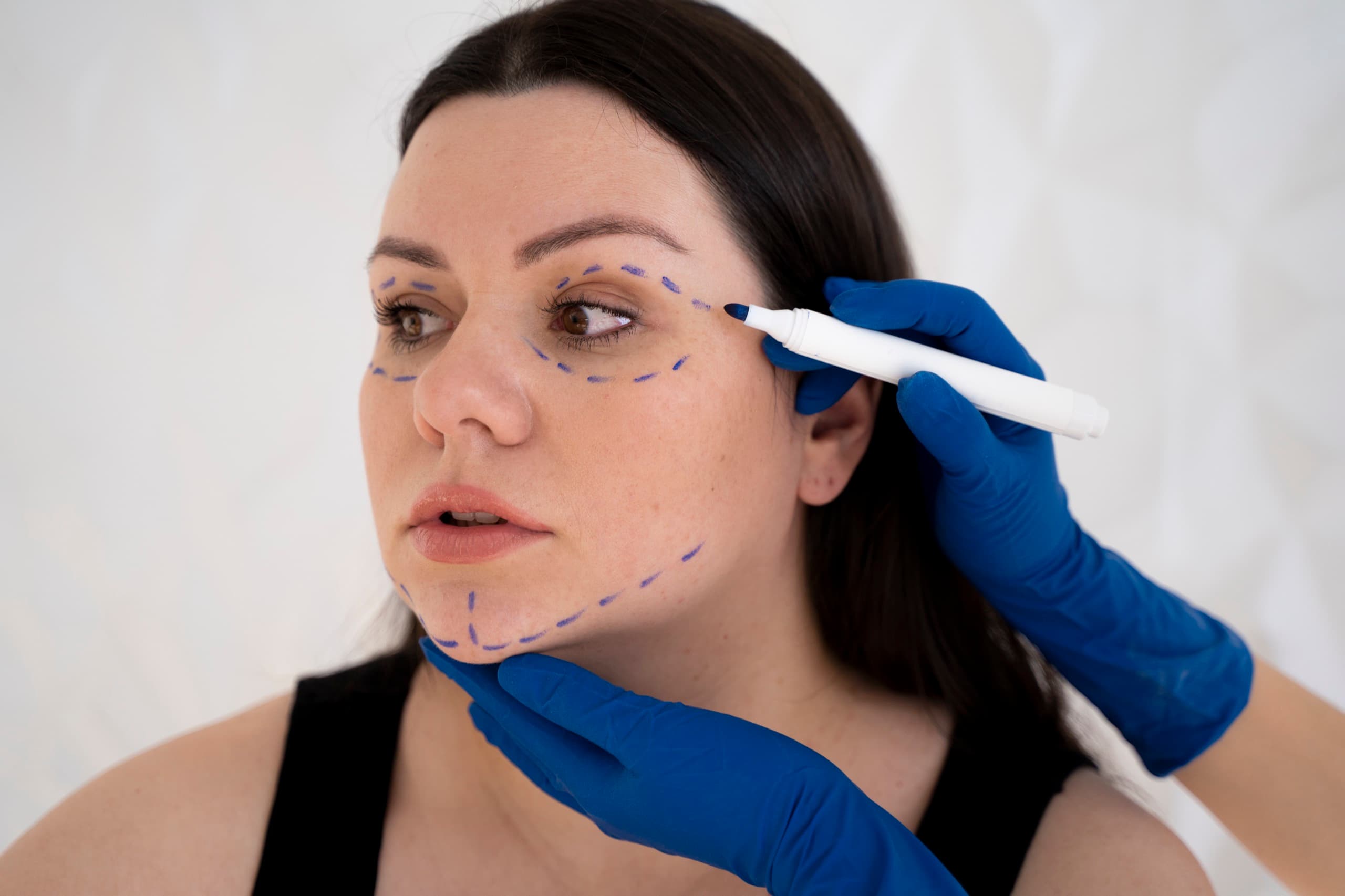
A thread lift uses fine dissolvable threads placed under the skin to lift and support tissue that has begun to sag, which is why the lift is visible at the end of the appointment. It works on mild to moderate laxity in skin that still has reasonable quality, and it is deliberately modest — a minimally invasive alternative to a surgical facelift rather than a replacement for one.
Whether that describes your jawline is the actual question, and it has a real answer rather than a sales answer. What follows is what threads do, who they suit, and how the decision is made.
What do the threads actually do?
Two things, on different timelines.
First, the lift. Threads are anchored under the skin and used to reposition tissue that has descended. That is a mechanical change and it is why you see a difference immediately.
Second, the collagen. Thread Lift uses absorbable threads, and as they break down they provoke a collagen response along their path — so firmness can keep improving for some weeks after the lift itself. The threads dissolve; what they prompted does not go with them straight away.
The appointment is typically under an hour, under local anaesthetic only. No general anaesthetic, no hospital stay, and no incisions of the kind a surgical lift requires. Recovery is measured in days rather than weeks.
Am I actually a candidate?
Threads work on mild to moderate laxity, in patients whose skin still has reasonable quality. They are not for everyone.
That sentence is the most useful thing on this page, and the treatment page is blunt about why the consultation exists: to give you a straight answer rather than a booking. If your laxity is beyond what a modest lift can address, you should be told that.
The comparison worth being clear about: a surgical facelift removes and repositions tissue and gives a far larger, longer-lasting change. A thread lift is a modest, temporary lift with a fraction of the recovery. If what you need is the former, a good doctor will say so — and a clinic that offers threads as an equivalent to surgery is misdescribing both.
The degree of lift a thread can achieve is modest by design. For the right patient that is the appeal rather than a limitation: the result reads as rested rather than altered, which is exactly what most people say they want when pressed.
What decides whether it looks good?
Placement, and it is worth understanding this before you compare prices anywhere.
Where a thread enters, the vector it follows and how many are used are anatomical decisions. They are made by a doctor, and they are what separates a good thread lift from a visible one. The threads themselves are not the skill.
So the question to ask is not which threads are being used. It is who is planning the vectors, and on what anatomical reasoning for your particular face.
How long does it last?
Generally several months to around a year, depending on the thread type, the area treated, your skin and your age. The collagen stimulated along the way can outlast the threads themselves.
Treat that as a range rather than a figure. It is a temporary lift by nature, and anyone quoting you a single confident duration is not accounting for the four variables above.
Does it hurt, and what is the recovery?
It is performed under local anaesthetic, so most patients describe pressure and pulling rather than pain. Some soreness and tightness in the days afterwards is normal, along with mild swelling or bruising that usually settles within days.
Plan around that honestly. "Days, not weeks" is genuinely short, but it is not nothing — so book it with a clear stretch afterwards rather than the evening before something you care about. In practice this is one of the easier treatments to fit around a working week in this city, since there is no hospital stay and no extended downtime to negotiate with your calendar.
Both our Indiranagar and Bellandur branches run it, so choose whichever you can reach without arriving rushed.
What about the alternatives?
This is where the honest answer is "it depends on what is actually going on with your lower face", and that is a diagnosis rather than a preference.
Dermal Fillers and HIFU each have their own pages, their own mechanisms and their own assessments. They are not interchangeable with threads and they are not competing versions of the same thing — they address different underlying situations, which is why a consultation rather than a fixed formula decides what fits.
Some patients are recommended one. Some are recommended a combination, sequenced by the doctor. And some are told that what they are describing is not well addressed by any of the three, which is a legitimate outcome of an honest assessment rather than a failure of it.
Come in with the concern rather than the treatment name. "My jawline has softened and I notice it in photographs" gives a doctor something to examine. "I want threads" skips the part that decides whether you should have them.
What to ask at the consultation
Is my laxity mild, moderate or beyond what threads address? What lift is realistic for me specifically? How many threads, along what vectors, and why those? How long should I expect it to hold? And is there a better-suited option for what you are seeing?
To get those answered against your own face, book an appointment at our Indiranagar or Bellandur branch. If photographs are what made you notice the change, bring them — they are useful context for the examination.