
Tattoo Removal in Bangalore
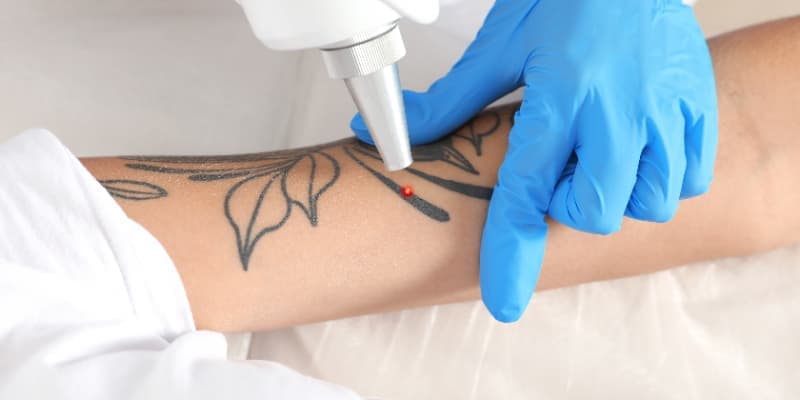
Laser tattoo removal breaks the ink in your skin into fragments small enough for your body to absorb and clear on its own. It is a gradual process rather than a single procedure, and how many sessions it takes depends on the size, colour and depth of the tattoo.
Is this you?
What it does for you
Gradual, controlled fading
Each session breaks down a further share of the ink, so the tattoo lightens step by step and your doctor can adjust settings based on how your skin and your ink actually responded.
Works across most ink colours
Black and dark inks clear most readily. Greens and blues are more stubborn and generally need more sessions, which your doctor will tell you before you start rather than after.
Clears space for new work
Many patients are not removing a tattoo so much as making room for one they actually want. Partial fading is a legitimate goal and takes fewer sessions than full clearance.
Low risk of scarring when done properly
Modern laser removal targets the ink rather than the surrounding tissue. Performed under medical supervision with correct settings and aftercare, the risk of scarring is small.
Removes problem tattoos
Older or poorly done work can sit unevenly in the skin and occasionally cause reactions. Removal addresses that as well as the appearance.
Assessed and performed by a doctor
Ink type, depth, skin tone and any history of keloid scarring all change the plan. That assessment happens before the first pulse, not during.
How the treatment works
Consultation and patch test
Your doctor reviews your medical history, examines the tattoo's size, colour and depth, and patch tests the laser so the response can be seen before committing to a plan.
Treatment plan
An honest session estimate and spacing schedule is agreed, including whether full clearance or significant fading is the realistic goal.
The laser session
With eye protection in place and cooling applied, the laser fragments the ink. Larger tattoos may be treated in sections across visits.
Healing and review
Your body clears the fragmented ink over the following weeks. A review before each session confirms how much has lifted and whether settings should change.
See the Treatment in Action
Say Goodbye to Unwanted Brow Ink
Removing old microblading pigment
Side effects, honestly
Most patients experience none of these. Some patients, in rare cases, may notice the following — listed because you deserve the full picture before you decide.
Redness, swelling and blistering
Common in the first days after a session, and blistering in particular is part of normal healing. Do not pop or pick — that is what turns a normal recovery into a scar.
Temporary lightening or darkening of the skin
The treated patch can look paler or darker than surrounding skin while it settles. It usually evens out, and sun protection substantially improves the odds that it does.
Incomplete clearance
Some ink sits deep or resists laser wavelengths, and certain colours are harder to shift. A faint shadow after a full course is a possible outcome and is discussed upfront.
Scarring risk
Low but not zero, and higher if aftercare is skipped or if you are prone to keloids. Tell your doctor about any keloid history at consultation.
About this treatment
Tattoo ink sits in the dermis, in particles too large for the body's immune cells to carry away — which is exactly why a tattoo is permanent in the first place. Laser removal solves that by making the particles smaller. Short, high-energy pulses shatter the ink where it sits, and your own immune system then clears the fragments over the following weeks.
Two things follow from that mechanism. The first is that removal takes a course of sessions spaced weeks apart: the laser does its part in minutes, but the clearing is biological and cannot be hurried. The second is that results vary with the ink itself. Black and dark pigments absorb laser energy readily; greens and blues are harder, and amateur ink placed at inconsistent depths behaves unpredictably.
An honest consultation is therefore worth more here than in most treatments. A doctor examining the tattoo can tell you roughly how many sessions to plan for, which colours will lag, and whether full clearance or a strong fade for a cover-up is the realistic goal. Getting that expectation right at the start is most of what separates a satisfying course of treatment from a frustrating one.
Questions patients ask
How many sessions will tattoo removal take?
Does laser tattoo removal hurt?
Can all tattoo colours be removed?
Will my tattoo disappear completely?
Is there any downtime?
How long do I wait between sessions?
Can I get a new tattoo over the area afterwards?
Related at The Aesthetic Edge
Get a doctor's read before you decide anything
₹500 consultation, waived off against your treatment. Indiranagar or Bellandur — closed Wednesdays.
General information, not medical advice — your treatment is decided at an in-person consultation. Terms & Conditions