
Why Laser Hair Reduction Needs a Course, Not a Session
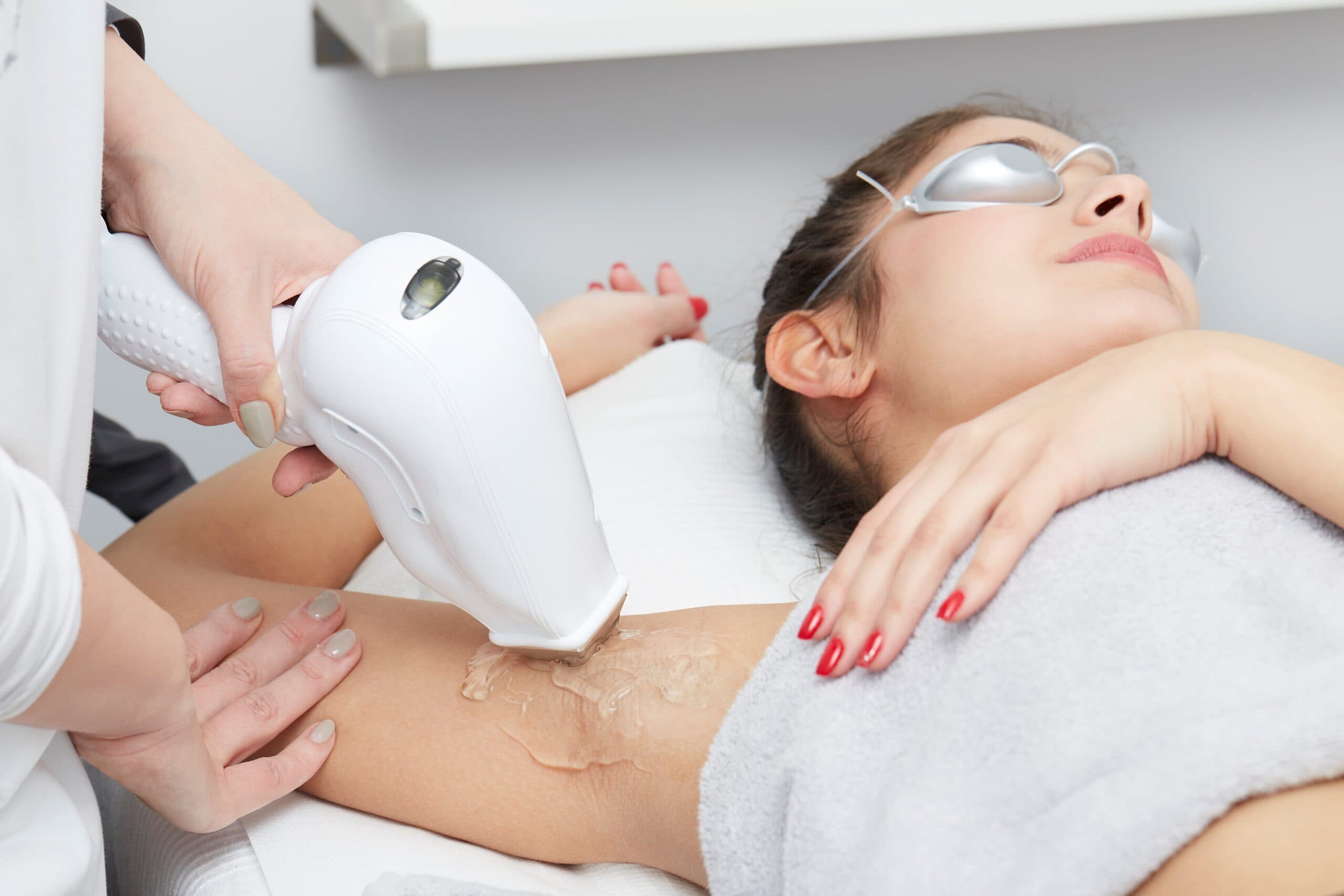
A single session cannot catch every follicle, because only hairs in their active growth phase respond to the laser. Your hairs are not all in that phase at the same time — so a course of six to eight sessions, spaced deliberately to catch follicles as they enter it, is what a result actually requires.
That is the whole explanation, and it is worth understanding before you start rather than at session three when you are wondering why hair is still appearing. The spacing between appointments is not the clinic managing its diary. It is the treatment waiting for follicles to become treatable.
How does the laser work at all?
Light absorbed by the pigment in the hair disables the follicle at its root, so hair grows back finer and sparser with each session.
That is why Laser Hair Reduction behaves so differently from shaving or waxing. Those remove hair at or near the surface, so the follicle is untouched and the cycle simply restarts. Treating the follicle is what changes the regrowth itself rather than just clearing what is currently above the skin.
It also explains the honest name. This is a reduction, not a permanent removal. After a full course most people see a marked, long-lasting reduction, with any regrowth typically finer and lighter than before — and then occasional maintenance, often a top-up every six to twelve months, rather than a repeating weekly routine.
Why can I still see hair after a session?
Two reasons, and both are normal.
First, treated hairs shed over roughly 5 to 30 days after a session. What you are seeing in the days afterwards is not necessarily surviving hair; it may be treated hair on its way out. That window is wide, so do not read much into day four.
Second, and more importantly, the follicles that were not in their active phase that day were never going to respond. They are still there, and they will be reachable at a later session. That is precisely what the next appointment is for.
This is why stopping after two sessions is the expensive mistake. You have paid for two passes at a rotating target and then walked away before most of the rotation happened. Six to eight is the typical course, though hair colour, thickness and the area treated all affect the number your doctor sets.
Is it suitable for Indian skin?
This is the question worth asking directly, and the answer is about the machine and the settings rather than a general reassurance.
The diode system used here has integrated cooling and is chosen specifically because it treats deeper skin more safely than older systems — and the behaviour of those older systems on deeper skin is the main historic risk with hair lasers. That history is the reason the question gets asked at all, and it is a fair one.
Safety depends on the treatment being performed under qualified supervision at settings correct for your skin tone. So the thing to ask is who is setting the parameters and on what basis for your skin, not simply whether the clinic has a laser.
Does it hurt, and what about afterwards?
It is designed to be comfortable, and the diode system uses cooling throughout. Most patients describe warmth or a light flick rather than pain, though anyone who is sensitive may find some areas more intense than others.
Afterwards, expect sensitivity for a day or two. No time off is needed. Treatment is quick and needs no recovery, so nothing has to be planned around it — which for a course of six to eight appointments is the practical detail that matters most. A course you can actually attend is the only kind that produces the result described above, so pick whichever of our Indiranagar or Bellandur branches you can reach repeatedly over several months rather than the one that sounds more convenient today.
What changes between sessions, apart from hair count?
The day-to-day texture of the area, which patients often notice before they notice the reduction.
Because the follicle is treated rather than the hair cut at the surface, the burn and prickly regrowth that follow shaving do not return between sessions. Ingrown hairs — which happen when hair curls back under the skin after waxing or shaving — reduce for the same reason: the cycle that creates them is what is being interrupted. Skin is generally left smoother and less irritated than it is on a waxing cycle, without the irritation repeated waxing causes.
In Bangalore's humidity, where a waxing cycle and the itch that follows it are their own small ordeal, that side of it lands for a lot of patients well before the hair count does.
Areas commonly treated include the underarms, bikini area, legs, back, arms and face.
Are these the same lasers as other treatments?
No. Q-Switch Laser and Tattoo Removal are different treatments with their own pages, their own mechanisms and their own assessments. Having one laser treatment tells you nothing about your suitability for another, and each is decided on its own.
Before you start
Plan for the full course, ask how many sessions your hair and area actually need, ask who is setting the parameters for your skin tone, and expect shedding across a wide window rather than a tidy result by the weekend.
To have your own hair and skin assessed and the course mapped out, book an appointment at our Indiranagar or Bellandur branch — and be honest at the consultation about whether you can commit to the spacing, because that is what decides the outcome more than anything else.