
Tattoo Removal: Why Some Colours Fade Faster Than Others
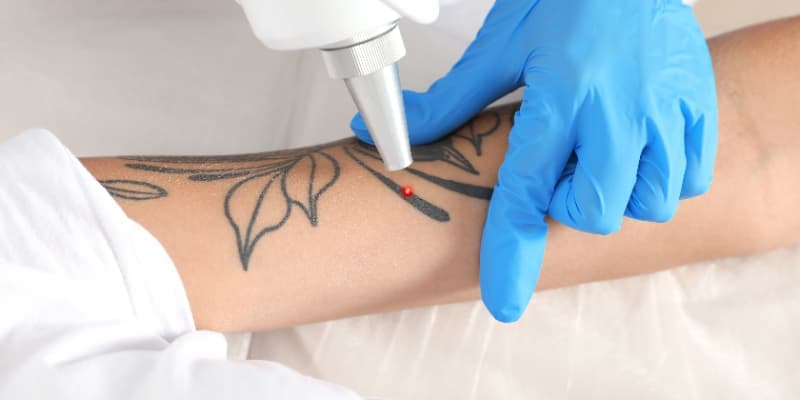
Not every part of a tattoo fades at the same rate. Black and dark inks clear most readily under laser, while greens and blues are more stubborn and generally need more sessions to shift. That is why a tattoo can look half-finished partway through a course — and why the colour breakdown of your particular tattoo should be discussed before the first pulse, not discovered at session four.
How does laser tattoo removal actually work?
Laser tattoo removal breaks the ink in your skin into fragments small enough for your body to absorb and clear on its own. It is not a procedure that removes anything on the day; it is a process in which your own immune system does the carrying away, over weeks, between appointments.
That mechanism explains almost every practical detail of the treatment. Sessions are spaced several weeks apart precisely so the body has time to clear the fragments before more are created. Each session breaks down a further share of the ink, so the tattoo lightens step by step rather than all at once — and because your doctor can see how your skin and your ink actually responded, the settings are adjusted between visits rather than fixed at the start.
It also explains why the colour matters so much. Fragmenting ink depends on the laser interacting with that specific pigment, and pigments are not interchangeable.
Which tattoo colours are hardest to remove?
Green and blue, as a rule. Black and dark inks respond fastest; greens and blues usually need more sessions. Most colours can be treated, but "most can" is not the same as "all at the same pace", and the difference is worth planning around.
What this looks like in practice: a tattoo with heavy black linework and a small patch of green may reach a point where the linework has faded substantially and the green is still clearly there. Nothing has gone wrong at that point. The stubborn part is simply on a longer schedule, and the honest version of the conversation at consultation is your doctor telling you which parts of your tattoo are likely to be slow — before you begin, rather than after.
If your tattoo is a single-colour black piece, you are on the easier end of this. If it is a multi-coloured sleeve section, budget for a longer course and a longer calendar.
How many sessions will it take?
Typically six to ten, depending on the tattoo's size, colour and how deep the ink was placed. Session length ranges from a few minutes to around an hour, again by size, and downtime is minimal — normal activities can usually be resumed immediately.
Do the arithmetic on the spacing, though, because that is what people underestimate. Several weeks between sessions across a course of six to ten means you are planning in months, not weeks. If you have a wedding, a holiday or a new tattoo appointment in view, work backwards from it now.
Your doctor gives you an estimate at consultation after actually seeing the tattoo, and then reviews that estimate as your skin responds. An estimate that moves is not a bait-and-switch; it is the plan being corrected against evidence.
Will my tattoo disappear completely?
Often it fades to the point of being unnoticeable, but complete clearance cannot be promised for every tattoo. Deep or multi-coloured ink can leave a faint shadow, and that possibility is something to hear honestly at consultation rather than hope your way past.
There is a related point that reframes the whole question for a lot of people. Many patients are not removing a tattoo so much as making room for one they actually want. Partial fading is a legitimate goal, and it takes fewer sessions than full clearance. If a cover-up is the real plan, say so at the first appointment — the target changes, and so does the number of visits you are committing to.
Removal also addresses problems beyond appearance. Older or poorly done work can sit unevenly in the skin and occasionally cause reactions, and that is a different reason to treat it than simply not liking the design any more.
What does the laser mean for Indian skin tones?
This is where the device matters. The Q-Switch Laser delivers extremely short, high-energy pulses that shatter pigment into particles the immune system can carry away, while the surrounding tissue barely heats. That short pulse duration is exactly what makes it usable on deeper skin tones that burn more easily with other lasers, and it is the same mechanism that breaks up tattoo ink over a course of sessions.
Two consequences worth knowing. First, treated pigment often looks darker before it lifts, and mild redness is common — both expected, not a sign anything has gone wrong. Second, and this one is a genuine scheduling constraint in Bangalore: tanned skin cannot be treated safely. You are asked to avoid direct sunlight and tanning for two weeks before a session, and to stop harsh exfoliants, bleaching creams and retinoids three days before.
That is harder than it sounds if your tattoo is on a forearm or a calf and you commute by two-wheeler, or if the course runs through a stretch of clear afternoons. Sun exposure after a session is also the main driver of pigmentation problems, so daily SPF 50 and a week out of direct sun are part of the plan rather than a suggestion. If the piece is somewhere your sleeve does not reach, plan the covering before you plan the appointments.
What should you expect from the appointment itself?
Some discomfort. Most patients describe it as similar to a rubber band snapping against the skin. Cooling is used throughout, and numbing can be discussed for larger or more sensitive areas — worth raising in advance rather than mid-session.
Before any of that, there is an assessment, and it is not a formality. Ink type, depth, skin tone and any history of keloid scarring all change the plan, and that assessment happens before the first pulse. A patch test is done at consultation before the first full session. Tell your doctor about any new medication and about any history of cold sores or keloid scarring, and mention pregnancy or breastfeeding, an active skin infection, or psoriasis in the area — each of those rules out treatment for now.
Done under medical supervision with correct settings and aftercare, the risk of scarring is small; modern laser removal targets the ink rather than the surrounding tissue. The qualifiers in that sentence are the working parts of it.
If you want a straight read on how your tattoo's colours are likely to behave and how many sessions that realistically means, book a consultation at our Bellandur or Indiranagar clinic. Bring a clear photograph of the piece, and mention up front whether you want it gone or faded for a cover-up — the two are different plans.