
Why Root Canal Treatment (RCT) Is a Course, Not a Single Session
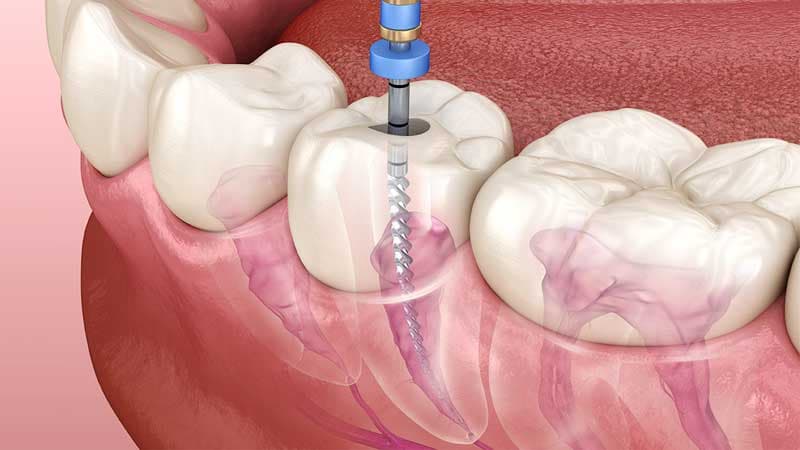
A root canal is finished across stages, even when the canal work itself takes only one sitting. There are four: diagnosis with an X-ray, then anaesthesia and access, then cleaning and sealing the canals, then a restoration to rebuild the tooth. The middle two are often one appointment of roughly 60 to 90 minutes. The last is a separate visit, and it is the stage people skip.
Understanding the sequence is what stops you thinking the job is done when the pain stops.
Is a root canal finished in one appointment?
The canal work frequently is. Straightforward cases are often completed in a single sitting, with the canals cleaned, shaped and sealed in one appointment.
The treatment is not, because the tooth still needs restoring. So the accurate answer to "how many appointments" is usually two at minimum for a back tooth — the canal work, then the crown — and sometimes three if the canal work itself needs splitting.
What are the four stages actually doing?
Each one has a distinct job, and none of them is padding.
Diagnosis. An examination and an X-ray, to confirm that the pulp is infected or inflamed and that a root canal is the right treatment for this tooth. This stage can also conclude that it is not, which is a good reason for it to happen before anything is paid for.
Anaesthesia and access. The area is numbed and a small opening is made through the crown of the tooth to reach the pulp chamber underneath.
Cleaning and sealing. The infected pulp is removed, and the canals inside the roots are cleaned, disinfected, filled and sealed against further infection. This is the part everyone pictures when they hear "root canal", and it is the longest.
Restoration. A filling or a crown to rebuild the tooth's strength and protect it from fracture under chewing load.
Why do some teeth need a second visit for the canal work?
Two situations account for most of them, and both are decided by what the X-ray shows rather than by preference.
An active infection is the first. Sealing a canal system is meant to shut bacteria out permanently, and where an infection is still active it may be better to let things settle before that seal goes in. A second appointment exists to give that time.
Complex canal anatomy is the second. Some teeth have several canals, and those canals can be narrow or sharply curved. Finding, cleaning and shaping each one properly takes longer than a single straight canal does, and there is a point at which splitting that work across two appointments is simply the better way to do it carefully.
Neither is a complication. Your dentist will say which applies to your tooth after the X-ray.
Why is the crown a separate appointment?
Because it is a separate piece of work with its own requirements, and because the tooth needs it for a specific reason.
A root-treated tooth has lost its blood supply and becomes more brittle. Back teeth carry heavy chewing forces, and a brittle tooth under that load can fracture — a fracture that often cannot be repaired, at which point the tooth is lost despite the root canal having gone perfectly. That is why a crown is recommended for back teeth rather than a filling alone.
Where enough sound tooth structure remains, a filling may be what is placed instead. That decision belongs to the dentist looking at your tooth.
In the meantime, avoid chewing on that side until the permanent restoration is fitted and any numbness has fully worn off. Once the crown is in, the tooth is used normally.
What happens if you stop after the canal work?
This is the commonest way a technically successful root canal ends badly. The pain has gone, the tooth feels fine, and the follow-up appointment slides down the list.
The problem is that the reason for the crown has nothing to do with how the tooth feels. A brittle tooth without a crown is a tooth waiting for the wrong bite on something hard. And because the pulp has been removed, the tooth no longer sends the early warnings a healthy one would.
If you have had a root canal at some point and never went back for the restoration, that appointment is worth making now rather than after something cracks.
Should you pay for a package before the X-ray?
This is where "a course of treatment" gets misused, so it is worth being blunt.
A root canal is a course in the sense that it has stages. It is not a course in the sense of a pre-paid block of sessions bought in advance, and you should be wary of anyone selling it that way — particularly before an examination and an X-ray have established what your tooth needs.
The reason is simple. Until the X-ray is done, nobody knows how many canals the tooth has, whether the infection needs settling first, or whether a root canal is even the right treatment. A package priced before that information exists is priced on a guess, and a guess can be wrong in both directions.
What a reasonable plan looks like instead:
- The consultation, examination and X-ray come first, and are quoted on their own. At The Aesthetic Edge a consultation is ₹500, waived against treatment.
- The quote follows the diagnosis, not the other way round.
- The restoration is stated explicitly — whether it is a filling or a crown, what it costs, and when the appointment is.
- The number of sittings is an estimate given after the X-ray, with a plain explanation if it changes.
If a clinic can tell you the full price of your root canal before looking at your tooth, ask what they are basing it on.
What to do with this
Book the diagnosis, not the treatment. Everything about the sequence — how many sittings, what the restoration will be, what the whole thing costs — follows from an examination and an X-ray, and none of it can honestly be settled before.
Then, once the canal work is done, put the restoration appointment in the diary before you leave the building. That single habit is what separates a root canal that lasts years from one that gets undone by a fracture nobody saw coming.
Read the stages on the root canal treatment page, or book an appointment to get the tooth assessed. Consultation ₹500, waived against treatment.