
What Is Root Canal Treatment (RCT)? A Plain-English Explanation
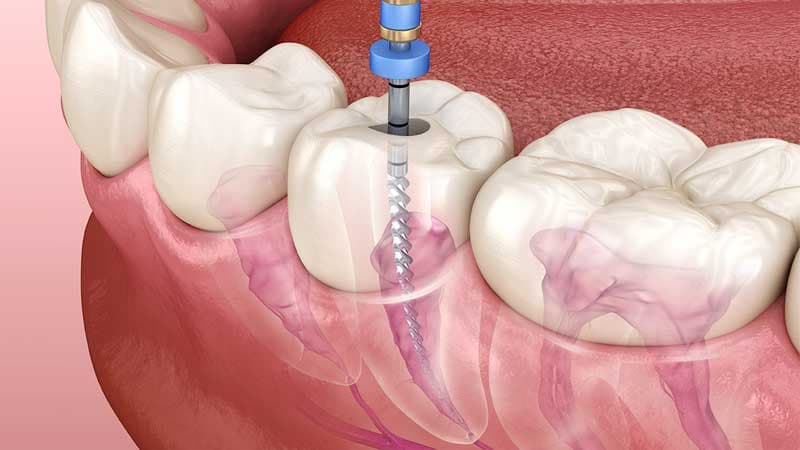
Root canal treatment is the procedure that saves a tooth whose inner core has become infected or inflamed. The damaged pulp is taken out, the narrow canals running down through the roots are cleaned, disinfected and sealed, and the tooth is rebuilt with a filling or a crown. It is carried out under local anaesthesia, and the alternative to it is losing the tooth.
That is the whole thing in six lines. The rest of this piece is for anyone who wants to understand why it works that way, because the procedure makes far more sense — and sounds considerably less alarming — once you know what is actually inside a tooth.
Why is it called a "root canal"?
Because a root canal is a part of your tooth, not a thing that is done to you.
Each root of a tooth contains a narrow channel running down its length. That channel is the root canal. The treatment is named after the anatomy it works on, in the same way that a knee operation is named after the knee. Nobody set out to give the procedure a frightening name; the name simply describes where the work happens, and decades of use as a byword for unpleasantness have done the rest.
Worth knowing, because a great deal of the fear attached to this treatment is attached to the phrase rather than to the experience.
What is the pulp, and what does it do?
Underneath the hard outer enamel and the dentine beneath it, every tooth has a soft centre made of nerve tissue and blood vessels. That is the pulp. It runs from a chamber in the crown of the tooth down through those canals to the tip of each root.
The pulp is what makes a tooth feel things — the sensation you get from cold water is the pulp reporting. It is also, crucially, tissue with a blood supply, which means it can become inflamed and infected the way any other living tissue can.
What holds a tooth in your jaw is not the pulp. It is the root itself, anchored in its socket by a ligament, and both of those remain after treatment. This is why removing the pulp does not mean losing the tooth: the structure that does the mechanical work is still there, and a treated natural tooth continues to sit in its own socket in a way no replacement quite matches.
Why can't my body just clear the infection?
Because the infection is sealed inside a hard, largely closed container.
Bacteria reach the pulp through deep decay, a crack, an injury, or repeated dental work on the same tooth. Once inside, they are somewhere your immune system cannot easily reach and cannot flush out. That is why this particular kind of toothache behaves so differently from most pain — it does not settle over a week the way a sprain does, it is often worse at night, and it comes back every time the painkiller wears off.
It is also why painkillers are a holding measure rather than a treatment. They work on your perception of the pain; they do nothing about what is causing it. Removing the inflamed tissue addresses the source directly, which is the reason the treatment relieves the pain rather than postponing it.
What is the treatment actually trying to achieve?
Six things, and it is worth seeing them together, because "it stops the toothache" is only the most obvious one.
- Relieving the pain, by removing the inflamed or infected tissue rather than masking it.
- Keeping your own tooth, rather than replacing it with something else.
- Stopping the infection spreading further into the bone or towards neighbouring teeth, and reducing the risk of an abscess.
- Restoring normal chewing, so you can stop favouring one side of your mouth — a habit most people do not notice they have adopted.
- Preserving the jawbone. The jaw resorbs where a tooth root is missing. Keeping the natural root in place avoids that entirely, and this is the consequence of extraction that patients are least often told about.
- Keeping it looking normal. A matched crown or filling restores the shape and shade, so a treated tooth does not announce itself.
The jawbone point is the one that changes people's thinking. An extraction can feel like the simpler, cheaper decision on the day. What it starts is a slower process in the bone underneath, and a gap that then needs filling.
What are the honest limits?
Three, and any explanation that omits them is selling rather than informing.
Tenderness afterwards. The tooth and the gum around it often feel sore to bite on for a few days. Ordinary pain relief is generally enough.
The tooth becomes more brittle. It no longer has a blood supply, and it can fracture under chewing load. This is why a crown is recommended for back teeth rather than a filling on its own — and a crown is part of the plan rather than an upsell.
It does not always work. A small proportion of root canals do not fully resolve, whether from a canal that was difficult to find, an infection that persists, or a fracture later on. Retreatment is often possible; rarely, the tooth still has to come out. Nobody can promise you otherwise, and you should be wary of anyone who does.
How would I know whether I need one?
You would not know for certain — that is what the assessment is for — but the patterns that lead here are recognisable. A throbbing ache that wakes you at night. A sharp jolt from something hot or cold that stays with one tooth long after the glass is back on the table. Swelling near the gum, with the tooth sore to bite on. Being told a tooth needs to come out and wanting to know whether it can be saved instead.
The examination and X-ray exist to answer two questions: is the pulp genuinely involved, and is a root canal the right treatment. Sometimes the answer is that a filling will do, which is the better news of the two.
What is involved, and what does it cost?
A straightforward single-visit case takes roughly 60 to 90 minutes under local anaesthesia. Teeth with several or curved canals, or with an active infection, are often split across two appointments. Afterwards the tooth is restored with a filling or a crown, and a crown is a separate two-visit sequence of its own.
Root canal treatment at The Aesthetic Edge starts from ₹2,999 per tooth. The consultation is ₹500 and is waived against your treatment.
And does it hurt?
The procedure is done under local anaesthesia, so you should not feel pain during it. The common verdict afterwards is that the toothache which brought them in was the worse of the two experiences by a distance.
That is not a claim that it is pleasant. It is a claim that the thing people are dreading is, for most patients, already behind them by the time they sit down.
The root canal treatment page covers the procedure in full. If a tooth has been bothering you and you would rather know than keep wondering, book an appointment.