
Root Canal Treatment in Your Thirties: Why This Is the Decade It Usually Comes Up
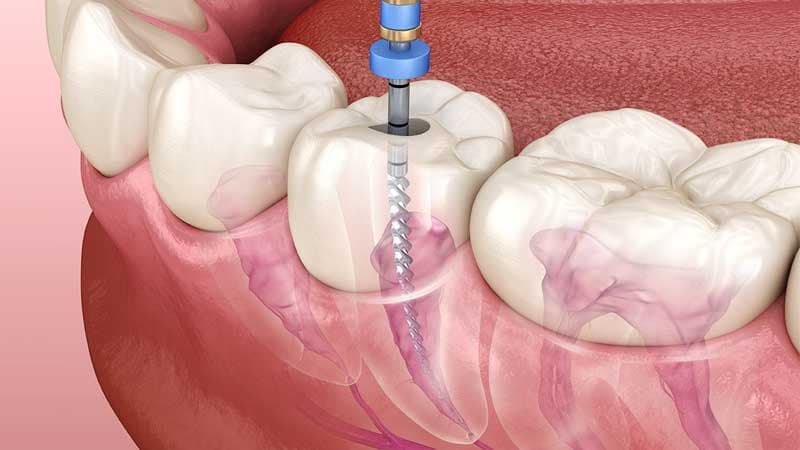
If a dentist has just told you a tooth needs a root canal and you are somewhere in your thirties, nothing unusual has happened. This is simply the decade in which teeth that were drilled, filled and re-filled through childhood and your twenties tend to reach the end of what a filling can do. Root canal treatment removes the infected or damaged pulp from inside the tooth, cleans and disinfects the canals and seals them, so the tooth can stay where it is instead of coming out.
What is different about being thirty-something is not the procedure. It is the length of time you are deciding for.
Why do root canals cluster in your thirties?
Because of what reaches the pulp. The pulp is the soft core inside a tooth, and it becomes inflamed or infected from deep decay, a crack, repeated dental work on the same tooth, or an injury. Three of those four are cumulative. A tooth that was filled at twelve, re-filled at nineteen and re-filled again at twenty-eight has had the same small area opened up three times, and each visit takes the work a little closer to the centre.
Decay behaves the same way. It does not announce itself at the moment it starts and it does not reverse on its own, so a cavity that began somewhere in your twenties can be years into its progress by the time the tooth starts speaking up. The pulp sits sealed inside hard tooth structure, which is also why the body cannot clear an infection there once bacteria have reached it.
So the thirties are less a biological milestone than an accounting one. The dental work of two earlier decades comes due.
Does being in your thirties change the treatment?
No. The protocol is the same at thirty as it is at sixty: local anaesthesia, the pulp removed, the canals cleaned, disinfected and sealed, and then a filling or a crown to restore and protect the tooth. A straightforward single-visit case takes roughly sixty to ninety minutes in the chair. Teeth with more complex canal anatomy are often split across two appointments.
Nobody should be offering you a different or accelerated version of a root canal on account of your age. If that is ever suggested, ask what in the X-ray makes this tooth different, rather than what in your birth year does.
Is extraction ever the simpler choice at this age?
It is the choice people reach for most often, and in your thirties it is the one worth thinking hardest about — because of how long you then have to live with the gap.
A treated natural tooth sits in its own socket, held by its own ligament. No replacement reproduces that. The jaw also resorbs where a tooth root is missing, so removing the root means losing bone in that spot; keeping the natural root in place avoids that entirely. If you are thirty-four, you are asking that site to work for another five decades.
There is also the quiet cost of favouring one side of your mouth. Once a tooth is filled or crowned it takes chewing load again, and the habit of biting around a bad tooth stops. That habit is easy to normalise when you are busy, and hard to notice until it is gone.
Extraction is sometimes genuinely the right answer, and that is a judgement made on the tooth in front of the dentist, not on a webpage. But "take it out and be done with it" is a decision with a fifty-year tail at this age, and it deserves more than a lunch break's thought.
How many appointments should you realistically plan for?
Plan for more than one, and you will rarely be wrong. One visit covers straightforward cases. Teeth with complex canals are often done across two. The restoration — the filling or the crown that protects the tooth afterwards — is its own step.
The practical lesson from most thirties schedules is not about the chair time. It is that the gap between the canal work and the final restoration is the part that gets lost to a travel week or a deadline. The tooth is at its most vulnerable in that window, so it is the appointment to defend in your calendar, not the first one.
Do you really need the crown if the tooth already feels fine?
For back teeth, usually yes, and the fact that it feels fine is not evidence against it. A root-treated tooth is more brittle than it was and still takes heavy chewing forces. The crown protects it from splitting — and a split of that kind is often not repairable, which means the tooth you went through all of this to keep comes out anyway.
Front teeth are assessed differently, and a properly matched crown or filling restores the shape and shade so a treated tooth does not stand out. The point to take is that the restoration is part of the treatment rather than an add-on to it. Bridges and crowns and dental fillings are both restorative options, and which one suits the tooth is settled at the appointment.
What is worth sorting out beforehand?
If you moved to Bangalore for work in your twenties, this tooth has probably been treated somewhere else — possibly in two or three somewhere elses. That matters more than people expect, because knowing when the tooth was last opened up, and how deep that work went, is useful context for the dentist reading today's X-ray.
Bring what you have: old X-rays on your phone, the name of the clinic that did the last filling, a rough year. If you have none of it, that is not a problem — the X-ray taken on the day is what the decision rests on. It simply saves a little guesswork.
Two other things worth doing before you sit down. Mention any medication you take and any medical condition you are managing, and say plainly if the idea of the appointment frightens you rather than mildly worries you. The procedure is carried out under local anaesthesia, so you should not feel pain during it; most people find the toothache that brought them in was the worse of the two. Some tenderness for a few days afterwards is normal.
Where to start
With an X-ray and a conversation, not with a decision. The question of whether this tooth can be kept, and whether a root canal or something simpler is the answer, is one a dentist settles by looking at it. A root canal is always carried out by a dentist, and the consultation fee is waived against treatment if you go ahead on the day.
If a tooth has been talking to you for a while — and in your thirties, it usually has been — book an appointment and have it looked at properly before it decides the matter for you.