
What Changes the Cost of Dental Implants in India
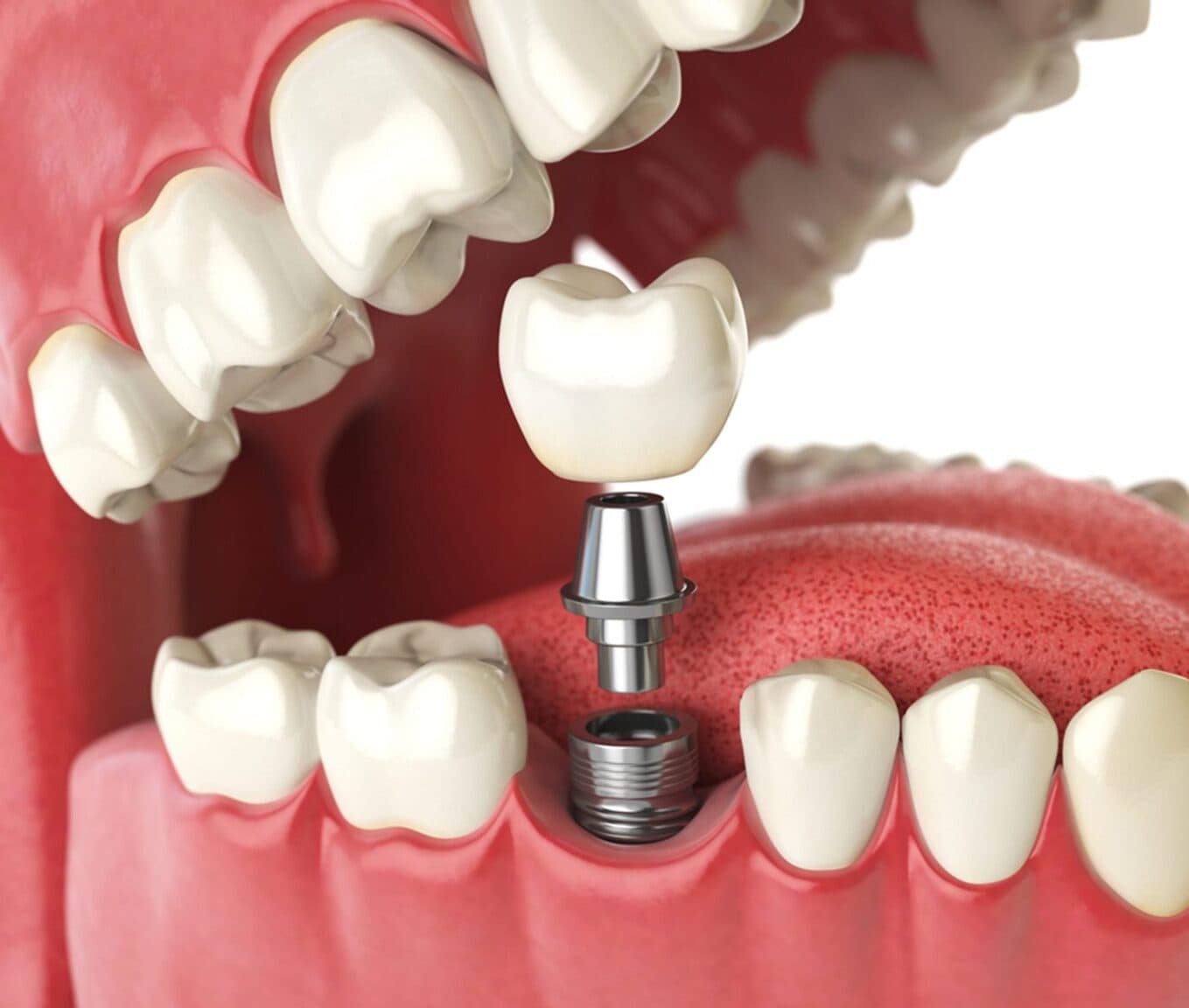
There is no single price for a dental implant, because what you pay for is a plan rather than a part. The number of teeth being replaced, the number of implants needed to carry them, whether the bone needs grafting first, the restoration fitted on top and the number of visits all move the figure. An examination and imaging settle it.
This page does not give you a number, and it does not give you a national range either. What it gives you is the list of things that change one — so that when you are quoted, you can tell what you are being quoted for.
Why does no honest page give you a single number?
Because an implant is not one item. It is three parts and a process, and the process is what varies.
The three parts are a titanium post placed into the jawbone, an abutment that connects that post to the visible part, and the crown on top that you actually see and chew with. A quote that covers one of those is not comparable with a quote that covers all three — and that single fact explains most of the wild disagreement between the figures you find online.
The process varies more still. As the treatment plan itself is described, it covers the number of implants, the type of restoration, whether any grafting is needed, and the expected timeline. Every one of those four is a cost driver, and none of them can be known before an examination.
We deliberately do not publish an implant price, and we do not publish a crown price either. We would be inventing a figure for a plan we have not seen, and a figure invented that way is worse than no figure at all — it sets an expectation that the real quote then has to argue with.
How many teeth are you replacing — and how many implants is that?
These are two different questions, and confusing them is the most common reason people misjudge what they are in for.
Implants can support a single crown, a bridge spanning several missing teeth, or a full arch. The number of implants required is decided at the planning stage. So replacing three teeth does not automatically mean three implants — several missing teeth can be carried by a bridge on fewer implants, and a full arch is its own kind of plan again.
This cuts both ways for the figure. Fewer implants than teeth pulls a plan downward. But it is decided by what your jaw can support and where, not by what would be convenient, and that is established at planning rather than requested.
What does the scan change?
It changes whether the plan you have in mind is possible at all.
Assessment involves an examination plus X-rays or a CT scan, to confirm that there is enough bone and to map the safe position for the implant. That is the step where the plan stops being hypothetical. Enough bone in the right place, and the plan is straightforward. Not enough, and the plan changes — which is the next driver.
The imaging itself is part of what you are paying for, and an X-ray and a CT scan are not the same investigation. Ask which your plan needs.
Is a bone graft part of the price or separate?
Ask, explicitly, because this is the single largest thing that separates two otherwise identical-looking quotes.
Grafting is only needed if the scan shows there is not enough bone to hold the implant securely. That is common where a tooth has been missing for a long time, and your dentist tells you at the planning appointment rather than partway through. Insufficient jawbone is also listed among the reasons an implant may not suit you, with grafting or alternatives discussed where that applies.
The practical consequence is that "how long has the tooth been missing?" is a cost question as much as a clinical one. A gap of many years is more likely to need bone built up first than a recent one. Nobody can tell you which applies to you without looking at your scan, and you should not try to judge it yourself from how the gap looks in the mirror.
What goes on top, and why is that its own decision?
Because the implant is the root, not the tooth. What is fitted on top is a separate piece of work with its own cost.
After the implant has fused with the bone, the abutment and the final crown are fitted, the bite is adjusted, and the implant is reviewed at routine check-ups. That crown is made for you. It is also the part with the shorter life: implants are intended as a long-term replacement, while the crown on top may need replacing sooner than the implant itself. A quote that looks cheap because it stops at the post is not the same offer as one that carries you through to a fitted, adjusted crown.
If your plan spans several teeth, the restoration may be a bridge rather than a single crown, and bridges and crowns are custom-made in their own right.
Do the materials change the figure?
Yes, and this is a conversation to have at planning rather than at fitting.
For the implant itself, titanium is used because bone bonds to it readily. For the restoration on top, materials are discussed at planning, and tooth-coloured options are available. Where in the mouth the tooth sits matters here too — a back tooth taking heavy chewing load and a front tooth in your smile line are not asking the same thing of a material.
Ask what material is being quoted, and ask what the alternative would cost. A quote is only comparable with another quote when you know that.
How many visits are you paying for?
Typically three to four across the full treatment, spread over several months.
That timeline exists because the implant needs time to fuse with the jawbone before the final tooth is attached, and the exact length depends on bone quality and whether any grafting is needed. It is not a queue you can pay to jump, and a plan that promises to compress it is promising something the biology does not offer.
Visits matter to your budget in two ways: the treatment itself is staged across them, and so is your own time and travel. If you are coming from outside the city, count that in.
Does anything about my health change what is possible?
It can, and this is the part that no online calculator will ever ask you about.
Uncontrolled diabetes, active gum disease, heavy smoking and insufficient jawbone can all affect healing. Where any of those applies, your dentist will discuss grafting or alternatives — which may mean treating something else first, and that is its own cost and its own timeline.
None of this is something to assess about yourself from a page. Active gum disease in particular is frequently not obvious to the person who has it. It is established by an examination.
How do a bridge or dentures compare on cost?
They are genuinely different propositions rather than cheaper versions of the same thing, so compare what each does before comparing what each costs.
A bridge is anchored to the teeth on either side of the gap, which must be reshaped to take it. It is quicker and does not involve surgery. The trade-off is permanent: preparing those neighbouring teeth removes tooth structure that does not grow back, and they will always need a restoration afterwards. An implant is anchored in the jawbone instead, so the neighbouring teeth are left as they are — but it takes longer and needs sufficient bone.
Dentures are removable, made to your own mouth and adjusted over several visits, with a few weeks to get used to eating and speaking.
Longevity belongs in this comparison too. Crowns and bridges commonly last a decade or more with good hygiene and regular check-ups, depending on material, position and whether you grind your teeth. Implants are intended as a long-term replacement rather than something replaced every few years. A figure compared without its lifespan is only half a comparison.
So what figure will I actually be given, and when?
At the planning appointment, once there has been an examination and imaging.
That is where the number of implants, the type of restoration, whether grafting is needed and the timeline are all set out — and a quote against that plan is a real number rather than an estimate against an imaginary mouth. What is fixed in advance is the consultation, which is ₹500 and is waived off against treatment if you go ahead.
When you get the quote, four questions make it comparable with any other:
- Does this cover the post, the abutment and the crown, or only some of them?
- Is grafting included, excluded, or not yet known?
- Which material is the crown, and what is the alternative?
- How many visits, and is the imaging in this figure?
Where to go next
If you are still deciding between approaches, read the dental implants page alongside bridges and crowns and dentures — the choice turns on your bone, your neighbouring teeth and how long you want the answer to last, and only then on the figure.
If you want the figure for your own mouth, book an appointment. Bring any recent X-rays you have, and the date the tooth came out if you remember it — both shorten the road to a real number.