
How Dental Implants Actually Work
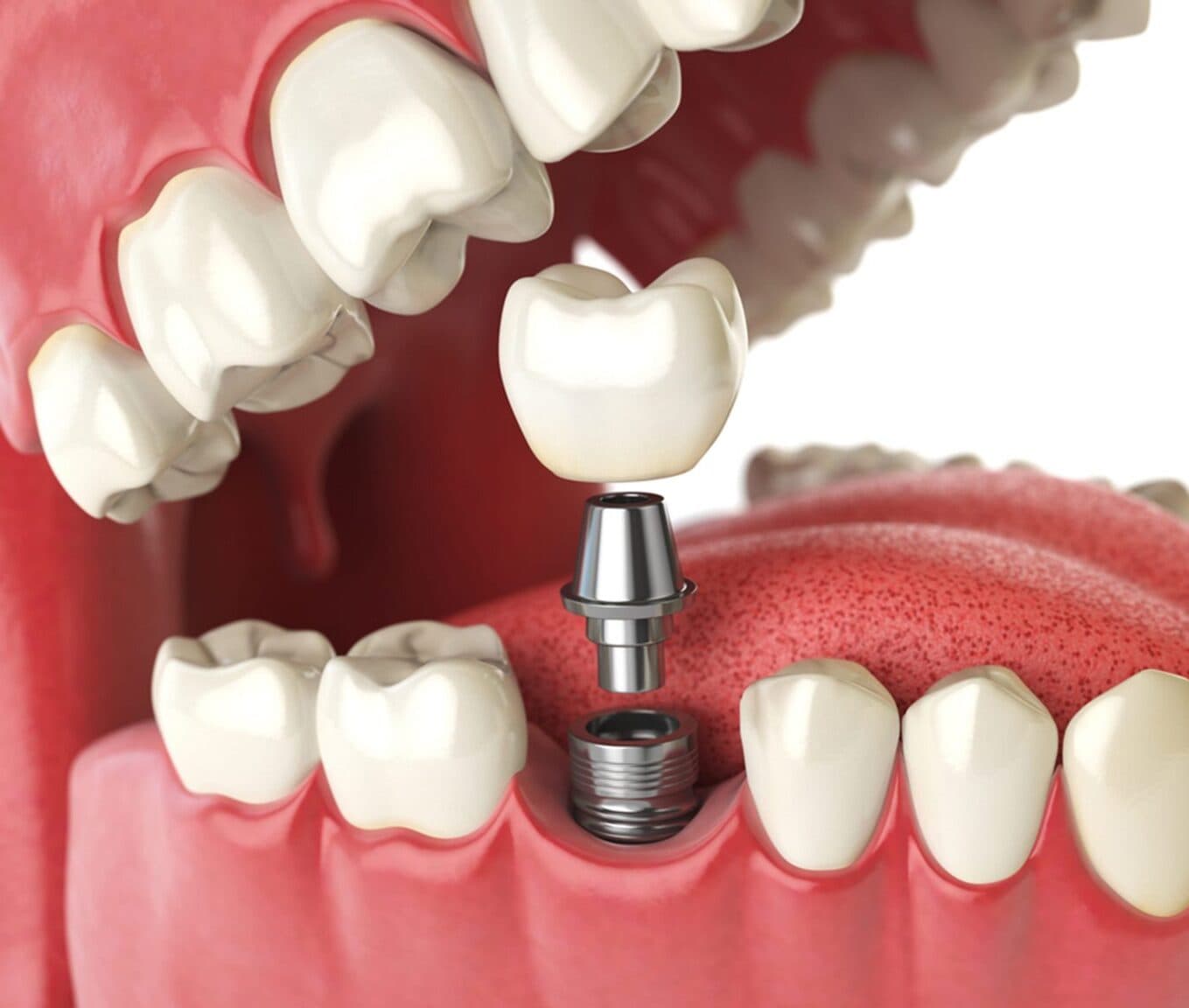
A dental implant works by bone bonding directly onto a titanium post placed in the jaw — a process called osseointegration. Until that bond forms, the post is simply sitting in a socket; once it has, the post behaves like a root and can carry a crown. Everything else about the treatment, including the months of waiting, follows from that one requirement.
If you are the kind of patient who would rather understand a treatment before consenting to it, this is the mechanism, taken slowly. It is not a step-by-step of your appointments — the treatment page for dental implants covers those. It is the reason the appointments are shaped the way they are.
What is osseointegration, in one paragraph?
It is living bone growing into direct contact with the surface of the implant, so that the two become mechanically locked together.
The post goes into a precisely prepared site in the jaw. Bone is not inert material — it is a tissue that remodels constantly, laying itself down where it is loaded and giving way where it is not. Placed against titanium, it does what it does against any surface it accepts: it grows onto it. The result is not glue, and it is not a screw thread doing the holding in the long run. It is bone, in continuous contact with metal, distributed across the whole surface of the post.
That is why titanium is the material of choice. Bone bonds to it readily, which is a property of the material rather than a feature of any particular brand of implant.
Why does the whole thing take months rather than weeks?
Because bone remodels at the speed bone remodels at, and no part of the treatment can move faster than that.
Cutting a hole and placing a post takes one appointment. Turning that post into something that will take the force of chewing for decades takes the body several months, and there is no way to instruct it to hurry. That is the honest reason the full treatment usually runs across three to four visits over several months: the visits are quick, the biology in between is not.
The exact length depends on your bone quality and on whether any grafting is needed first. Your dentist sets that expectation at the planning appointment, having looked at your scan. Anyone offering you a materially faster timeline than that is describing something different from what is described here, and it is worth asking them precisely what.
What is the scan actually for?
To find out whether there is enough bone to hold an implant securely, and to map a safe position for it.
The assessment stage is an examination plus X-rays or a CT scan. Two questions are being answered. First, volume: is there enough bone, in three dimensions, for a post of the required length and width to be fully surrounded by it? Second, position: where exactly can that post sit without straying into the structures that live in a jaw — the nerve canal in the lower jaw, the sinus above the upper back teeth, the roots of the neighbouring teeth.
This is why nothing on this page can tell you whether an implant will work for you. That is settled by examination and imaging, by a dentist, looking at your jaw. There is no substitute for it and no way to estimate it from the outside.
Why does bone volume decide what is possible?
Because the bond is made across the surface where bone touches metal — so if there is not enough bone in contact, there is not enough bond.
Here is the part that surprises people. The jaw does not keep bone it is not using. A tooth root transmits the force of every bite into the bone around it, and that loading is the signal that tells the bone to maintain itself. Remove the root and the signal stops, so the ridge where the tooth used to be slowly loses height and width. This is why the answer to "do I need a bone graft?" is so often tied to how long the tooth has been missing.
Where the scan shows there is not enough bone to hold an implant securely, grafting may be discussed — building the site up first, and then placing into it. Where it shows there is plenty, the plan is simpler. Either way the scan decides, not the calendar and not the patient's preference.
How does the finished implant carry the force of chewing?
Through the bone that has grown onto it, spread over the whole surface of the post.
Once the post has integrated, the abutment and crown are fitted and the bite is adjusted. That bite adjustment is not cosmetic fine-tuning; it is making sure the force arriving on the new tooth is sensible in direction and amount, because that force now passes straight into bone.
And this is the mechanism behind one of the quieter advantages of an implant: because it transmits chewing forces into the jaw, it restores the loading signal that was lost with the root, and helps slow the bone loss that follows a missing tooth. A bridge restores the chewing surface beautifully but does not put load into the ridge underneath the gap, because nothing is anchored there. Neither do conventional dentures, which rest on the gum rather than in the bone.
Why are the neighbouring teeth left alone?
Because the implant carries itself. Nothing else is being asked to support it.
A conventional bridge spans a gap by borrowing the teeth on either side, which have to be reshaped to take crowns. An implant is anchored in the jawbone instead, so those teeth stay untouched — structurally, this is the clearest difference between the two approaches, and it comes directly from where each gets its support.
Does one implant mean one tooth?
No. Implants can support a single crown, a bridge spanning several missing teeth, or a full arch.
How many posts are needed to carry a given number of teeth is worked out at the planning stage, from the scan and the bite, and it is a smaller number than people expect. The principle is the same in every case: a fixed number of integrated roots, sharing the load of the teeth built onto them.
What can interfere with the bond forming?
Anything that interferes with healing in bone and gum.
The core reasons an implant may not suit someone are uncontrolled diabetes, active gum disease, heavy smoking, or insufficient jawbone. Read through the lens of this article, they are one reason wearing four hats — each of them affects whether bone and gum can heal well around a post. Your dentist will discuss grafting or alternatives where any of these applies. Do not try to place yourself in or out of that list from a web page; it is a clinical judgement made after an examination.
What should I expect while it is healing, and when should I call?
Soreness, swelling and minor bruising for a few days after placement, plus soft foods and avoiding the surgical side for a short period.
Placement is done under local anaesthesia, so it should not hurt at the time. Afterwards, tenderness and swelling are expected and are usually managed with prescribed medication and post-operative care.
What you should not do is sit at home deciding for yourself whether something is part of normal healing. Contact the clinic rather than waiting if pain or swelling is worsening after the first few days instead of easing, if bleeding does not settle, if you develop a fever, if a suture comes away early, or if something simply does not feel right to you. Call the clinic or use the booking page and ask to be seen. Early is easy.
How long does the bond last?
With good oral hygiene and regular check-ups, implants are intended as a long-term replacement rather than something replaced every few years.
Integrated bone is maintained the same way the rest of your jaw is: by being loaded, and by the gum around it staying healthy. That is why routine check-ups are part of the treatment rather than an afterthought, and why the same conditions that threaten the bond during healing — gum disease above all — matter for the whole life of the implant. The crown on top may need replacing sooner than the post beneath it.
Where to go next
If the mechanism now makes sense, the remaining questions are all about your own jaw, and those need a scan rather than an article. A consultation is ₹500, waived off against treatment, and it is where the imaging, the bone volume and a realistic timeline get settled together. You can book an appointment at either of our Bangalore clinics.