
Root Canal Treatment (RCT): The Myths Worth Clearing Up Before You Book
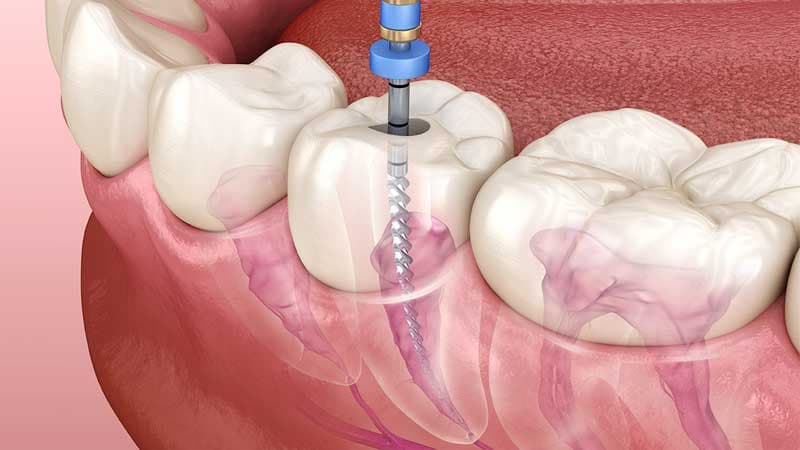
The three beliefs that keep people out of the chair longest: that a root canal is agonising, that pulling the tooth is simpler, and that the crown afterwards is a way of adding to the bill. None holds up. The procedure is done under local anaesthesia, extraction leaves a gap that costs more to solve later, and the crown is what stops a treated tooth splitting under chewing load.
Those are the headlines. Here they are one at a time, along with the others we hear most often.
"A root canal is the most painful thing in dentistry"
It is the myth with the deepest roots and the least support. Root canal treatment is carried out under local anaesthesia, so you should not feel pain while it is happening. Most people say afterwards that the toothache which drove them to book was considerably worse than the appointment.
What is true is that the tooth and the surrounding gum often feel sore or tender to bite on for a few days afterwards. Over-the-counter pain relief is usually enough for that.
The confusion is understandable. People arrive in real pain, associate the pain with the visit that followed it, and pass the story on. The pain came from the infection. The appointment is what dealt with it.
"It would be simpler to just have the tooth out"
You can have the tooth out, and on the day it is quicker. What it is not is simpler, because the decision does not end there.
An extraction leaves a gap. That gap then needs an implant, a bridge or a denture, and while you decide, the jawbone where the root used to sit begins to resorb — the bone is maintained by the root being there, and it goes when the root goes. A treated natural tooth, by contrast, stays in its own socket with its own ligament, and no replacement quite matches that.
That is why keeping the natural tooth is generally the better outcome wherever it is possible. There are teeth beyond saving, and a dentist will say so plainly when that is the case — but "pull it and move on" is a bigger decision than it sounds.
"The crown afterwards is just an upsell"
It is the part of the treatment that decides whether the tooth survives.
A root-treated tooth has lost its blood supply, and that makes it more brittle than a healthy tooth. Back teeth take heavy chewing forces, and a brittle tooth under that kind of load can split — which is often not repairable, meaning the tooth comes out after all and you are back to the implant-or-bridge decision.
So for back teeth a crown is usually recommended rather than a filling alone. It rebuilds the tooth's strength and protects it. Where enough sound tooth structure remains, a filling may be sufficient — which one applies is a judgement about your tooth, made by the dentist, not a sales choice.
If you have had a root canal in the past and never went back for the final restoration, that is the appointment worth making.
"It takes forever and endless appointments"
Straightforward cases are often completed in a single sitting, with the canals cleaned, shaped and sealed in one appointment of roughly 60 to 90 minutes.
Some teeth do need two. A tooth with an active infection may need a second visit so the infection settles before the canals are sealed, and a tooth with several curved canals is more work than one with a single straight canal. Your dentist can say which after the X-ray — not before, and not from a phone call.
Two appointments is a clinical decision about your tooth. It is not the default, and it is not a sign anything has gone wrong.
"Root canals fail all the time"
A small proportion do not fully resolve, and it is more honest to say that than to pretend otherwise. The usual reasons are a canal that was missed, an infection that persists, or a fracture later on. Where that happens, retreatment or, rarely, extraction may be needed.
"A small proportion" is the accurate framing. Done properly and restored well, a root-treated tooth can last many years. Its long-term survival then depends on the same things every other tooth depends on — good oral hygiene and regular check-ups.
"If the pain has stopped, I probably do not need it any more"
Pain settling is not the same as the problem resolving. The pulp inside the tooth has become inflamed or infected, usually from deep decay, a crack, repeated dental work or trauma, and that infection is sealed inside a hard tooth where the body cannot easily reach it.
Left untreated, an infection can spread and cause severe pain and an abscess. So a quiet week is not evidence you have got away with it, and cancelling on the strength of it is a decision worth discussing with the clinic rather than making alone.
"A root-treated tooth will look obviously fake"
A properly matched crown or filling restores the shape and shade of the tooth, so a treated tooth — front or back — should not stand out. Matching a front tooth to its neighbours is ordinary restorative work, and it is reasonable to ask to see the shade being chosen against your own teeth.
"You need to be knocked out for it"
Local anaesthesia is what is used. You are awake, you can talk to the dentist, and you can raise a hand to pause. If dental anxiety is your real concern — and for many people it is the actual reason for the delay, not the pain itself — say so when you book rather than at the door. It changes how the appointment is paced.
The one thing worth taking from all of this
Most of these myths share a shape: they make waiting feel like the safe choice. It generally is not. A tooth that needs treatment does not improve on its own, and the work involved tends to grow rather than shrink while you think about it.
The honest way to settle any of this for your own tooth is an examination and an X-ray, which is what confirms whether the pulp is infected or inflamed and whether a root canal is the right treatment at all.
Read the detail on the root canal treatment page, or book an appointment. Consultation ₹500, waived against treatment.