
Root Canal Treatment (RCT) for Men: The Questions Nobody Answers Straight
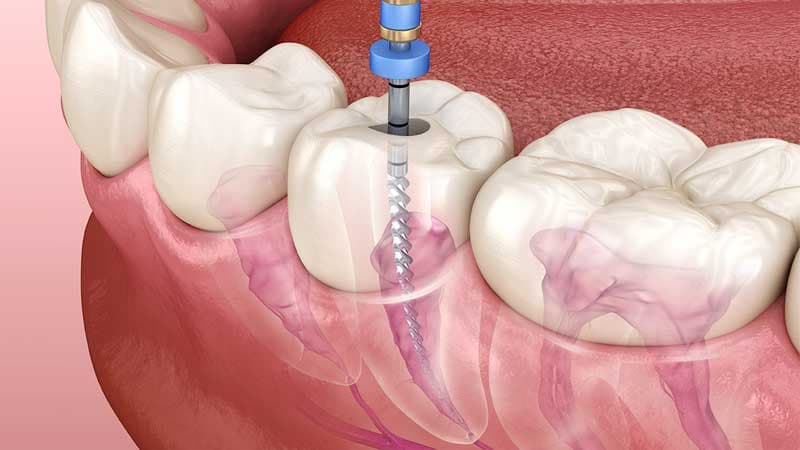
The procedure is identical whoever is in the chair — an X-ray, local anaesthesia, the infected pulp removed, the canals cleaned and sealed, then a filling or crown. What differs is the questions asked. The four we hear most from men: can it just come out, how much working time does it cost, does a back tooth really matter, and does months of waiting change anything.
Taking those in order.
Can you just have it pulled and get on with it?
You can. Whether it is the shorter route depends on how far ahead you are looking.
Extraction is quicker on the day and cheaper on the day. What it produces is a gap, and the gap is not a stable end state. It needs an implant, a bridge or a denture, all of which cost more than the treatment you skipped, and while you decide, the jawbone where the root used to sit begins to resorb. That bone is maintained by the root being there. Take the root out and it goes.
A treated natural tooth sits in its own socket with its own ligament. Nothing you can buy replaces that properly, which is why saving the tooth is generally preferred where it is possible. There are teeth too damaged to save, and a dentist will tell you honestly when yours is one of them. But "take it out, one appointment, done" is not the clean trade it sounds like.
How much working time does this actually cost?
Less than most people budget for, and it is worth being specific rather than vague.
A straightforward single-visit case is roughly 60 to 90 minutes of chair time. Some teeth need a second visit — a tooth with an active infection, or with several curved canals — and your dentist can say which after the X-ray. Then there is a separate, shorter appointment later for the crown or filling.
Afterwards, the tooth and gum are often sore or tender to bite on for a few days, and over-the-counter pain relief is usually enough. That is not normally a reason to be off work.
The practical constraint is the numbness, which does not lift when you stand up. For the first couple of hours you will not speak entirely cleanly, so book around anything where that matters and keep the hour after the appointment clear. The realistic figure is half a day for the main appointment, not a week.
That half-day is worth comparing against the time already lost. Broken sleep, a day where you are functionally useless because a tooth is throbbing, and chewing on one side for months add up to considerably more than the treatment costs you.
It is a back tooth and nobody can see it. Does it matter?
It matters more than a front tooth would, and for reasons that have nothing to do with appearance.
Back teeth do the actual work. They carry the heaviest chewing forces in your mouth, which is why a root-treated back tooth is usually protected with a crown rather than a filling alone — the tooth is more brittle once its blood supply is gone, and under that kind of load a brittle tooth can split. A split root-treated tooth is often not repairable, so the tooth comes out and you are back at the implant-or-bridge decision you were trying to avoid.
The second reason is that you have already been compensating. Favouring one side is what people do for months without noticing, and getting the tooth restored is what lets you stop.
Where enough sound tooth structure remains, a filling may be enough instead. That call belongs to whoever is looking at the X-ray.
You have been putting up with it for months. Does that change anything?
Possibly, and this is the one question worth answering carefully rather than comfortingly.
The pulp becomes inflamed or infected from deep decay, a crack, repeated dental work or an injury, and that infection is sealed inside a hard tooth where the body cannot easily clear it. It does not resolve because you stopped thinking about it. Left untreated it can spread and cause severe pain and an abscess.
What waiting tends to change is the amount of work involved — how much sound tooth is left to build on, whether the infection needs settling before the canals can be sealed, and therefore whether it is one appointment or two.
What it does not do is make the situation permanent. Plenty of teeth that have been ignored for a long time are still perfectly saveable. The only way to find out where yours sits is an examination and an X-ray, and being told off is not part of the appointment.
If the pain gets severe, or there is swelling near the gum, or biting on it hurts sharply, that moves from "book something" to "call the clinic now".
Is it going to hurt?
Worth asking plainly rather than pretending not to care about it, because dental anxiety is common and it is not a character flaw.
The procedure is carried out under local anaesthesia, so you should not feel pain during it. Most people say afterwards that the toothache which brought them in was worse than the treatment itself. Tenderness for a few days afterwards is normal and manageable.
You are awake throughout, you can talk to the dentist, and you can stop the appointment. If the dread is the actual obstacle — and for a lot of people it is — say so when you book, not at the door.
What should you ask at the consultation?
Five questions, and any dentist should answer all five without hedging:
- Is this tooth saveable, honestly?
- One sitting or two, and why?
- Filling or crown afterwards, and when is that appointment?
- What is the total, including the restoration?
- What happens if it does not fully resolve? A small proportion of root canals do not — a missed canal, a persistent infection, a later fracture — and retreatment or, rarely, extraction may then be needed. It is a fair thing to ask about upfront.
Get the answers, get the restoration appointment in the diary before you leave, and go back for it. The commonest way a good root canal ends badly is a man whose pain went away and who never returned for the crown.
Read the detail on the root canal treatment page, or book an appointment. Consultation ₹500, waived against treatment.