
What Is Tattoo Removal? A Plain-English Explanation
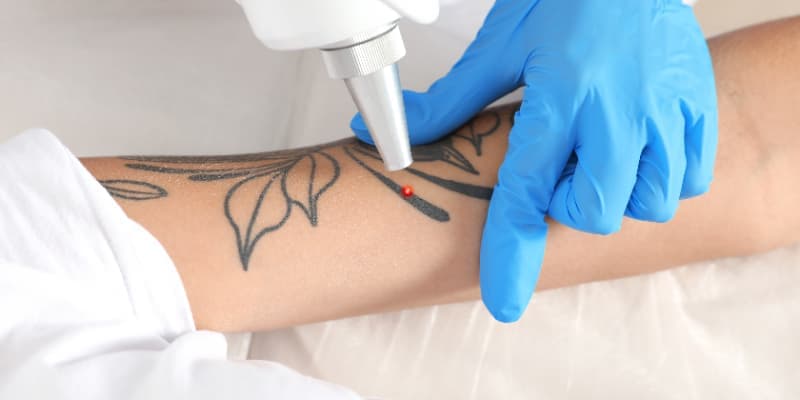
Tattoo removal is a medical procedure in which a laser breaks the ink held in your skin into fragments small enough for your own body to absorb and clear away. It is done as a course spread over months rather than in one appointment, and the number of sessions needed depends on how large the tattoo is, which colours it contains and how deeply the ink was placed.
That is the short version. Below is the longer one, written for someone who has heard the term, has never sat in a clinic chair for it, and would like to know what the words actually describe before deciding whether to ask anybody about it.
Is "tattoo removal" the same thing as "laser tattoo removal"?
In practice, yes. When a clinic in India advertises tattoo removal today it almost always means the laser method, and that is what is offered at The Aesthetic Edge. The two phrases have effectively merged.
The distinction worth holding on to is a different one: the laser is the tool, and the treatment is the whole course — the assessment beforehand, the spaced appointments, and the healing in between. People who think of it as "a laser session" tend to be surprised by the calendar.
How does a laser get rid of ink that is under the skin?
Not by burning it off or lifting it out. The pulse shatters the pigment where it sits, turning a solid deposit into particles fine enough for the body's own clearing mechanisms to handle. Those particles are then carried away gradually over the following weeks.
So a laser session is better understood as one half of the job. The machine fragments; your body disposes. That division is the reason the treatment behaves the way it does — why it is gradual, why the tattoo keeps lightening after you have gone home, and why appointments cannot usefully be stacked close together.
The same principle drives the Q-Switch laser used here for pigmentation concerns: very short, high-energy pulses that shatter pigment particles while surrounding tissue barely warms. Ink is simply another pigment to the machine.
What happens at the first appointment?
Not the laser, in the sense most people expect. The first visit is an assessment. Your doctor goes through your medical history, examines the tattoo for size, colour and depth, and carries out a patch test — a small area treated so that your skin's real response can be observed before a full session is committed to.
A patch test is not a formality. Two people with visually similar tattoos can respond differently, and testing first means the plan is built on what your skin did rather than on what it was expected to do.
Out of that comes a treatment plan: an honest session estimate, a spacing schedule, and a decision about the goal — whether you are aiming at full clearance or at significant fading, which are different targets with different timelines.
What is a session actually like?
Short, for most tattoos. A session runs from a few minutes for something small up to about an hour for something large. You wear eye protection, cooling is applied, and the laser is passed over the area. A big piece may be divided into sections and treated across separate visits rather than all at once.
Discomfort is generally compared to a rubber band flicked against the skin. Cooling is used throughout, and for larger or more sensitive areas numbing can be discussed beforehand.
Downtime is minimal. Most people go back to whatever they were doing that day. The area needs to be kept clean, dry and shielded from sun while it heals over the weeks that follow.
Why are appointments weeks apart?
Because the clearing is biological and takes its own time. Several weeks between sessions gives the body the interval it needs to remove the fragments produced by the last one.
Shortening the gaps does not shorten the course. Treating skin that is still processing the previous round achieves little and increases the chance of damaging it. The waiting is not padding in the schedule; it is where much of the visible fading actually happens.
How many sessions does it take?
Typically six to ten. Where a particular tattoo falls in that range is decided by its size, its colours and the depth of the ink, and your doctor gives an estimate after seeing it rather than over the phone. That estimate is revisited as the course goes on, because the earliest sessions reveal how responsive your ink really is.
Before each appointment there is a review of how much has lifted and whether the settings should be adjusted. The plan is meant to move with the evidence.
Does it work on every colour?
Most colours can be treated, but they are not equal. Black and other dark inks break down the fastest. Greens and blues are more resistant and typically require additional sessions.
A related point people are often not told early enough: complete clearance cannot be promised for every tattoo. Ink that sits deep, or in a resistant colour, may leave a faint shadow at the end of a full course. That possibility belongs in the first conversation, and at this clinic it is raised then rather than later.
What are the side effects?
Four, documented plainly:
- Redness, swelling and blistering in the first days. Blistering in particular is part of ordinary healing. Leave blisters intact — picking is what converts a normal recovery into a scar.
- Temporary lightening or darkening of the treated patch while it settles. It generally evens out, and sun protection improves the chances considerably.
- Incomplete clearance, as above.
- Scarring, low but not zero, and more likely where aftercare is skipped or where someone is prone to keloids. A keloid history should be mentioned at the consultation.
If the treated area becomes progressively more painful or inflamed instead of calming down over the first week, contact the clinic and describe it rather than waiting to see.
Is it the same as a laser facial?
No, and the shared word causes real confusion. A carbon laser peel is a treatment for oily, congested skin and enlarged pores: a carbon lotion is drawn into the pores and vaporised, taking oil and debris with it. It has nothing to do with tattoo ink.
Different lasers, different targets, different reasons to book them. Asking a clinic which one it is proposing and why is an entirely reasonable question.
Can a new tattoo go over the area afterwards?
Usually, once the skin has healed fully. This is a common reason for starting in the first place, and it is worth naming early — if the aim is a cover-up rather than bare skin, the course only has to lighten the old work enough for a tattooist to work over it, which takes fewer sessions than clearing it outright.
What does it cost, and what is the next step?
The consultation is ₹500, waived off against treatment, and it is where a realistic quote comes from — a course priced without seeing the tattoo would be a guess, because size, colour and depth are exactly the variables that set it.
If you have read this far and are curious about your own piece, book a consultation. You will get a patch test, an estimate of sessions, and a straight answer about what your tattoo is likely to do.