
What Is Evolve Skin Tightening? A Plain-English Explanation
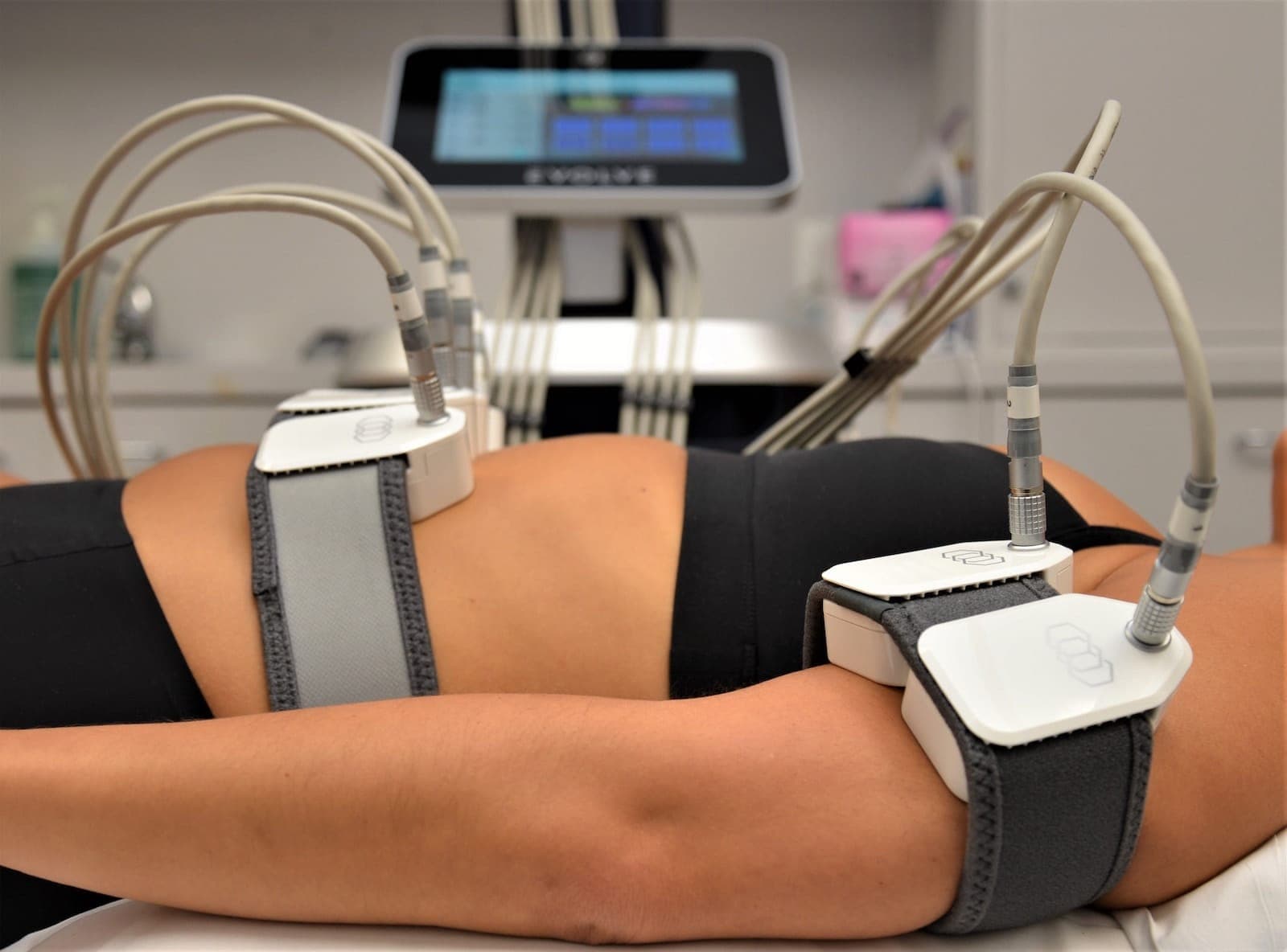
Evolve is a hands-free body platform with three modes — Tite for skin tightening, Tone for muscle stimulation and Trim for fat reduction. Applicators are strapped to the treatment area and the session runs without a therapist holding a handpiece. It is body contouring rather than weight loss: it changes the shape and firmness of a treated area.
The name gets used loosely, which is why this page exists. Below is what the device is, what each of its three modes does, and — just as usefully — what it is not for. Nothing here replaces an assessment; it is here so that the conversation at a consultation starts from the same place.
What is Evolve, in one sentence?
A body-contouring platform that combines three different technologies in one machine, applied through applicators strapped to the area being treated.
The three technologies are radiofrequency, electrical muscle stimulation, and vacuum-assisted radiofrequency. Each is packaged as a mode with its own name, and which of them you have depends entirely on what you are trying to change. Most treatment plans use more than one.
What do the three modes actually do?
Tite works on skin, Tone works on muscle, and Trim works on localised fat.
- Tite — tightens loose skin. Heated applicators warm the deeper layers of the skin to prompt a collagen response. That collagen response is what firms skin which has loosened after pregnancy or a change in weight.
- Tone — stimulates the muscle underneath. Electrical muscle stimulation produces contractions in the muscle beneath the treatment area, working it in a way that is difficult to replicate voluntarily.
- Trim — reduces localised fat. Vacuum-assisted radiofrequency targets subcutaneous fat in a defined area. It is designed to be used alongside the other two rather than on its own.
Put simply: three different things sit under the skin of any given area — the skin itself, the fat below it, and the muscle below that. The three modes address one layer each.
What does "hands-free" actually mean here?
The applicators are strapped on rather than held by a therapist for the whole session.
That has two practical consequences. Several areas can be treated in the same appointment, because nobody has to hold a device over each in turn. And the treatment time is predictable, since the programme runs to a set length rather than to how long a therapist works over an area.
What is Evolve NOT?
It is not a weight-loss treatment, and it should not be chosen as one.
This is worth being blunt about, because "body contouring" and "weight loss" get used interchangeably in advertising and they are not the same thing. Body contouring changes the shape and firmness of a treated area in someone who is near a stable weight. It is not a weight-management programme, it does not replace one, and it is not a treatment for anybody's body size. If what you want is a change in weight, that is a different conversation with a different kind of clinician, and a consultation here should say so plainly rather than sell you sessions.
Who tends to consider it?
People with a specific area they want firmer or more defined, who are already at a weight they are content with.
The three descriptions we hear most: skin that loosened after pregnancy or after losing weight and has not bounced back; consistent training that has not produced the definition through the midsection someone expected; and wanting something that fits around work, without recovery time. Whether any of those is a good fit for you is decided at an assessment, not from a description.
What happens in a session?
Four stages, and only one of them is the machine running.
- Consultation. The doctor works out whether what you want to change is loose skin, muscle tone, localised fat or a combination — and therefore which modes to use.
- Preparing the area. The skin is cleansed and checked. Anything on the surface — oil, lotion, powder — is removed so that the energy reaches the tissue as intended.
- The session itself. The applicators are strapped on and the programme runs hands-free. Expect warmth throughout, and noticeable muscle contractions if Tone is included.
- The weeks afterwards. Some change is visible early, but the result keeps developing over roughly six to eight weeks as collagen builds and the course progresses.
It is non-invasive, and most people describe warmth and a strong but tolerable sensation rather than pain. In Tone mode the contractions are unmistakable. If anything is uncomfortable, say so during the session — the settings can be adjusted, and that is exactly what the operator is there for.
How many sessions will I need?
A course is usual, and the number is set at your consultation rather than sold as a standard package.
It varies with your body, your skin and what you are trying to change, so anybody quoting a fixed number before examining you is guessing. What we can say about timing is consistent: some change is often noticeable soon after treatment, and it continues to develop over roughly the next six to eight weeks as collagen builds.
Is there any downtime?
None for most people. You can return to your usual activities immediately, with mild soreness in the treated area for about a day.
That soreness is most often reported after Tone, which makes sense — the muscle has been worked.
What are the side effects, and when should I contact the clinic?
Redness and warmth in the treated area, soreness for about a day, and sometimes dryness or sensitivity for a short period afterwards.
The redness and warmth are normal straight after a session and usually settle within hours. Blistering or burns are rare, and they are the reason surface preparation and correct settings matter.
Please do not try to judge for yourself whether something has crossed a line. Report any persistent pain or blistering to the clinic rather than treating it at home — and the same goes for redness or warmth that has not settled by the following day, soreness that is getting worse rather than easing after the first 24 hours, or any change in the skin over the treated area that worries you. Call the clinic or use the booking page and ask to be seen. Being checked early costs very little and is far better than waiting to see.
Who should not have it?
It is not advised during pregnancy or breastfeeding, or with a pacemaker or metal implant in the treatment field.
It is also not advised where there is an active skin disorder in the area, for people prone to keloid scarring, or where there is an immunosuppressive condition. That list is not exhaustive and it is not for you to apply to yourself — your doctor confirms suitability at assessment, which is one of the reasons the consultation exists.
Does it work on darker skin?
Radiofrequency heats tissue rather than targeting pigment, so it is generally suitable across skin tones.
That is a genuine difference from some light-based devices, which read pigment and are therefore restricted by how deep a skin tone is. Suitability is still confirmed by your doctor at assessment.
How does it compare with HIFU or CoolSculpting?
They are different tools that overlap in what people want from them.
HIFU and CoolSculpting each have their own treatment pages setting out what they involve. The useful comparison is not device against device in the abstract but which one fits what you actually want changed — and that is what an assessment is for. Deciding between them from reading alone tends to produce a decision based on which page was written more persuasively.
What does it cost?
We do not publish a figure for Evolve, and the honest reason is that a course is planned rather than priced off a shelf.
The number of sessions and which modes are used are both decided at consultation, and those are what set the cost. What we can tell you is that the consultation itself is ₹500, waived off against treatment.
Where to go next
If this has told you what Evolve is and left you wondering whether it suits what you want changed, that is the right question to be left with — and the only way to answer it is an assessment. The full treatment page for Evolve skin tightening covers the procedure in more detail, and you can book an appointment at either of our Bangalore clinics.