
What Changes the Cost of Dental Fillings in India
The cost of a dental filling is driven mainly by the cavity itself: how much decay has to be removed, where the tooth sits in your mouth, and which material suits that position. Fillings are priced per tooth, so the number of teeth being treated multiplies it. At The Aesthetic Edge, dental fillings start from ₹999 per tooth.
That is the short answer. The longer one is worth reading, because the single biggest thing that changes what you pay is something you can still influence: how long you leave the cavity before you have it looked at.
Why does the cavity itself set the price?
A filling is not a fixed procedure applied to a fixed problem. It is a repair, and repairs are priced by how much there is to repair.
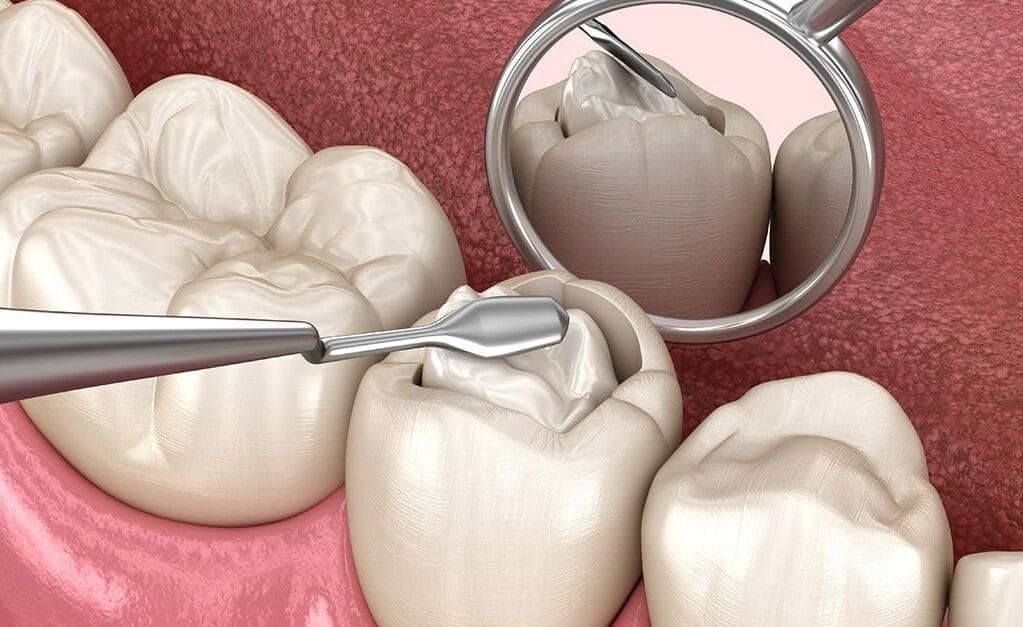
Our own treatment page describes the sequence plainly: the tooth is numbed if required, the decayed tissue is removed, and the cavity is cleaned and shaped to hold the filling. A small area of early decay on a smooth surface is a short, contained piece of work. A cavity that has spread under the enamel and undermined a cusp is a much larger reconstruction — more tissue to remove, more shaping, more material, and more time spent rebuilding a biting surface that has to survive years of chewing.
This is why a dentist will rarely give you a firm figure over the phone. Until the tooth has been examined, and an X-ray taken where one is needed to confirm the extent of the decay, nobody knows which of those two jobs it is.
Does it matter which tooth needs the filling?
It does, for reasons that are mechanical rather than commercial.
A molar at the back of the mouth takes the heaviest chewing load in your jaw. A filling there has to be built to a biting surface with functional cusps and grooves, contoured so food does not pack into it and so the opposing tooth meets it cleanly. A chipped edge on a front tooth is a different problem again: the work there is largely about shade-matching and contour, because the repair is on display every time you speak.
Our treatment page notes that fillings repair molars, premolars and front teeth, including chipped edges, with the material chosen to suit the position and the chewing forces there. Position drives material, and material drives cost.
Which materials are used, and do they cost the same?
Three are in normal use, and the choice is clinical rather than a menu you pick from on price alone:
- Composite resin — tooth-coloured, bonded to the tooth and shade-matched to the surrounding enamel. It is the usual choice, and it is why a repaired tooth does not announce itself the way a metal filling does.
- Glass ionomer — used in specific situations your dentist will explain.
- Amalgam — the traditional silver material.
Your dentist recommends one based on the size and position of the cavity. Where two materials are genuinely both appropriate, the difference in cost is worth asking about directly at the appointment — but a material chosen because it is cheaper and then fails early in a heavy-load molar has not saved anybody anything.
What if the cavity has gone too deep for a filling?
This is the answer people least want and most need, and it is the largest single jump in cost anywhere in this article.
Decay does not stop on its own. Left alone, it reaches the pulp — the point at which a filling is no longer enough. Our page on fillings is direct about the consequence: a cavity caught early is a filling; the same cavity left alone becomes a root canal and a crown, or an extraction.
At this clinic, root canal treatment starts from ₹2,999 per tooth, and a crown normally follows it. Set that against ₹999 per tooth for a filling and the arithmetic makes itself. Two more things belong alongside it, honestly stated:
- Where decay has reached close to the nerve, the pulp can remain inflamed even after a filling is placed. If pain persists or worsens, root canal treatment may still be required. Your dentist should warn you of this before starting.
- Where the damage is too extensive for a filling to hold, an inlay, onlay or crown may be recommended instead. That decision depends on how much healthy tooth structure is left, and it is made when the tooth is opened up.
Neither is a hidden charge. Both are the reason a quote given before the tooth is examined is not really a quote.
What is actually included in the fee?
Ask, and ask before treatment starts. At minimum you want to know whether the figure covers:
- the examination, and any X-ray needed to confirm the extent of the decay
- local anaesthesia, which is used where the cavity is deep or close to the nerve
- the filling material itself
- the bite check and polish — the filling is adjusted so it sits level and the surface is smoothed
That bite check matters more than it sounds. If a filling feels like it hits first when you bite, it needs adjusting. Left alone it causes ongoing soreness and can crack the filling; corrected, it takes a couple of minutes. A practice that charges you to come back and have that done is charging you for part of the original job.
Our consultation is ₹500, waived against treatment.
Why do prices differ between cities and clinics?
Some of the spread across India is real overhead — premises, staffing, equipment and sterilisation standards differ, and a metro practice carries costs a smaller town does not. Some of it is who is doing the work; at this clinic a filling is done by a dentist, always.
What no one should read into a low headline figure is that the underlying tooth is somehow simpler. It is the same cavity. A very cheap quote given sight-unseen usually means the assessment, the X-ray or the follow-up adjustment sits outside it, and you will meet those separately.
How do I actually keep this cost down?
By finding cavities while they are still small, which mostly means not waiting for symptoms.
Early decay causes no symptoms at all — that is precisely why routine check-ups find it and you do not. Sensitivity, a dark spot, food catching in a tooth or a rough edge you notice with your tongue are all worth having looked at rather than watched. This is the entire argument for preventive dentistry: the cheapest filling is the small one, and the only way to get a small one is to arrive early.
It is also worth knowing that fillings do not last forever. They wear, chip and can leak at the margins over the years, letting decay start again underneath. That is why they are checked at routine appointments rather than assumed to be permanent — and a leaking filling replaced on schedule is far cheaper than the decay that develops quietly beneath one nobody looked at.
The one-line version
You cannot price a filling from a photograph or a phone call, and you should be wary of anyone who offers to. You can price it quickly and accurately once somebody has looked at the tooth — and the earlier that happens, the smaller the number tends to be.
If a tooth is bothering you, or you have simply not had a check-up in a while, book an appointment and have it examined. The consultation is ₹500 and is waived against treatment.