
Tooth Pain & Sensitivity: What Actually Works, and What Only Sounds Like It Does
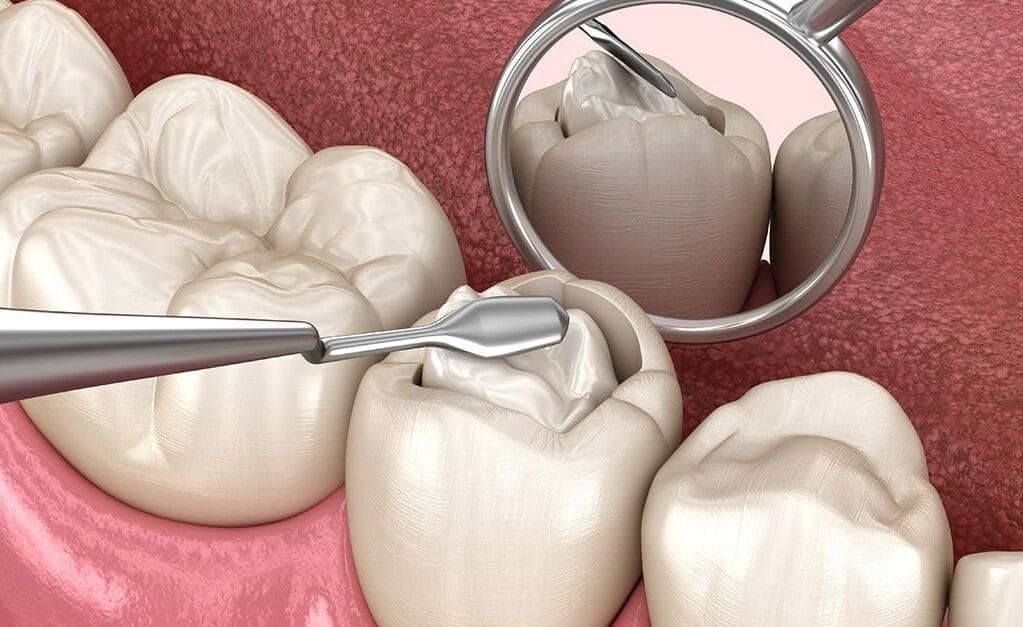
Tooth sensitivity and toothache are different problems that feel related. A brief twinge on cold in one tooth is worth having examined, because decay does not stop on its own. Pain that lingers, throbs at night, or comes with swelling or pain on biting needs prompt dental attention rather than another toothpaste. Only an examination tells you which you have.
That distinction is the whole of this article. Almost everything sold for tooth pain works on how the tooth feels. Very little of it works on why the tooth feels that way — and the gap between those two things is where people lose teeth they could have kept.
What is the difference between sensitivity and toothache?
The useful question is not how much it hurts. It is how long it hurts for after the thing that caused it has stopped.
A short, sharp response to something cold that fades within seconds behaves like sensitivity. Our own patients describe it as cold water giving a sharp twinge on one particular tooth. It is worth investigating, but it is not usually urgent.
Pain that lingers after the hot or cold has gone is a different signal entirely. So is pain that arrives on its own, without anything triggering it, particularly at night. Patients who end up needing root canal treatment tend to describe exactly that: a throbbing toothache that wakes them at night, or hot and cold drinks sending a sharp pain through one tooth that then stays.
You cannot tell these apart by how brave you are about pain. You tell them apart by the clock.
Which signs mean I should not wait?
Please take these seriously. Contact the clinic promptly rather than trying another remedy first if you have:
- Pain that keeps you awake, or wakes you up. Pain with its own schedule, independent of eating and drinking, is not something to manage overnight.
- Swelling near the gum, or swelling in the face or jaw.
- Pain when you bite on a particular tooth.
- Pain that keeps coming back in the same place every few weeks or months, even if it settles in between.
These patterns are the ones associated with infection or inflammation inside the tooth, and left untreated an infection spreads and can cause severe pain and an abscess. That is not a reason to panic. It is a reason to be seen this week rather than next month, because the treatment that saves the tooth is much easier while the tooth is still there to save.
If you have recently had a tooth out, the thresholds are more specific still: pain that increases rather than eases after the third day, bleeding that does not settle, fever, spreading swelling or difficulty swallowing all mean you call the clinic. None of those are things to wait out at home.
Does sensitivity toothpaste actually work?
For genuine sensitivity, a desensitising toothpaste can make a tooth more comfortable, and plenty of people use one happily for years.
Here is the problem, and it is worth being blunt about it. A toothpaste changes how the tooth reports what is happening to it. It does not remove decay. If the twinge is coming from a cavity, then quietening the signal while the cavity carries on is the worst of both worlds: the discomfort that would have sent you to a dentist goes away, and the thing causing it does not.
Decay does not stop on its own. Removing it and sealing the cavity is what prevents it reaching the pulp — which is the point at which a filling is no longer enough, and the same tooth needs a root canal and a crown, or comes out.
So: use the toothpaste if it helps. Do not let it replace the examination.
What about painkillers and repeat courses of antibiotics?
Same principle, higher stakes.
Painkillers mask a toothache. When the source is inflamed or infected pulp inside the tooth, treating it addresses the source of the pain rather than masking it — and the mask wears off every few hours while the cause does not change.
The pattern we see most often at the back of the mouth is people who have been managing flare-ups with painkillers and antibiotics for months. Each episode settles, which feels like the treatment worked, and then it returns. Where a wisdom tooth is behind it, removing the tooth removes the cause rather than treating each episode. Where it is something else, that something else is still there.
If you are on your third round of the same problem, the round is not the treatment. Getting it looked at is.
Why does the very back of my mouth ache?
The back corner deserves its own answer, because it behaves differently.
Wisdom teeth are the third molars right at the back, usually arriving in the late teens or early twenties, and there is often not enough room for them. A partly erupted one leaves a flap of gum that traps food and bacteria, which is why the ache there so often comes with a gum that is swollen and sore, and why it tends to recur until the tooth is dealt with.
Two things worth knowing. Not every wisdom tooth needs removing — one that has come through straight, has room and can be cleaned properly is usually left alone. And whether yours is in that group is decided by an X-ray, not by how much it hurts.
What actually helps, then?
An examination, and it is not a dodge to say so.
Early decay causes no symptoms at all, which is exactly why routine check-ups find it and you cannot. By the time a tooth is talking to you, something has changed enough to be worth looking at — and the assessment itself is quick: an examination, and an X-ray where one is needed to see how far any decay or damage extends and whether the pulp is involved.
What comes out of that is a decision, not automatically a procedure. Depending on what is found, the answer might be a filling, it might be root canal treatment to save the tooth rather than lose it, it might be an extraction at the back, or it might be that the tooth is sound and the sensitivity can simply be managed. All four are useful answers. Guessing between them at a pharmacy counter is not.
No one can promise which of those it will be before the tooth has been looked at, and you should be wary of anyone who tells you otherwise over the phone.
If a tooth is bothering you now
Sensitivity that has been niggling for weeks, an ache that keeps returning, a tooth that has started to hurt when you bite — none of these get cheaper or simpler by being left. A cavity caught early is a filling; the same cavity left alone becomes considerably more work.
Book an appointment and have it examined. The consultation is ₹500, waived against treatment — and if the news is that nothing needs doing, that is a good outcome too.