
The Preventive Dentistry Visits That Actually Save You Money Long-Term
The dental visits that save you money are the ones you book when nothing is wrong. Two examinations a year cost far less than the fillings, root canals and crowns they prevent — and the reason is simple arithmetic rather than salesmanship: decay and gum disease are silent in their early stages, so the window where a problem is small and cheap to fix closes long before you feel anything.
That single fact is the whole logic of Preventive Dentistry. It is the routine work that keeps you out of the chair for anything bigger — regular examinations, professional cleaning, fluoride, sealants, and technique guidance specific to the spots you personally keep missing. None of it is dramatic. All of it is cheaper than the alternative.
Why should I see a dentist if nothing hurts?
Because pain is a late symptom, not an early one. Early decay and early gum disease are both painless, so by the time a tooth actually hurts, the simple and inexpensive window has usually closed. A mouth that feels fine is evidence of nothing except that the nerve has not been reached yet.
This is the part patients find hardest to accept, and it is understandable — every other part of the body tends to complain before it fails. Teeth do not. Decay starts on the outer enamel, where there is no nerve supply to send a signal, and works inwards quietly. Gum disease behaves the same way: the early, reversible stage produces no discomfort at all, and it is gum disease rather than decay that is the leading cause of adult tooth loss. Catching that stage is not a matter of noticing it. It is a matter of someone looking.
An examination is therefore a search, not a confirmation. So are the X-rays taken at intervals set by your risk, which exist specifically to see between and beneath teeth — the surfaces no amount of careful brushing or mirror-time can show you.
What actually happens in a preventive appointment?
Three things, and the third is the one most people undervalue.
An examination, which is the search described above — every surface, the gums, and imaging where risk warrants it.
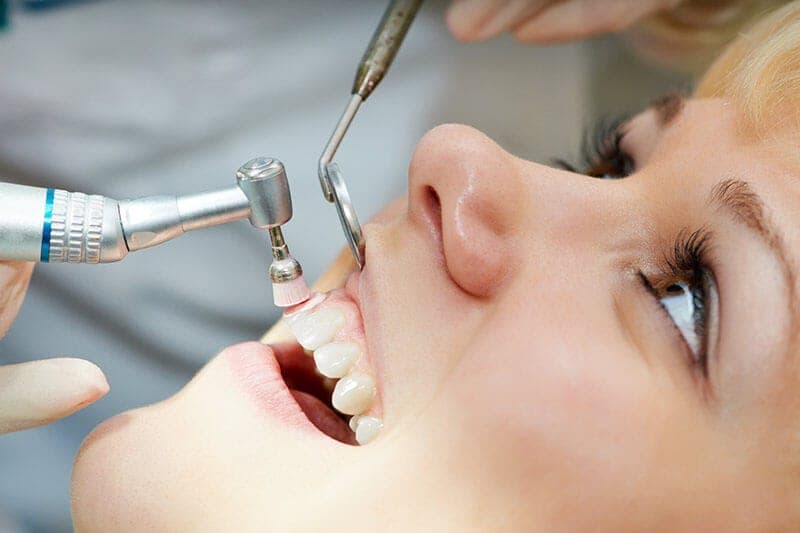
A professional cleaning, which removes the hardened deposits a brush cannot. Where there is more build-up than a routine polish addresses, this becomes a dedicated Scaling & Polishing appointment; either way, regular cleaning and monitoring is the mechanism by which the reversible stage of gum disease gets caught while it is still reversible. It is also, incidentally, why persistent bad breath often improves after a visit — that complaint frequently traces back to plaque and gum inflammation, so cleaning and treating the underlying gum condition address the cause rather than covering it.
Technique guidance built around your own mouth. Generic brushing advice helps far less than being shown the three specific places you keep missing, and those places are only visible to someone examining your teeth. Most people brush conscientiously and still have two or three consistent blind spots. Ten minutes of being shown exactly where they are changes the next six months of home care more than any product will.
Two preventive treatments are added where they are indicated rather than routinely. Fluoride application strengthens enamel against acid attack. Fissure sealants close off the deep grooves of the back teeth, which is where most cavities begin — they are clear or tooth-coloured and effectively invisible, and placing them needs no drilling and no anaesthesia. All of this is carried out by a dentist or dental hygienist.
How often do I actually need to go?
Every six months suits most people, but that number is a starting point, not a rule. Your own interval should be set to your risk: if you have a history of gum disease, form tartar quickly, smoke, or have a high rate of decay, your dentist may recommend shorter gaps between visits. Someone with none of those may sit comfortably at the standard six months for years.
Ask for your interval to be stated explicitly, and ask why. A frequency chosen for your mouth is worth considerably more than a default one, and it is a reasonable thing to expect from a doctor-led practice.
The Bangalore version of this problem
The reason preventive dentistry gets skipped here is almost never disbelief. It is the calendar. A check-up is the easiest appointment in the world to move, because nothing is wrong — so it slides behind a release week, then behind a quarter close, and a six-month interval quietly becomes two years. Add a cross-city journey to it and the appointment stops happening altogether: nobody is crossing the Outer Ring Road at 6 p.m. for a visit they have already convinced themselves is optional.
That is the practical case for choosing the clinic you can actually reach on a weekday. We see patients at both our Indiranagar and Bellandur clinics, and the honest advice is to pick whichever is closer to where your day already takes you, rather than whichever you visited first. A twenty-minute appointment near your office gets kept. A forty-five-minute drive does not.
The pattern that follows from postponement is one we see often: someone arrives with a tooth that has been mildly sensitive for months, and what would have been a small, single-visit repair a year ago is now a larger piece of work. Nothing was neglected in any dramatic sense. The visit that would have caught it simply never got booked.
Children are worth a separate note here, because the same drift costs more in a growing mouth and the habits formed early tend to hold — the reasoning behind treating Kids Dentistry as its own practice rather than an adult appointment scaled down.
What you are really buying
Every preventive measure serves the same end: preserving your own natural tooth structure, which no replacement fully matches. That is the point worth holding on to. A crown is good dentistry and sometimes exactly the right answer, but it is a repair, and the tooth it repairs is never returned to what it was. The financial argument here is unusually straightforward — two examinations a year against the treatments they head off — and behind it sits a simpler one, which is that the teeth you keep are your own.
If your last check-up is far enough back that you cannot date it, that in itself is the answer to whether you need one. Book an appointment at The Aesthetic Edge — Indiranagar or Bellandur — for an examination, a cleaning, and a check-up interval set to your own risk rather than a default. Nothing hurting is a good reason to come in, not a reason to wait.