
Sagging Skin & a Softening Jawline: What Actually Works, and What Only Sounds Like It Does
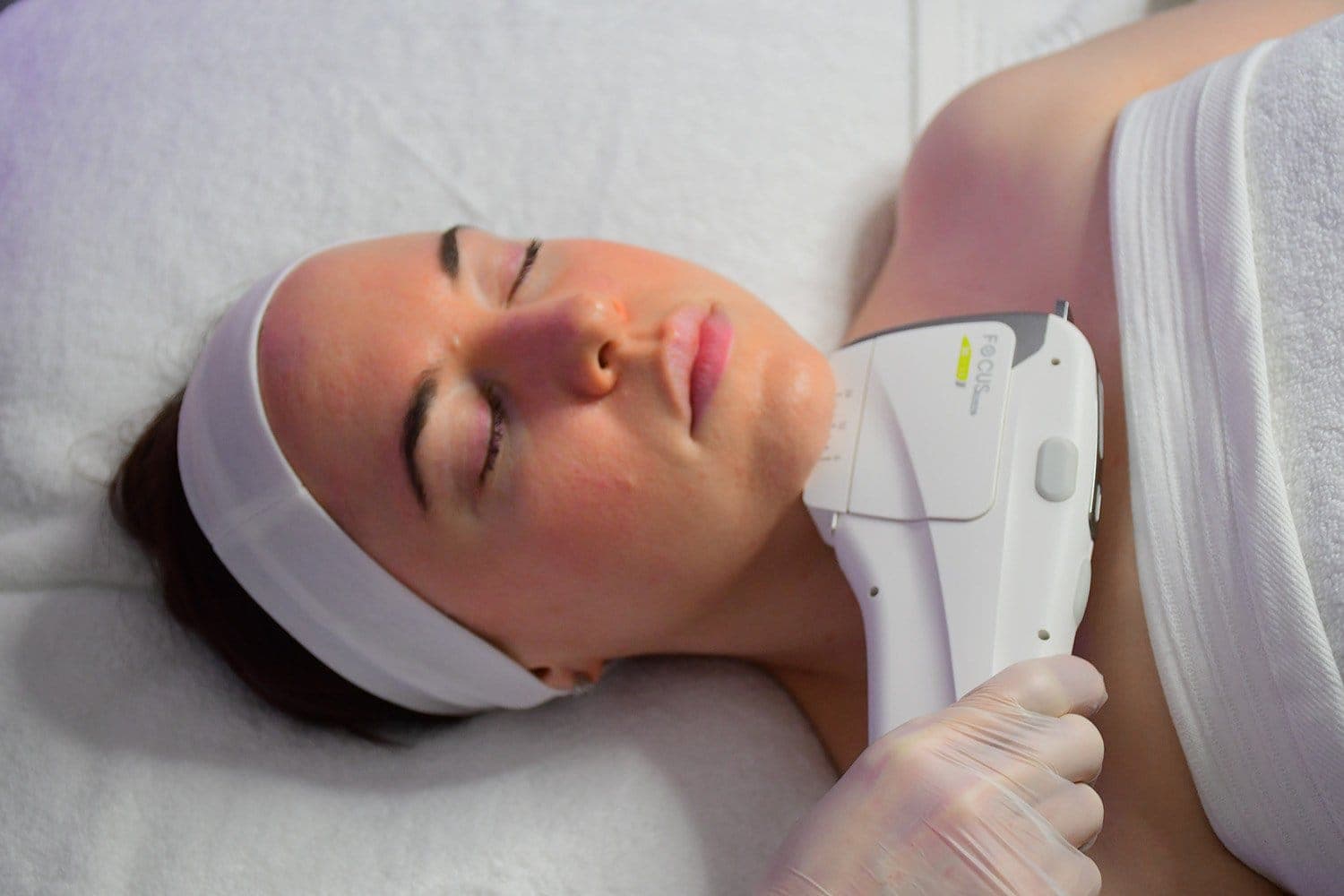
Mild to moderate laxity along the jawline and neck is addressed in clinic by two quite different approaches: focused ultrasound, which heats a set depth beneath intact skin so your own collagen builds gradually, and dissolvable threads, which reposition tissue and produce a lift you can see on the day. Laxity beyond that range needs a surgical opinion instead — and a sound consultation will tell you so.
Most people arrive at this subject without a treatment name. What they have is a photograph. The jawline that used to end in a clean line now blurs into the neck; the cheeks look as though they have slid a few millimetres downward. This piece is written for that reader — not to recommend a procedure, but to lay out what each option is actually for, so that you walk into a consultation able to ask a better question.
What is actually happening when a jawline softens?
The short answer is that support is being lost, not skin gained.
Every non-surgical option discussed below works on the same underlying material: collagen. HIFU heats tissue at a set depth so the body responds by producing more of it. Threads provoke a collagen response along their path as they dissolve. Radiofrequency body devices warm the deeper skin layers for the same purpose. None of them removes skin. They all, in different ways, ask the tissue you already have to firm up and hold better.
That matters for expectations. Because the change comes from your own collagen response rather than from a product being placed on the surface, it develops over weeks and months rather than appearing on the day — with the single exception of threads, where the lift itself is mechanical and immediate.
What do patients tell us has not worked?
The sentence we hear most often, almost word for word, is that creams and facials are not touching it, but surgery feels like too big a step. That is not a criticism of skincare — a good routine does real work on texture, tone and barrier health. It is simply a different job. Laxity is a structural problem at depth, and a topical applied to the surface is not reaching the layer where the support has gone.
The same logic applies to the many devices and gadgets marketed for facial "lifting" at home. If the mechanism does not deliver energy to a controlled depth under clinical supervision, it is not doing what an in-clinic device does, whatever the marketing says.
How does focused ultrasound work along the jawline?
HIFU delivers ultrasound energy to a precise depth beneath the skin without breaking the surface. There is no wound, no injection and no incision to heal, because the energy passes through the surface untouched and does its work further down.
In practice the doctor examines how much laxity you actually have, cleanses the skin and draws a grid over the treatment area so the energy is delivered evenly rather than by eye. The handpiece is then passed over that grid. Expect brief tingling or warmth at each pass. A session runs from about 30 minutes to an hour and a half depending on the area, needs no anaesthesia, and most patients go straight back to their day — any slight redness usually settles within a few hours.
The areas it is commonly used for are exactly the ones where mild laxity shows first: the brow, the nasolabial folds, the jawline and the neck. The trade-off is patience. Results are not immediate; they develop over the following months as collagen builds, which is why the result is reviewed some weeks later rather than on the day.
It suits you if you would rather see a gradual change than an obvious one, you want firmness without injections or incisions, and you cannot give up time to recovery. It will disappoint you if you want the change visible this month, or if your laxity is beyond the mild-to-moderate range.
When does a thread lift make more sense?
When you want the lift to be visible at the end of the appointment.
A thread lift is a different category of intervention — minimally invasive rather than non-invasive. Fine dissolvable threads are placed under the skin along planned vectors, under local anaesthetic, and drawn to reposition tissue that has descended. The lifting effect is visible during the procedure itself, and firmness can continue improving for some weeks afterwards as the threads break down and provoke a collagen response.
You pay for that immediacy in recovery. Expect mild swelling, bruising or a feeling of tightness for a few days, and plan to avoid vigorous facial movement, facial massage and sleeping face-down in the first week. It is measured in days rather than weeks, but it is not nothing — unlike ultrasound, which for most patients has essentially none.
Where a thread enters, the direction it follows and how many are used are anatomical decisions. They are made by a doctor here, and they are what separates a well-planned thread lift from a visible one.
What if the loose skin is on my body rather than my face?
Then neither of the above is the conversation you need.
Evolve is a hands-free body platform with three modes — Tite for skin tightening, Tone for muscle stimulation and Trim for localised fat. Applicators are strapped to the treatment area and the programme runs without a therapist holding a handpiece, so several areas can be treated in one predictable session. The patients it is built for describe skin that loosened after pregnancy or after weight loss and has not bounced back, or a midsection that stays untoned despite consistent training.
Because radiofrequency heats tissue rather than targeting pigment, it is not restricted by how deep your skin tone is. A course is usual, the number set at consultation, and results keep developing over roughly six to eight weeks. Most patients resume normal activity immediately, with some soreness in the treated area for about a day.
For anyone fitting appointments around a Bangalore working week and a commute, that no-recovery pattern is often the deciding practicality rather than a clinical one — and it is a legitimate reason to choose one route over another.
How do I know if I am beyond what these can do?
You ask, and a good clinic answers honestly.
Non-surgical tightening is an option for mild to moderate laxity, not a substitute for surgery. The degree of lift is modest by design — which is precisely why the result reads as rested rather than altered. If your laxity is beyond what these can address, the appropriate answer is a surgical opinion, not a course of sessions. The assessment step exists for that decision, and a doctor should tell you plainly rather than sell you a package.
There are also situations where these treatments are set aside regardless of degree: pregnancy and breastfeeding, an active skin infection or open lesion in the treatment area, and metal implants in the field, among others. Those are established at consultation.
What should I watch for afterwards?
After ultrasound, redness and mild swelling are common and usually gone within hours; the area can feel tender or slightly numb for a few days, and small bruises along the jawline are uncommon but possible. After threads, swelling and bruising in the first days are expected, as is a tight or pulling sensation while the tissue settles.
What is not routine, and is worth contacting the clinic about rather than waiting out: increasing pain, spreading redness or discharge at a thread entry point, or puckering along a thread's path that persists rather than settling. Threads placed on the nasal bridge carry a rarer concern — severe pain, blanching or a dusky colour change after treatment should be reported to the clinic straight away rather than left to see if it resolves.
What happens at the consultation?
The doctor establishes which of these problems you actually have — facial laxity and its degree, body skin laxity, muscle tone, or a combination — and says which approach that calls for, including when the answer is none of them. A consultation is ₹500, waived against treatment. If you are unsure which category you fall into, that is exactly the right reason to book an appointment rather than choosing a treatment name first and working backwards.