
HIFU vs Thread Lift: How to Choose
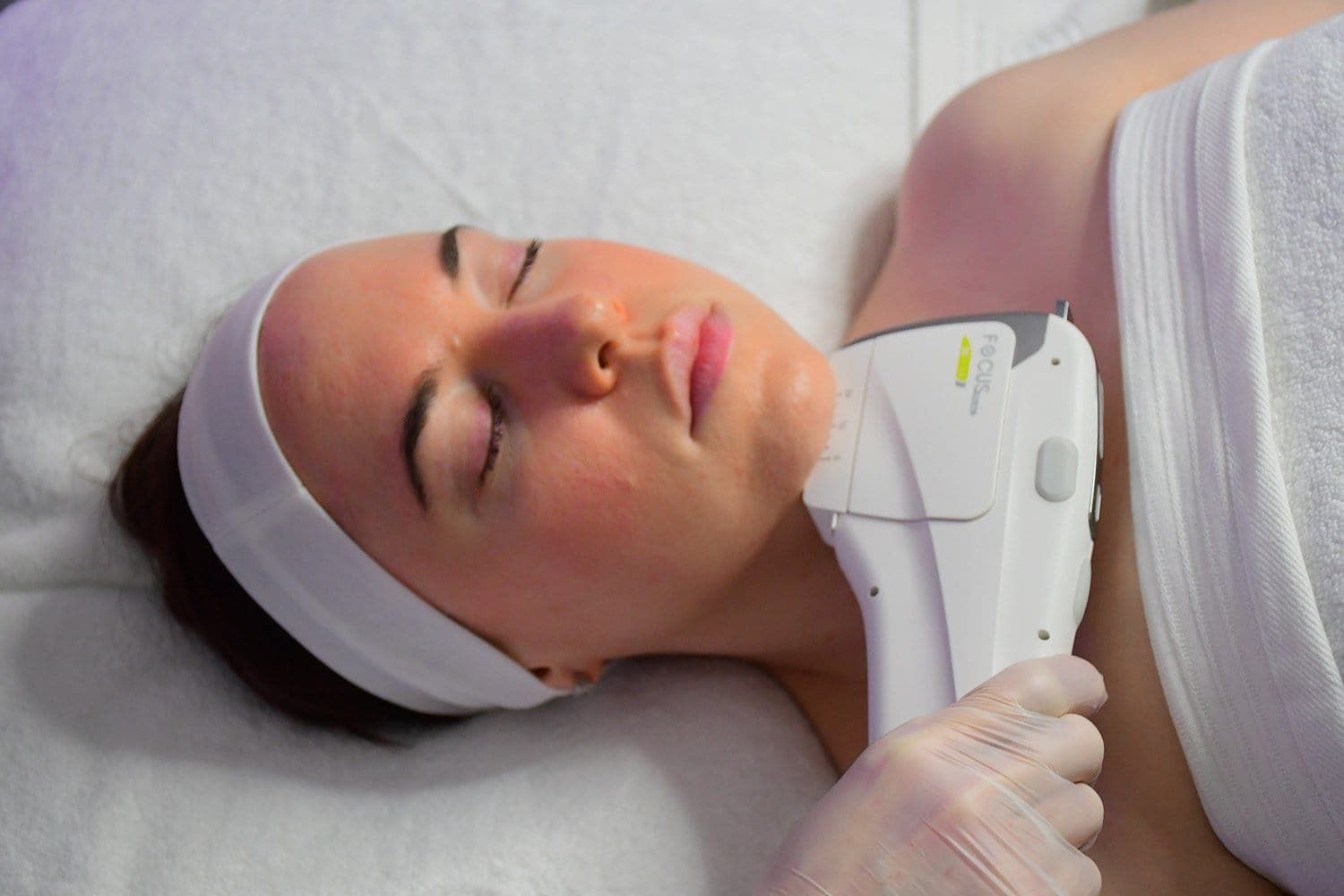
The choice is between putting energy through intact skin and placing material underneath it. HIFU breaks no skin and works by stimulating your own collagen, so the change is gradual and there is essentially no downtime. A thread lift repositions tissue mechanically under local anaesthetic, so the lift is visible the same day and costs you a few days of swelling.
Everything else follows from that. If you find yourself weighing these two, you are really answering three questions — how much recovery you can absorb, whether you want to watch a change arrive or see it happen, and how long you expect the result to hold. Neither device is the stronger one in the abstract; they are different categories of intervention.
Is a thread lift surgery?
No, and this is the confusion worth clearing first.
A thread lift is minimally invasive. Fine dissolvable threads are introduced under the skin through a fine needle or cannula, under local anaesthetic only — no general anaesthetic, no hospital stay, and no incisions of the kind a surgical lift requires. It is an in-clinic appointment, typically under an hour, and most patients go home the same day. Recovery is measured in days rather than weeks.
HIFU sits a category below that: non-invasive. The ultrasound energy is focused at depth and passes through the surface untouched, so there is no wound, no injection and no incision to heal at all. No anaesthesia is required.
Both are non-surgical. Only one of them puts anything under your skin.
How does each one actually produce a lift?
They arrive at a similar-sounding outcome by genuinely different routes.
Threads lift mechanically. Entry points are marked and the direction each thread will follow is planned in advance, because where a thread enters and the vector it travels are anatomical decisions. The threads are then drawn to reposition tissue that has descended — which is why the lifting effect is visible during the procedure itself. The doctor chooses the thread type to match the plan: smooth mono threads where the aim is firmness, barbed cog threads where tissue has to be lifted and held.
HIFU lifts biologically. Focused ultrasound heats a set depth beneath the skin, and the tightening comes from the collagen your body produces in response. Before treatment the skin is cleansed and a grid is drawn over the area so the energy is delivered evenly rather than by eye; the handpiece is then passed over that grid.
There is a second-order overlap worth knowing about. Threads are absorbable, and as they break down they provoke a collagen response along their path — so part of a thread lift's later result is the same mechanism HIFU relies on from the start. PDO, the material most commonly used, dissolves over roughly six months, and the collagen laid down along its path is what carries the result once the thread itself has gone. Nothing needs to be removed.
How much time will I lose afterwards?
This is where the two genuinely part company, and for many patients it decides the question outright.
After HIFU, most patients resume normal activities immediately. Some notice slight redness or swelling that settles within a few hours. The area can feel tender or slightly numb for a few days, and small bruises are uncommon but possible, particularly along the jawline. There is nothing you are asked to stop doing.
After threads, expect mild swelling, bruising or a feeling of tightness for a few days. There are real restrictions attached: avoid vigorous facial movement, facial massage and sleeping face-down for the first week, and skip strenuous exercise for a few days. Alcohol is better avoided for 24 hours beforehand, and you will be asked about medication — blood thinners in particular — before the appointment is booked.
Neither list is alarming. But one of them requires you to plan a week, and the other does not.
How soon will I see it, and how long should it hold?
Threads show immediately and hold for a stated window. The lift is visible at the end of the appointment, then improves further as collagen builds. On duration the treatment is specific: generally several months to around a year, depending on the thread type, the area treated, your skin and your age — and the collagen stimulated along the way can outlast the threads themselves. You are reviewed once the swelling has settled, so the final position can be judged properly rather than through swelling.
HIFU shows late and is framed differently. The change is not immediate, because new collagen takes time; improvement develops over the weeks and months after the session and keeps developing rather than peaking on the day. The result is reviewed some weeks later for that reason. How many sessions you need depends on your skin and the area treated, and the honest position is that your doctor gives you a realistic plan at consultation rather than a fixed package or a quoted number of months.
If you have an event in three weeks, those two paragraphs are not interchangeable.
Which one is more uncomfortable?
Both are described in mild terms, but the sensations differ in kind.
With HIFU, most patients report minimal discomfort — a slight tingling or a warm sensation as the energy is delivered at each pass. If it is more than that, say so, because the settings can be adjusted.
With threads, local anaesthetic means most patients describe pressure and pulling rather than pain during the procedure. What follows is different: some soreness and a tight or pulling sensation in the days afterwards is normal as the tissue settles into its new position, and it eases as the swelling reduces.
Do I actually have to choose?
Not always. Thread lifts are frequently combined with other treatments, and a combined plan is common — volume loss is addressed better with filler and skin quality with a resurfacing or biostimulator treatment, so the doctor sequences them rather than treating one concern with the wrong tool.
That is a useful reframing of the whole comparison. "HIFU or threads" assumes one problem with two candidate answers. Quite often a face presents more than one problem — some descent, some volume loss, some surface quality — and the sequencing conversation is more valuable than the head-to-head.
What are the honest limits of both?
Neither replaces surgery, and both cores say so plainly.
HIFU is a non-surgical option for mild to moderate laxity. The degree of lift is modest, and if your laxity is beyond what it can address, a sound consultation says so rather than selling you a course.
A thread lift is a modest, temporary lift with a fraction of the recovery of a surgical facelift — which removes and repositions tissue and gives a far larger, longer-lasting change. Threads suit mild to moderate laxity in patients whose skin still has reasonable quality. They are not for everyone, and the consultation exists to give you a straight answer rather than a booking. Beyond that range, a thread lift disappoints, and you should be told so before you book.
Both are also set aside during pregnancy and breastfeeding and over an active skin infection. HIFU is additionally not used over an open lesion in the treatment area or where there are metal implants in the field. Threads are not placed where there is skin cancer, or where significant laxity is served better by a different approach.
What should I report afterwards?
After HIFU, redness, mild swelling, tenderness and a few days of slight numbness are expected and settle on their own.
After threads there is a little more to watch. Small irregularities — puckering or dimpling along a thread's path — can appear early and usually settle, but tell your doctor if they persist rather than waiting. Infection and thread extrusion are uncommon but possible: contact the clinic if you develop increasing pain, redness or discharge at an entry point rather than managing it at home. One situation warrants immediate contact rather than a next-review mention — threads placed on the nasal bridge sit close to the vessels that supply the overlying skin, so severe pain, blanching or a dusky colour change after treatment should be reported to the clinic straight away rather than left to see whether it settles.
Which one fits me?
Choose the ultrasound route if you want firmer skin without injections or incisions, cannot give up any recovery time, and would rather see a gradual change than an obvious one — the kind where people notice you look well rather than that you have had something done.
Choose threads if your jawline has softened and your cheeks have started to slide downward, creams and facials are not touching it, you are not ready for surgery, and you want a lift you can see at the end of the appointment — and you can give up a week of face-down sleeping and facial massage to get it.
If you cannot place yourself in either paragraph, that is what the assessment is for. A consultation is ₹500, waived against treatment, and the doctor's first job is to establish whether your laxity is in the range either of these can treat at all. Book an appointment to have that conversation before you choose a technique.