
Root Canal Treatment (RCT) vs Dental Fillings: How to Choose
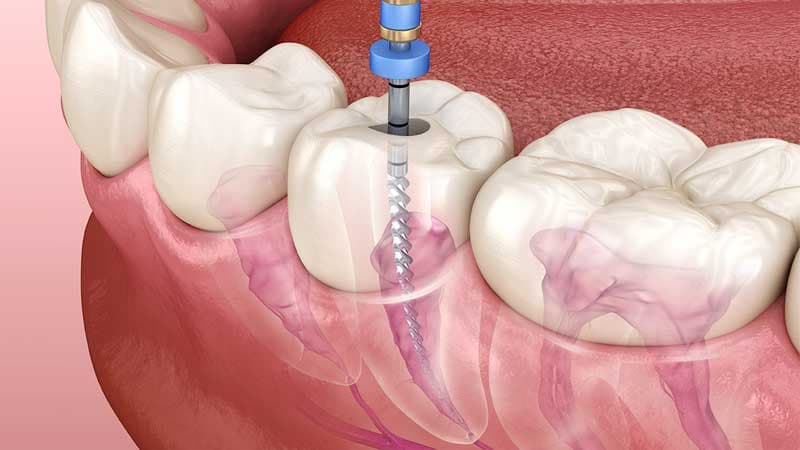
A filling repairs a tooth where decay or a fracture has damaged it but has not reached the pulp. A root canal is needed once the pulp — the living core — has become inflamed or infected. So the choice is not really yours to make: it is settled by how deep the damage has gone, which an examination and an X-ray establish. A filling is the outcome you want; it means you caught it in time.
That framing matters, because these two get presented as a decision on price and they are nothing of the kind. Nobody picks a root canal over a filling. People arrive needing one because the window for the other has closed.
Are they alternatives at all?
Only in the sense that a plaster and stitches are alternatives. They sit on the same continuum.
Decay starts in the enamel and works inward. While it stays outside the pulp chamber, the treatment is to remove the decayed tissue and rebuild the space — that is a filling, and the healthy part of the tooth, including its nerve and blood supply, carries on as before. Once bacteria reach the pulp, the tooth cannot resolve that itself. Cleaning out a cavity and sealing over an infected pulp does not address what is happening underneath it.
Decay does not pause between those two states. That is the entire argument for treating a small cavity now rather than at some more convenient moment.
What decides which one I need?
Depth, and whether the pulp is involved. That is what the assessment is for — an examination, and an X-ray where needed, to see how far the damage extends.
Symptoms contribute but do not settle it, and they overlap more than people expect. Broadly, the picture that tends to bring someone in for a filling is a dark spot on a tooth, something catching the tongue, a rough edge, or a brief twinge from something cold that passes as soon as it arrives. The picture that tends to point toward the pulp is a throbbing ache that wakes you at night, sharp pain from hot or cold that lingers after the drink has gone, pain on biting, or swelling near the gum.
But early decay very often causes no symptoms at all, which is exactly why routine check-ups find it and you do not. Do not use the list above to reach a conclusion about your own tooth. Use it to know what is worth mentioning.
How do the two compare in practice?
| Dental filling | Root canal treatment | |
|---|---|---|
| What it treats | Decay or a fracture that has not reached the pulp | Pulp that has become inflamed or infected |
| Visits | Usually one appointment per tooth | One where straightforward, more where canals are complex |
| Time | Most single fillings take well under an hour | Roughly 60 to 90 minutes for a single-visit case |
| Anaesthesia | Local where the cavity is deep or near the nerve; small shallow ones sometimes without | Local anaesthesia |
| What is removed | Only the decayed tissue; healthy structure is preserved | The pulp, via a small access opening |
| Straight afterwards | Composite sets before you leave — eat once the numbness goes | Keep off that side until the permanent restoration is fitted |
| Longer term | Fillings wear, chip and can leak at the margins over years | The tooth becomes more brittle; a crown is usually advised for back teeth |
| From | ₹999 per tooth | ₹2,999 per tooth |
Both are carried out by a dentist, and the consultation for either is ₹500, waived against treatment.
When is a filling genuinely the right answer?
Whenever the pulp is still healthy, which is most cavities caught at a check-up. It is the less invasive option by a wide margin: one appointment, only the damaged tissue removed, tooth-coloured composite bonded in and shaped to the tooth's own contours, hardened on the spot. You leave with a finished repair rather than a stage of a plan.
It also keeps the tooth's nerve, which is not a small thing. A tooth with a living pulp still tells you when something is wrong. That early-warning system is precisely what a root-treated tooth loses.
The honest limit is that fillings are not permanent. They wear, chip and can leak at the margins over the years, letting decay restart beneath them — which is why they are checked at routine appointments rather than assumed to be done with. And where too little sound tooth remains for a filling to hold, an inlay, onlay or crown may be recommended instead.
When is a root canal the only thing that will work?
When the pulp is already inflamed or infected — typically from deep decay, a crack, repeated dental work on the same tooth, or an injury.
At that stage the realistic options narrow to two: remove the pulp and keep the tooth, or remove the tooth. Root canal treatment relieves the pain by dealing with its source rather than masking it, stops the infection tracking further into the bone, and leaves you with your own root in your own socket — which preserves the jawbone that resorbs wherever a root is missing. Extraction leaves a gap that shifts the neighbouring teeth and then needs replacing.
The trade-offs are real and worth knowing: tenderness for a few days, a tooth that is more brittle afterwards and usually wants a crown on a back tooth, and a small proportion of cases that do not fully resolve and need retreatment.
Can I ask for a filling instead, to keep the cost down?
Not if the pulp is involved. It would not save you anything — the infection would continue underneath the repair, and you would end up paying for the filling and then for the root canal anyway, with more pain in between.
Where cost genuinely is the lever is earlier. A cavity treated at the filling stage is a smaller appointment and a smaller bill than the same cavity treated eighteen months later as a root canal and a crown. That is the saving, and it is available only before the symptoms start.
I had a filling and the tooth still hurts. Did something go wrong?
Not necessarily. Where decay had reached close to the nerve, the pulp can stay inflamed even after the decay is removed and the tooth repaired — and if pain persists or worsens, root canal treatment may then be needed. A dentist should flag this possibility before starting a deep filling rather than after.
Separately, a filling that feels high when you bite is a different and much smaller problem, and it is fixed by a short adjustment appointment rather than by putting up with it.
What should I do now?
If a tooth is aching at night, get it seen this week. If a tooth merely looks or feels slightly off, get it seen anyway — that is the stage where the answer is still the cheaper one.
The root canal treatment page and the dental fillings page set out each in full. To have a tooth assessed and find out which of the two you are actually looking at, book an appointment.