
Polynucleotide (Rejuran) Statistics: What the Data Shows
Polynucleotide injections, sold as Rejuran and often called the salmon sperm facial, are widely discussed and barely counted. This is what the available primary data does and does not show.
Last updated 6 October 2026Reviewed by The Aesthetic Edge medical team
Key statistics
The 2024 ISAPS survey, the largest global count of cosmetic procedures, has no category for polynucleotides or skin boosters.[1]
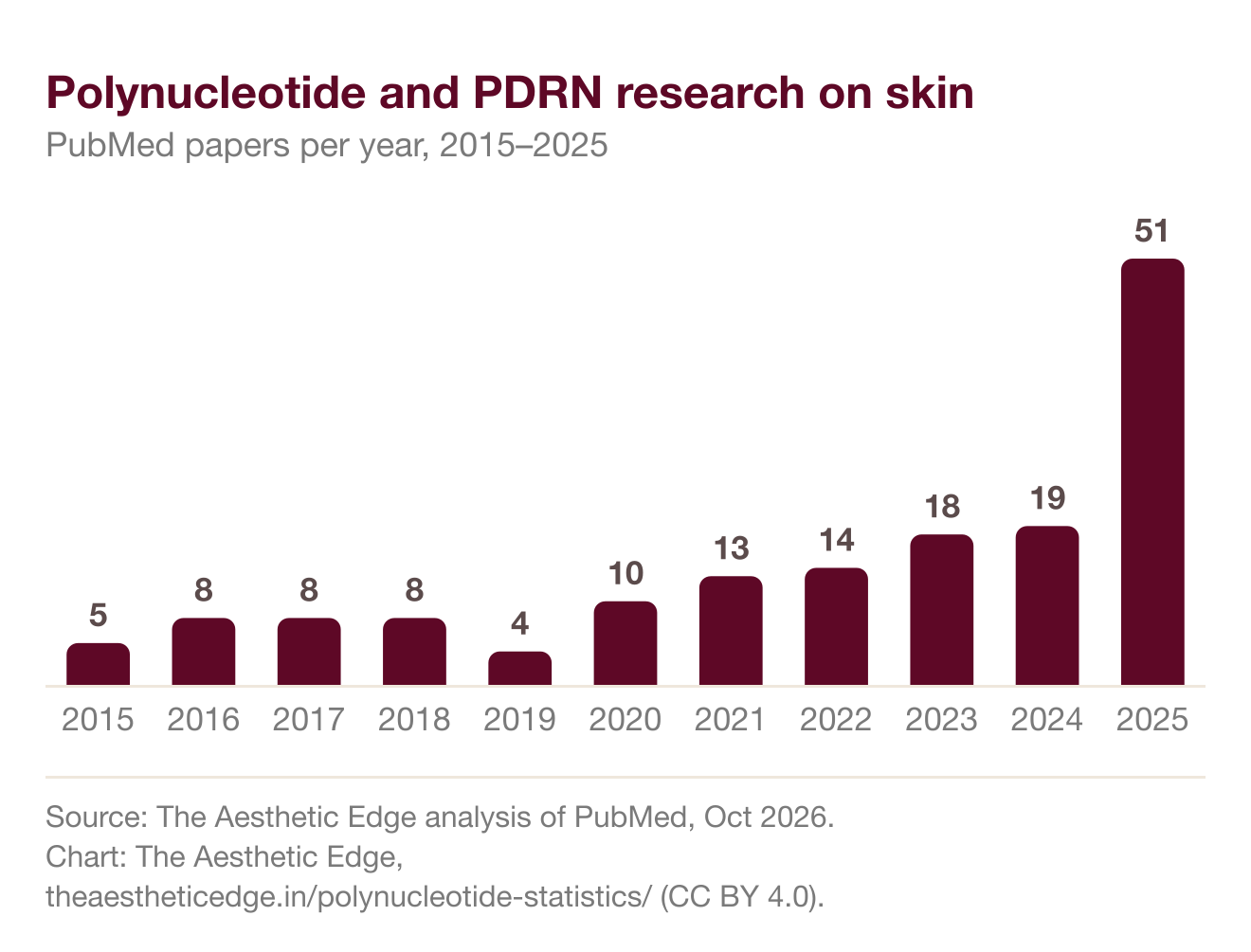
51 PubMed papers published in 2025 discuss polynucleotides or PDRN together with skin or aesthetic terms, up from 19 in 2024.[2]
There were 3 such papers in 2014, the year Rejuran launched in Korea.[2][3]
PubMed papers on PDRN for any medical use rose from 2 in 2010 to 57 in 2025.[2]
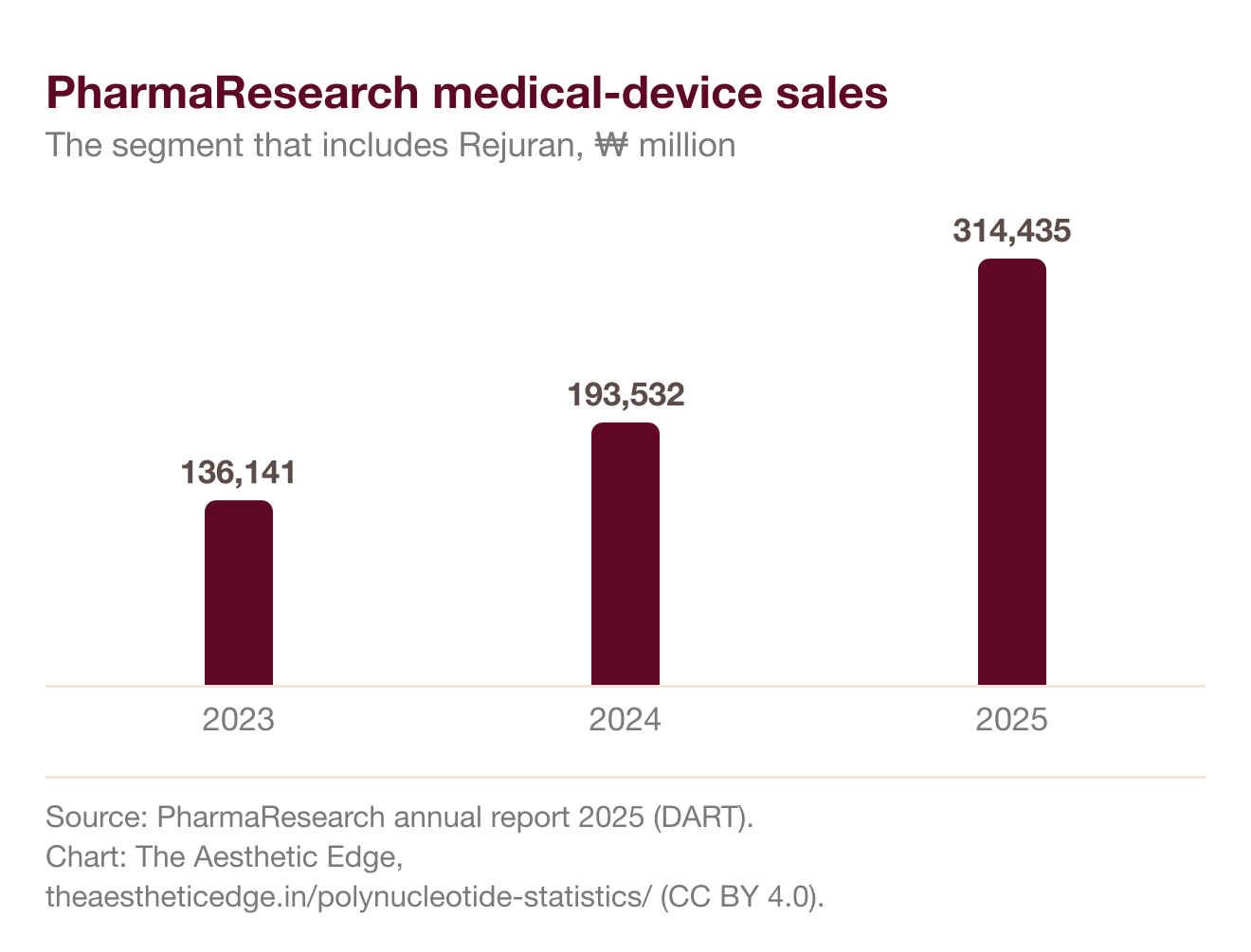
Rejuran's maker, PharmaResearch, sold ₩314,435 million of medical devices in 2025, up from ₩136,141 million in 2023.[3]
Its medical-device exports reached ₩88,564 million in 2025, from ₩41,170 million in 2023.[3]
Medical devices, the segment that includes Rejuran, made up 58.6% of PharmaResearch's 2025 sales.[3]
What are polynucleotides?
Polynucleotides (PN) are purified DNA fragments, in Rejuran's case isolated from salmon germ cells, with longer chains and a higher molecular weight than the related ingredient PDRN (polydeoxyribonucleotide).[3]
PharmaResearch, which makes Rejuran, describes the product as a polynucleotide medical device for the face and says it is the company's main product.[3]
How many polynucleotide treatments are performed each year?
No one publishes a count: the 2024 ISAPS survey, the largest global count of cosmetic procedures, has no category for polynucleotides or skin boosters.[1]
Until a survey adds the category, this page uses two indirect measures instead: research output, and the sales of Rejuran's manufacturer.
How fast is research on polynucleotides growing?
PubMed lists 51 papers published in 2025 that mention polynucleotides or PDRN together with skin or aesthetic terms, up from 19 in 2024 and 3 in 2014.[2]
These are counts of records matching the searches below, run on 6 October 2026. They measure research activity, not the number of treatments, and include laboratory and animal studies.[2]
| Publication year | Polynucleotides or PDRN with skin or aesthetic terms | PDRN, any medical use |
|---|---|---|
| 2010 | 1 | 2 |
| 2011 | 3 | 6 |
| 2012 | 4 | 9 |
| 2013 | 4 | 5 |
| 2014 | 3 | 5 |
| 2015 | 5 | 5 |
| 2016 | 8 | 15 |
| 2017 | 8 | 22 |
| 2018 | 8 | 25 |
| 2019 | 4 | 12 |
| 2020 | 10 | 20 |
| 2021 | 13 | 23 |
| 2022 | 14 | 22 |
| 2023 | 18 | 30 |
| 2024 | 19 | 24 |
| 2025 | 51 | 57 |
| Column | PubMed search, by publication year |
|---|---|
| Polynucleotides or PDRN with skin or aesthetic terms | (polynucleotide*[tiab] OR polydeoxyribonucleotide[tiab] OR PDRN[tiab]) AND (skin[tiab] OR facial[tiab] OR face[tiab] OR aesthetic*[tiab] OR cosmetic*[tiab] OR wrinkle*[tiab] OR rejuvenation[tiab] OR scar*[tiab]) |
| PDRN, any medical use | polydeoxyribonucleotide[tiab] OR PDRN[tiab] |
[tiab] searches titles and abstracts. Run through NCBI's E-utilities, one count per publication year.
How big are Rejuran's sales?
PharmaResearch does not report Rejuran on its own, but its medical-device segment, led by Rejuran, sold ₩314,435 million in 2025, up from ₩136,141 million in 2023.[3]
The segment also includes the company's hyaluronic acid fillers and its Conjuran knee injection. Medical devices made up 58.6% of PharmaResearch's total sales of ₩536,289 million in 2025.[3]
| Segment | 2025 | 2024 | 2023 |
|---|---|---|---|
| Medical devices, Korea | 225,871 | 137,367 | 94,971 |
| Medical devices, export | 88,564 | 56,165 | 41,170 |
| Medical devices, total | 314,435 | 193,532 | 136,141 |
| Medical devices, share of company sales | 58.6% | 55.3% | 52.2% |
| Pharmaceuticals | 82,540 | 64,522 | 54,535 |
| Cosmetics | 131,645 | 77,730 | 60,035 |
| Other | 7,669 | 14,331 | 10,300 |
| Company total | 536,289 | 350,115 | 261,011 |
As printed in the sales section of the company's fiscal 2025 annual report filed in Korea.
Where is Rejuran sold?
PharmaResearch exported ₩88,564 million of medical devices in 2025, against ₩41,170 million in 2023, and says it is expanding in Asia, led by China and Japan, and in Europe and North America.[3]
Its filing does not give sales by country, and no figure for India was found.
When did polynucleotide skin boosters launch?
Rejuran launched in Korea in 2014, and PharmaResearch credits it with starting the Korean skin booster market.[3]
How reliable are these numbers?
None of them counts treatments directly: the PubMed figures measure research interest, and PharmaResearch's figures are company sales that include products other than Rejuran.[2][3]
The sales figures are as reported in PharmaResearch's annual business report for fiscal 2025, filed on Korea's DART disclosure system, in millions of Korean won.[3]
How do I cite or reuse this data?
Cite this page, and the original source of any figure you quote. The numbered sources below link to each one.
The Aesthetic Edge. “Polynucleotide (Rejuran) Statistics and Data.” Last updated 6 October 2026. https://theaestheticedge.in/polynucleotide-statistics/
The charts and text on this page are licensed under CC BY 4.0: you may republish them, including commercially, if you credit The Aesthetic Edge and link to this page. The credit line is built into every chart image. The figures themselves belong to the publishers listed under Sources, and their own terms apply, so credit them too.
Spotted an error? Tell us through our contact page and we will check it against the source.
Sources
- International Society of Aesthetic Plastic Surgery (ISAPS). ISAPS International Survey on Aesthetic/Cosmetic Procedures Performed in 2024. Published 2025. https://www.isaps.org/media/razfvmsk/isaps-global-survey-2024.pdf (accessed 6 October 2026).
- The Aesthetic Edge, analysis of PubMed (US National Library of Medicine). Count of PubMed records by publication year for the two searches listed on this page, run through the NCBI E-utilities API on 6 October 2026. Published 6 October 2026. https://pubmed.ncbi.nlm.nih.gov/?term=%28polynucleotide*%5Btiab%5D+OR+polydeoxyribonucleotide%5Btiab%5D+OR+PDRN%5Btiab%5D%29+AND+%28skin%5Btiab%5D+OR+facial%5Btiab%5D+OR+face%5Btiab%5D+OR+aesthetic*%5Btiab%5D+OR+cosmetic*%5Btiab%5D+OR+wrinkle*%5Btiab%5D+OR+rejuvenation%5Btiab%5D+OR+scar*%5Btiab%5D%29 (accessed 6 October 2026).
- PharmaResearch Co., Ltd.. Annual business report (사업보고서) for fiscal 2025, filed on DART, 19 March 2026. Published 19 March 2026. https://dart.fss.or.kr/dsaf001/main.do?rcpNo=20260319001417 (accessed 6 October 2026).
Related at The Aesthetic Edge
Get a doctor's read before you decide anything
₹500 consultation, waived off against your treatment. Indiranagar or Bellandur — closed Wednesdays.
General information, not medical advice — your treatment is decided at an in-person consultation. Terms & Conditions