
Hair Loss Statistics: India and Global Data
How common male and female pattern hair loss and alopecia areata are, and what hair restoration surgeons report about their patients, from peer-reviewed studies and the ISHRS 2025 Practice Census.
Last updated 6 October 2026Reviewed by The Aesthetic Edge medical team
Key statistics
58% of men aged 30–50 in a Bangalore study had male pattern hair loss.[1]
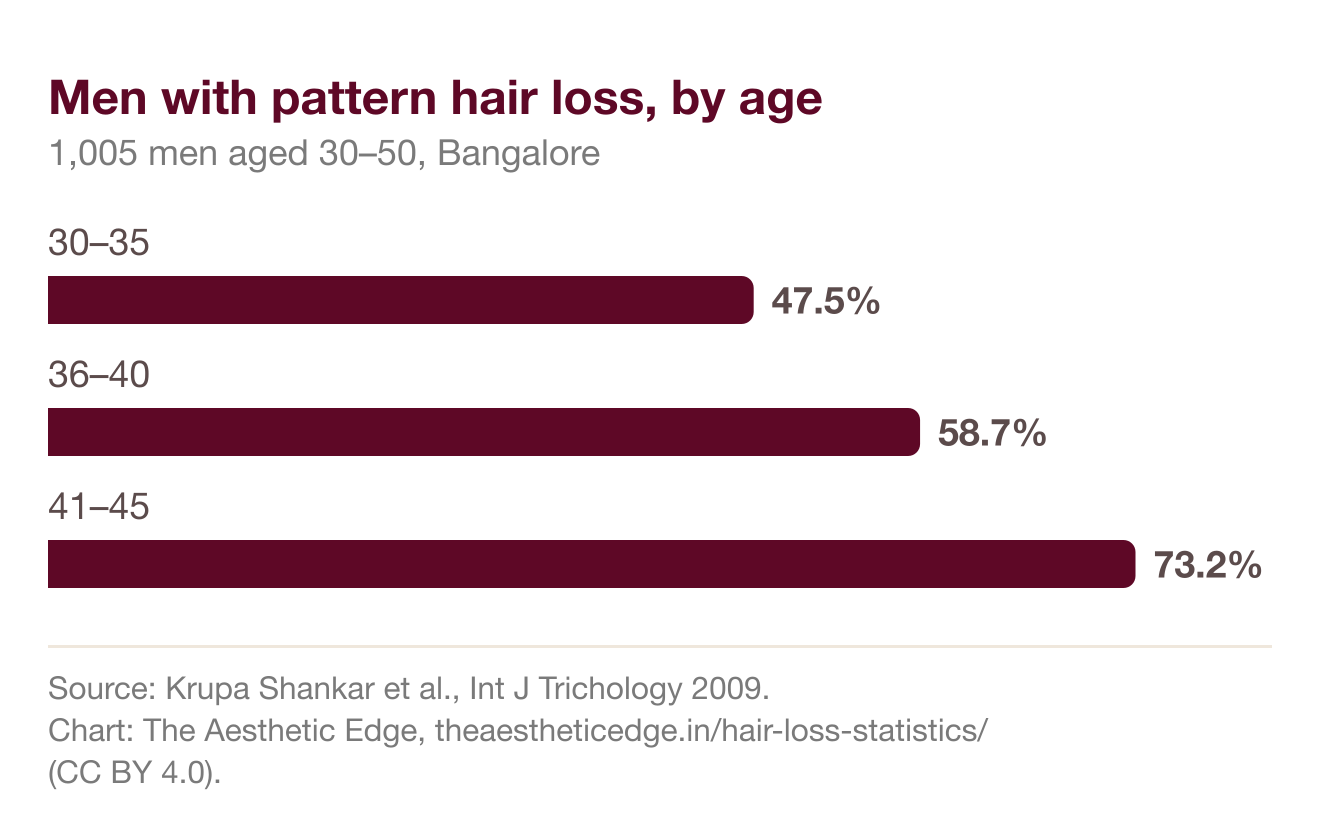
In the same study, 73.2% of men aged 41–45 had it, against 47.5% of men aged 30–35.[1]
12.9% of the men studied had advanced hair loss, Norwood grades IV to VI.[1]
57% of women and 73.5% of men aged 80 and over had mid-frontal hair loss in an Australian population study.[2]
Alopecia areata affects 2.11% of people across all studies pooled, and 0.75% in population-based studies.[3]
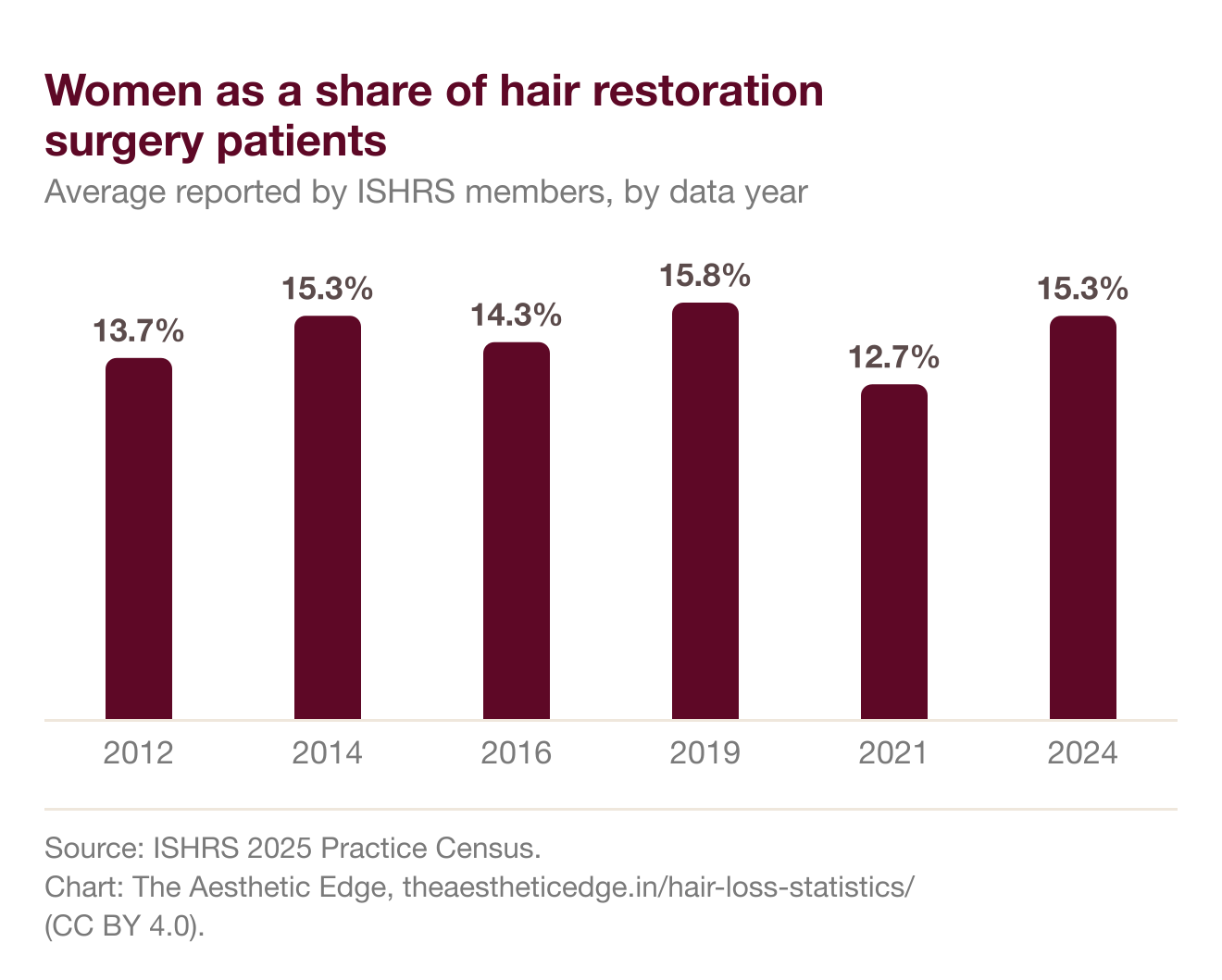
15.3% of hair restoration surgery patients in 2024 were women, up from 12.7% in 2021.[4]
38.3% of non-surgical hair restoration patients treated by ISHRS members in 2024 were women.[4]
59% of ISHRS surgeons report black-market hair transplant clinics in their city, up from 51% in 2021.[5]
How common is male pattern hair loss in India?
In a study of 1,005 men aged 30–50 in Bangalore, 58% had male pattern hair loss (androgenetic alopecia).[1]
The men were selected at random as they entered Manipal Hospital, Bangalore, including patients, attendants, doctors and staff but not dermatology patients, and their scalps were graded on the Hamilton-Norwood scale. 583 of the 1,005 had pattern hair loss. No national survey of hair loss in India was found.[1]
How does male pattern hair loss change with age?
In the Bangalore study, male pattern hair loss rose from 47.5% of men aged 30–35 to 58.7% at 36–40 and 73.2% at 41–45.[1]
| Age group | Men examined | With pattern hair loss | Prevalence |
|---|---|---|---|
| 30–35 | 394 | 187 | 47.5% |
| 36–40 | 346 | 203 | 58.7% |
| 41–45 | 261 | 191 | 73.2% |
| 46–50 | 4 | 4 | 100.0% |
| All ages | 1,005 | 583 | 58.1% |
Only four men were in the 46–50 group, too few to read anything into; the chart leaves it out. The paper's table gives 58.1% overall and its abstract rounds this to 58%.
How advanced is hair loss in men in their 30s and 40s?
In the Bangalore study, 44.1% of men had early-stage hair loss (Norwood grades I to III) and 12.9% had advanced hair loss (grades IV to VI).[1]
| Severity | Share of men studied |
|---|---|
| Early stage, Norwood grades I to III | 44.1% |
| Advanced, Norwood grades IV to VI | 12.9% |
How common is female pattern hair loss?
In an Australian population study, 57% of women and 73.5% of men aged 80 and over had mid-frontal hair loss, which became more common with age.[2]
The 2005 study surveyed adults in Maryborough, Victoria: 1,456 answered a postal questionnaire and 396 were examined. 64.4% of the women had some bitemporal (temple) hair loss. No population study of female pattern hair loss in India was found.[2]
| Measure | Women | Men |
|---|---|---|
| Mid-frontal hair loss, aged 80 and over | 57% | 73.5% |
| Bitemporal hair loss, all ages | 64.4% | 98.6% |
How common is alopecia areata?
A 2020 meta-analysis put the pooled prevalence of alopecia areata at 2.11%, falling to 0.75% when only population-based studies are counted.[3]
Clinic-based studies, which count people already seeing a doctor, gave 3.47%. Prevalence was lower in adults (1.47%) than in children (1.92%), and studies published after 2009 reported a higher rate (3.22%) than those before 2000 (1.02%).[3]
| Study group | Pooled prevalence |
|---|---|
| All studies | 2.11% |
| Population-based studies | 0.75% |
| Clinic-based studies | 3.47% |
| Adults | 1.47% |
| Children | 1.92% |
| Studies before 2000 | 1.02% |
| Studies 2000–2009 | 1.76% |
| Studies after 2009 | 3.22% |
| Alopecia totalis | 0.08% |
| Alopecia ophiasis | 0.02% |
| Alopecia universalis | 0.03% |
Meta-analysis of 94 studies.
Who has hair restoration surgery?
84.7% of hair restoration surgery patients treated by ISHRS members in 2024 were men and 15.3% were women.[4]
For non-surgical hair restoration, the split was 61.7% men and 38.3% women. The share of surgical patients who were women has moved between 12.7% and 15.8% in every census since 2012.[4]
| Data year | Share of surgical patients who were women |
|---|---|
| 2012 | 13.7% |
| 2014 | 15.3% |
| 2016 | 14.3% |
| 2019 | 15.8% |
| 2021 | 12.7% |
| 2024 | 15.3% |
Census years are irregular; each figure is the average reported by responding ISHRS members.
| Patient type | Men | Women |
|---|---|---|
| Surgical | 84.7% | 15.3% |
| Non-surgical | 61.7% | 38.3% |
How many hair loss patients does a hair restoration surgeon treat?
An average ISHRS member treated 668 hair restoration patients in 2024: 156 surgical and 498 non-surgical.[4]
| Measure | 2024 |
|---|---|
| Surgical patients | 156 |
| Non-surgical patients | 498 |
| All hair restoration patients | 668 |
| Hair restoration surgeries in the year | 178 |
| Hair restoration surgeries per month | 15 |
Averages are calculated separately, so surgical and non-surgical patients do not sum exactly to the total.
At what age do people have their first hair transplant?
57.6% of ISHRS surgeons said their patients were on average 26–35 years old at their first hair restoration surgery, and 37.3% said 20–25.[4]
ISHRS's press release summarises this as 95% of patients starting surgery between 20 and 35. The census question asked each surgeon for their patients' average age at first surgery, so the figures describe surgeons' typical patients, not every patient.[5][4]
| Average age at first surgery | Share of surgeons |
|---|---|
| Under 20 | 1.7% |
| 20–25 | 37.3% |
| 26–35 | 57.6% |
| 36–45 | 2.8% |
| 46–60 | 0.6% |
How widespread are black-market hair transplant clinics?
59% of ISHRS surgeons reported black-market hair transplant clinics in their city in the 2025 census, up from 51% in 2021.[5]
Repairs of earlier black-market transplants made up 10% of their cases on average, up from 6% in 2021. ISHRS links the problem to surgery being delegated to unlicensed, untrained people who are not doctors.[5]
| Measure | 2021 | 2025 census |
|---|---|---|
| Surgeons reporting black-market clinics in their city | 51% | 59% |
| Average share of cases that repair a black-market transplant | 6% | 10% |
How reliable are these numbers?
None of them is a national estimate for India: the hair loss figures come from one Bangalore hospital and one Australian town, and the ISHRS figures are averages reported by the surgeons who answered its census.[1][2][4]
ISHRS received 247 responses from 946 members with valid email addresses, a 26% response rate, and states a margin of error of plus or minus 5.4 percentage points at 95% confidence.[4]
| Source | Who was studied | Sample |
|---|---|---|
| Krupa Shankar et al., 2009 | Men aged 30–50 entering Manipal Hospital, Bangalore | 1,005 men |
| Gan & Sinclair, 2005 | Adults in Maryborough, Victoria, Australia | 1,456 questionnaires, 396 examined |
| Lee et al., 2020 | Meta-analysis of published studies | 94 studies |
| ISHRS 2025 Practice Census | ISHRS physician members | 247 of 946 (26%) |
How do I cite or reuse this data?
Cite this page, and the original source of any figure you quote. The numbered sources below link to each one.
The Aesthetic Edge. “Hair Loss Statistics: India and Global Data.” Last updated 6 October 2026. https://theaestheticedge.in/hair-loss-statistics/
The charts and text on this page are licensed under CC BY 4.0: you may republish them, including commercially, if you credit The Aesthetic Edge and link to this page. The credit line is built into every chart image. The figures themselves belong to the publishers listed under Sources, and their own terms apply, so credit them too.
Spotted an error? Tell us through our contact page and we will check it against the source.
Sources
- International Journal of Trichology. Krupa Shankar DS, Chakravarthi M, Shilpakar R. Male androgenetic alopecia: population-based study in 1,005 subjects. Int J Trichology 2009;1(2):131–133. doi:10.4103/0974-7753.58556. Published 2009. https://pmc.ncbi.nlm.nih.gov/articles/PMC2938575/ (accessed 6 October 2026).
- Journal of Investigative Dermatology Symposium Proceedings. Gan DC, Sinclair RD. Prevalence of male and female pattern hair loss in Maryborough. J Investig Dermatol Symp Proc 2005;10(3):184–189. doi:10.1111/j.1087-0024.2005.10102.x. Published 2005. https://pubmed.ncbi.nlm.nih.gov/16382660/ (accessed 6 October 2026).
- Journal of the American Academy of Dermatology. Lee HH, Gwillim E, Patel KR, et al. Epidemiology of alopecia areata, ophiasis, totalis, and universalis: a systematic review and meta-analysis. J Am Acad Dermatol 2020;82(3):675–682. doi:10.1016/j.jaad.2019.08.032. Published 2020. https://pubmed.ncbi.nlm.nih.gov/31437543/ (accessed 6 October 2026).
- International Society of Hair Restoration Surgery (ISHRS). ISHRS 2025 Practice Census Results (data for 2024), prepared by Relevant Research Consulting. Published 2025. https://ishrs.org/wp-content/uploads/2025/05/report-2025-ishrs-practice-census_05-12-25-final.pdf (accessed 6 October 2026).
- International Society of Hair Restoration Surgery (ISHRS). New Survey Finds Younger Adults, More Women Seeking Treatment for Hair Loss (press release, 13 May 2025). Published 13 May 2025. https://ishrs.org/2025-practice-census-results/ (accessed 6 October 2026).
Related at The Aesthetic Edge
Get a doctor's read before you decide anything
₹500 consultation, waived off against your treatment. Indiranagar or Bellandur — closed Wednesdays.
General information, not medical advice — your treatment is decided at an in-person consultation. Terms & Conditions