
Combining Root Canal Treatment (RCT) and Bridges & Crowns: Order, Spacing and Why
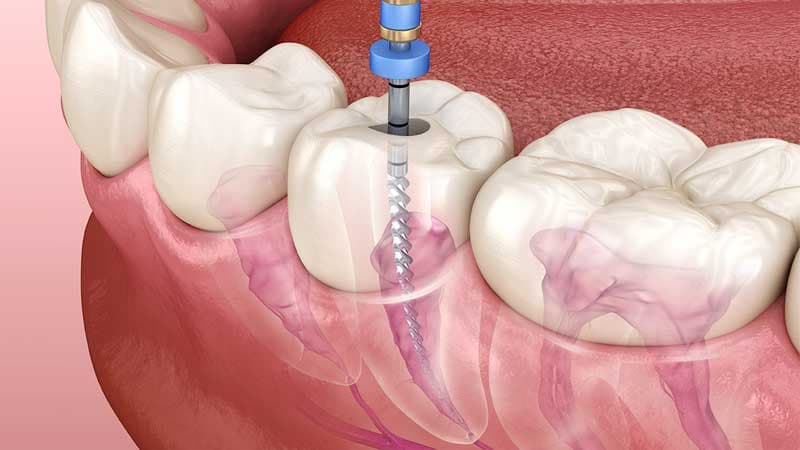
The root canal always comes first and the crown follows it. Removing the infected pulp deals with the problem inside the tooth; the crown rebuilds and protects what is left, because a root-treated tooth is more brittle than it was and back teeth take heavy chewing forces. Expect the root canal in one visit where the case is straightforward, then two more for the crown.
There is no version of this where the order is a matter of preference, and that is worth saying plainly, because patients often arrive assuming the crown is an optional extra being sold to them. It is the part of the plan that determines how long the work lasts.
Why does a crown usually follow a root canal at all?
Because of what the treatment necessarily removes. The pulp is the tooth's living core, and taking it out is what resolves the infection — but the tooth loses its blood supply along with it. A tooth in that state can fracture under load, and a root that splits often cannot be rescued, which puts you back to extraction and replacement.
A crown addresses this directly. It caps the tooth, holds the remaining structure together and spreads the force of chewing across the whole restoration rather than concentrating it on weakened walls. The treatment information for crowns and bridges lists a root-treated tooth among the situations a crown exists for, alongside cracked and heavily filled teeth.
There is a second, quieter reason. The nerve that used to tell you when you were biting too hard is gone. You will not get a warning before something gives way.
Does every root-treated tooth need one?
Not automatically — a filling or a crown may restore the tooth, and which one is right depends on the tooth and on how much sound structure survives.
For back teeth the answer is usually a crown, because that is where the chewing load lives. Front teeth, and teeth where a good deal of healthy structure remains, can be a different conversation. The evaluation covers exactly this: whether what is left of the tooth can carry a crown at all, and what material and shade suit its position. That is decided by examination, not in advance.
What is the actual order of appointments?
Four stages, though not always four visits.
- Assessment. Examination and X-ray to confirm the pulp is inflamed or infected and that a root canal is the right treatment.
- The root canal. Local anaesthesia, a small access opening, the pulp removed, the canals cleaned, disinfected, filled and sealed. Around 60 to 90 minutes for a single-visit case. Teeth with complex or curved canals, or an active infection, may need a second appointment before sealing.
- Crown preparation. Under local anaesthesia the tooth is reshaped to make room for the crown, and an impression or digital scan goes to the laboratory. A temporary crown is fitted to protect the prepared tooth.
- Crown fitting. The temporary comes off, the finished crown is tried in and checked for fit, contact and shade, adjusted against your bite, and cemented.
So the common shape is one visit for the root canal and two for the crown. Where the root canal itself needs splitting, add one.
How long should I leave between the root canal and the crown?
That interval is set at your consultation rather than being a fixed number, and it depends on the tooth, on whether the dentist wants to see how it settles, and on the laboratory's schedule for the finished crown.
What is not variable is the principle: the gap is meant to be planned, not open-ended. Between the root canal and the permanent restoration the tooth is unprotected, so keep chewing off that side, and treat the restoration appointments as part of the treatment rather than as a follow-up you might get round to. This is the stage at which people drift — the pain that drove them in has gone, life resumes, and the tooth quietly waits in a vulnerable state.
What is the preparation visit actually like?
Similar in feel to the root canal and usually shorter. The area is numbed, which is worth knowing because people brace for a crown and are surprised it is uneventful. The tooth is reshaped, the scan or impression is taken, and the temporary goes on before you leave.
Two honest points about it. Reshaping removes tooth structure permanently — that enamel does not return, and the tooth will need a restoration from then on. And the temporary is cemented lightly by design, so avoid sticky and hard food on that side, and telephone the clinic if it comes away rather than waiting for the fitting appointment.
What if the tooth turns out not to be savable?
Then the conversation changes from restoring a tooth to replacing one, and a bridge is one of the options — the replacement tooth carried by crowns on the teeth either side of the gap.
It is worth going into that discussion knowing the trade-off, because it is real: a bridge means preparing the neighbouring teeth, and if those teeth are currently sound, that is healthy structure being cut into. An implant avoids it. Your dentist should set out both for your particular gap rather than defaulting to either.
What does the pair cost?
Root canal treatment starts from ₹2,999 per tooth. The crown is a separate restoration and is quoted after the tooth has been examined, because how much sound structure remains genuinely changes what is involved — we do not publish a combined figure for the two. The consultation is ₹500, waived against treatment.
Ask for both halves to be quoted at the same time. Budgeting for the root canal alone is how the crown gets deferred.
What does the finished tooth need afterwards?
Ordinary care, applied properly. A crowned tooth still decays at the margin where the crown meets the tooth, so brushing and cleaning between the teeth matter as much as before. If you end up with a bridge rather than a single crown, cleaning underneath it needs a floss threader or an interdental brush — normal flossing cannot reach, and you will be shown the technique at the fitting.
Once the permanent restoration is cemented and the bite adjusted, the tooth goes back to normal use. That is the whole aim of doing both halves.
Detail on each is on the root canal treatment page and under bridges and crowns. To have a tooth assessed and both stages planned together, book an appointment.