
Combining Dental Implants and Bridges & Crowns: Order, Spacing and Why
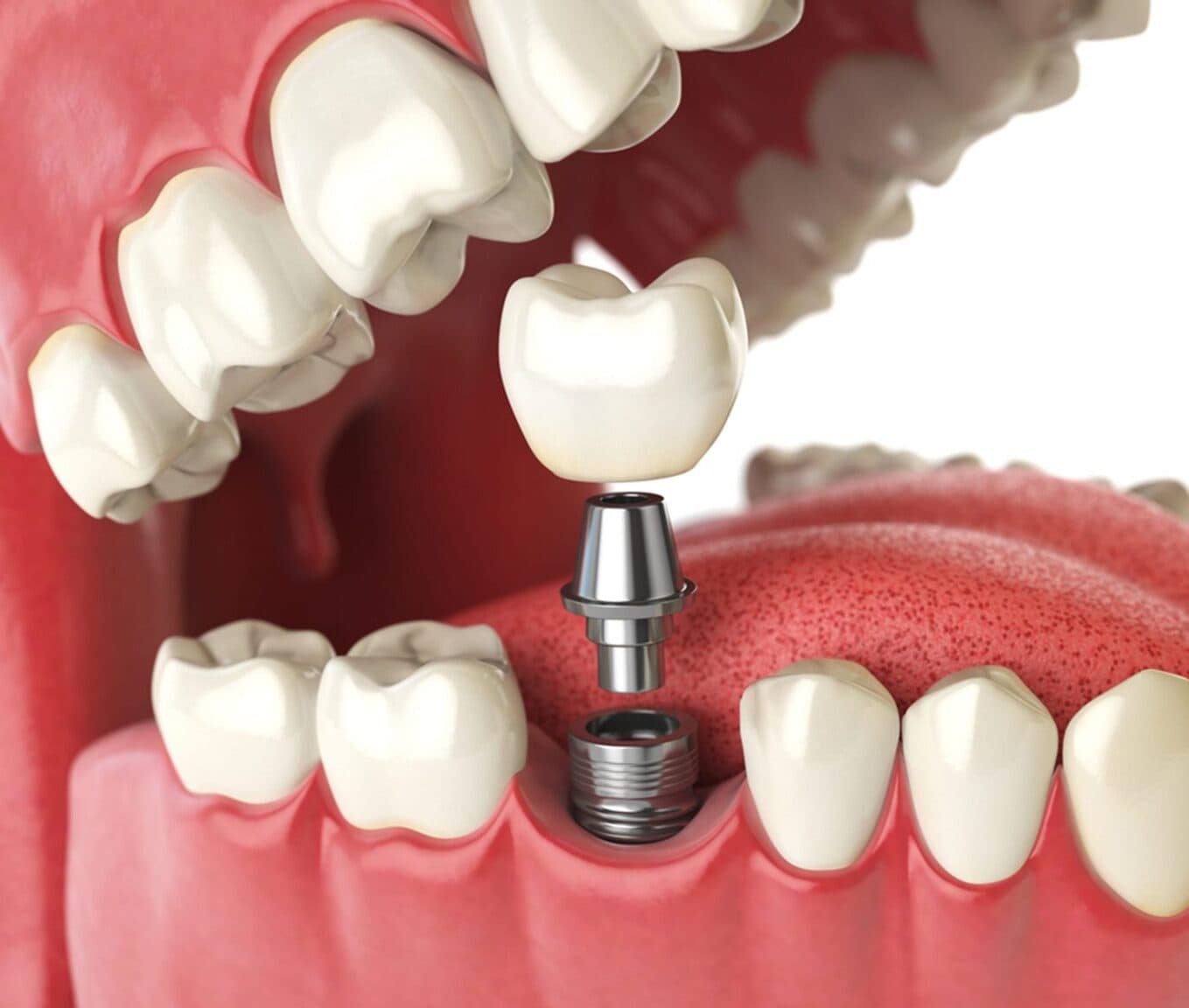
An implant and a crown are not alternatives — the implant is the root and the crown is the tooth that goes on it. The order is fixed by biology: assessment and imaging, then a plan, then the implant placed and left to fuse with the jawbone over several months, and only then the abutment and final crown.
Patients usually arrive asking which of the two they need. The more useful question is what order they happen in and how far apart, because that is what shapes the months ahead.
Are these two treatments, or one treatment in two halves?
One treatment, described in two places, because each half is also a treatment in its own right for different situations.
A dental implant has three parts. A titanium post, shaped like a small screw, is placed into the jawbone and left to fuse with it — the process called osseointegration. An abutment then connects that post to the visible part. The crown on top is what you see and chew with.
So the crown is not an extra you decide on afterwards. It is the third part of the thing, and without it the implant does no chewing at all. That is why the restoration is written into the treatment plan from the start alongside the number of implants, whether grafting is needed and the expected timeline.
Crowns and bridges also exist independently, for teeth you still have — a crown caps a weakened, cracked or heavily filled tooth, and a conventional bridge spans a gap using crowns on the teeth either side. Same components, different foundation.
What is decided first, and why does that matter?
The restoration is decided before the implant goes in, not after it heals. This is the sequencing point people find most surprising.
Assessment comes first: an examination plus X-rays or a CT scan, to confirm there is enough bone and to map the safe position for the implant. Then the plan, which covers the number of implants, the type of restoration, whether any grafting is needed, and the timeline.
The reason the order runs that way is that what goes on top determines what goes underneath. Implants can support a single crown, a bridge spanning several missing teeth, or a full arch — and the number of implants required, along with where they sit, follows from which of those you are having. Deciding the restoration late would mean deciding the implant positions blind.
Where does the crown come from if there is no tooth to reshape?
From the abutment. This is the real difference between a crown on an implant and a crown on one of your own teeth, and it is worth understanding because it changes what is permanent.
On a natural tooth, the tooth itself is reshaped under local anaesthesia to make room for the crown. That removal is permanent — the tooth structure does not grow back, and that tooth will always need a restoration afterwards. The same applies to the two teeth either side of a gap when they are prepared to carry a conventional bridge.
On an implant there is no natural tooth in that position to reshape. The abutment connects the post to the visible part, and the crown is made to sit on that. This is exactly why an implant leaves neighbouring teeth alone where a conventional bridge requires reshaping them — and it is the trade-off worth weighing if the teeth either side of your gap are currently sound.
What is the actual order of appointments?
Typically three to four visits across the full treatment, spread over several months, in this sequence:
- Assessment and imaging. Examination plus X-rays or a CT scan, to confirm there is enough bone and to map the safe position.
- Treatment plan. The number of implants, the type of restoration, whether any grafting is needed, and the expected timeline.
- Implant placement. The implant is placed into the jawbone under local anaesthesia. Sutures may be used, and the site is left to heal. Expect soreness and swelling for a few days, along with soft foods and avoiding that side for a short period while the site closes.
- Restoration and review. After osseointegration, the abutment and the final crown are fitted, the bite is adjusted, and the implant is reviewed at routine check-ups.
Where grafting is needed because the scan shows there is not enough bone to hold the implant securely, that adds its own stage and its own healing. Your dentist tells you at the planning appointment.
Why is there a wait in the middle, and can it be shortened?
The wait is the implant fusing with the jawbone, and no, it cannot be compressed on request.
The whole process usually takes several months precisely because the implant needs time to fuse before the final tooth is attached, and the exact timeline depends on bone quality and whether any grafting is needed. That period is doing the work that makes the implant a long-term replacement rather than a fixture sitting loosely in bone.
It is the single biggest planning difference from a conventional crown or bridge, which is usually two visits — preparation, then fitting — with the laboratory making the restoration in between. If you are having both kinds of work, those two rhythms are very different, and that is a real scheduling question rather than a detail.
Can a bridge sit on implants instead of on my own teeth?
Yes. Implants can support a bridge spanning several missing teeth, as well as a single crown or a full arch.
This is the combination most worth knowing about, because it changes the trade-off. A conventional bridge is anchored to the teeth on either side of the gap, which must be reshaped to take it — and if those teeth are sound, that means cutting into healthy teeth. A bridge carried on implants is anchored in the jawbone instead, so the neighbours stay as they are.
It is not automatically the right answer. A conventional bridge is quicker and does not involve surgery; an implant-supported one takes longer and needs sufficient bone. Your dentist sets out both for your specific gap, and the number of implants a span needs is decided at the planning stage rather than assumed from the number of missing teeth.
What if I need crowns on other teeth as well?
That is common — an implant for a gap, and a crown elsewhere for a tooth that is cracked, heavily filled or root-treated and at real risk of fracturing.
The two run to different clocks. A crown on a natural tooth is usually two visits, with a temporary in place while the laboratory works. An implant runs to several months. Neither core sets out a fixed rule for interleaving them, so how your particular sequence is staged is settled at your planning appointment rather than assumed here.
What is worth raising in that appointment is shade. Both an implant-supported crown and a conventional one are shaped and shaded against your own teeth, so if several restorations are being made at different times, say so and let your dentist plan for it.
Do I get something temporary in the meantime?
For prepared natural teeth, yes — a temporary crown or bridge protects the prepared tooth and maintains appearance and function while the final one is made. Temporaries are cemented lightly on purpose, so avoid sticky and hard foods on that side, and contact the clinic if one comes off rather than waiting.
For the implant site during the months of healing, the cores do not set out a standard temporary, so what you will have in that gap in the meantime is a question to ask at planning. If appearance during the healing period matters to you — and for a front tooth it usually does — raise it then rather than discovering the answer afterwards.
How do I clean it once it is finished?
An implant is cleaned like a natural tooth. There is no nightly soaking and no fixative.
Where the restoration is a bridge, the cleaning is different and it matters more than most people expect. Plaque collects beneath the false tooth and cannot be reached by ordinary flossing, so a floss threader, superfloss or an interdental brush is needed to clean underneath it. Without that, the supporting teeth are at risk of decay and gum disease. You are shown the technique at the fitting appointment — pay attention to that part of the visit.
Regular check-ups belong in this answer too. Implants are reviewed at routine check-ups, and both implants and crowns depend on good hygiene and those reviews to last.
What gets replaced first over the years?
The crown, not the implant.
Implants are intended as a long-term replacement rather than something replaced every few years, while the crown on top may need replacing sooner than the implant itself. Crowns and bridges commonly last a decade or more with good hygiene and regular check-ups, with lifespan depending on the material, where in the mouth it sits, and whether you grind your teeth.
That is a genuinely useful thing to know before you start, because it reframes what you are buying: a foundation intended to stay, and a visible part that is renewable on it.
What does it cost?
We do not publish a price for implants or for crowns and bridges, because the figure follows the plan — how many implants, what restoration, whether grafting is needed, which material, and over how many visits.
The consultation is ₹500 and is waived off against treatment if you go ahead. You will have a plan and a figure for it before any treatment starts.
Where to go next
If the gap is your main concern, start with the dental implants page. If you also have teeth that are breaking down and need protecting, read bridges and crowns alongside it — in most combined plans, both are involved.
What neither page can do is tell you what your own jaw will support. Bone and gum condition decide what is possible, and those are established by an examination and imaging rather than by reading. When you are ready, book an appointment.