
What Is Microneedling with Dermapen? A Plain-English Explanation
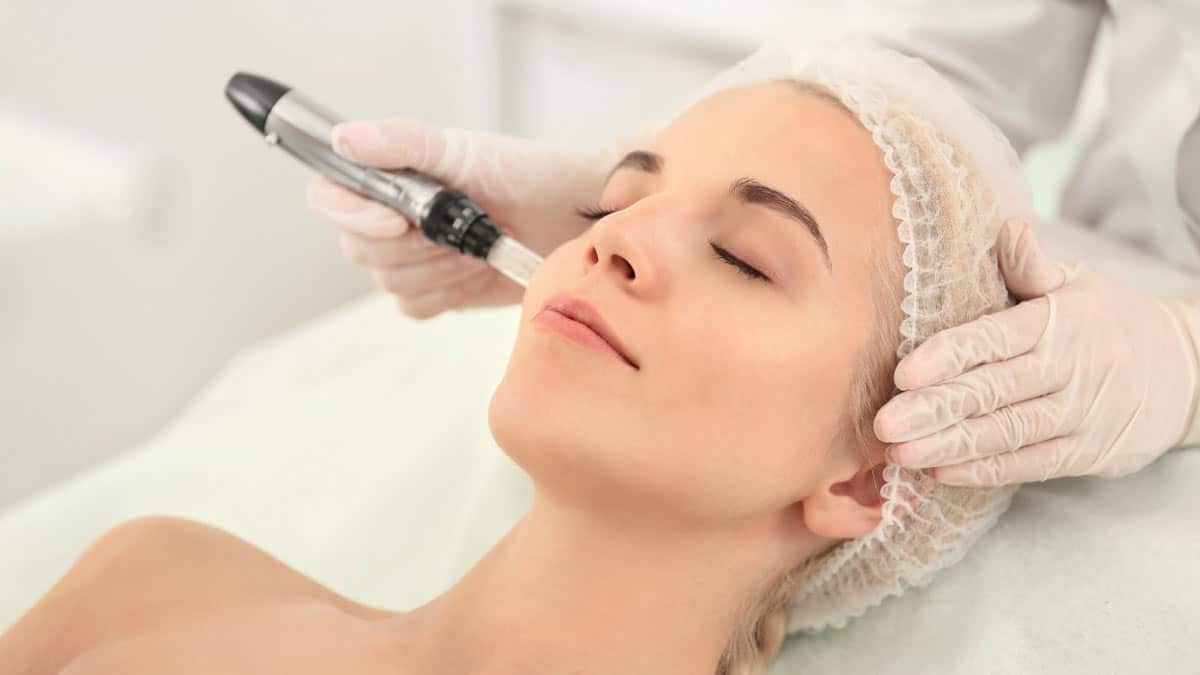
Microneedling with a Dermapen is a doctor-performed treatment that uses very fine needles to create controlled micro-channels in the skin. Those tiny, deliberate injuries prompt your skin to repair itself by laying down new collagen and elastin. It is used for acne scarring, open pores, uneven texture, stretch marks and fine lines, and the result builds across a course of sessions.
That is the whole idea in one paragraph. The rest of this article is the detail you would otherwise have to ask for across three appointments.
What actually happens during a session?
Four things, in order.
Your doctor examines the area being treated — the scarring, the pores, the stretch marks — checks for anything that rules microneedling out, and sets how many sessions your concern is likely to need. The area is then deep cleansed and a topical anaesthetic is left on for fifteen to twenty minutes, which is what makes the session itself comfortable rather than something to brace against.
The Dermapen pass comes next. The device creates controlled micro-channels at a depth chosen for the concern — shallower for texture and tone, deeper for scarring. That choice is the treatment. The same pen, set differently, is doing a different job.
Then you heal. Redness and flaking settle over about a day, and sessions are spaced to let collagen remodelling finish between them, usually across several months.
What does it treat?
Acne scars, open pores, uneven texture, stretch marks and fine lines.
Those five are worth separating out, because they are not all the same kind of problem. Acne scarring and stretch marks are both scars sitting in the deeper layer of the skin; controlled micro-injury prompts the skin to rebuild through a scar rather than over it, which is why they respond to needling where creams do not. Open pores and rough texture improve because repeated collagen remodelling tightens the skin around them over a course. Fine lines sit with the collagen and elastin rebuilding that the depth is set to reach.
Patients also describe a brightening as the surface renews and dull skin and shallow pigmentation lift. That is real, but it is a by-product of the remodelling rather than the reason to book.
The point worth holding on to is that nothing synthetic is placed in the skin. Nothing is injected, and nothing is stripped away. The improvement comes from your own repair response, which is why it builds gradually and why it holds.
Is a Dermapen different from other microneedling?
It is a motorised pen with a sterile, single-use tip, which is what allows the depth to be set precisely and kept consistent across an area. That matters more than the brand name on the handle.
It is worth saying plainly that this is a needling device and nothing else. It does not emit light or energy into the skin. If what you are reading talks about how your skin absorbs energy, you are reading about lasers — a different category of treatment with a different set of considerations.
Does it hurt?
It is designed to be comfortable. Topical anaesthetic is applied for fifteen to twenty minutes beforehand, and most patients describe mild pressure or a scratchy sensation rather than pain.
Deeper settings, used for scarring, are felt more than shallow ones. Tell your doctor during the session rather than afterwards — the setting is adjustable.
How long is the downtime?
Short. Expect redness, mild swelling and some flaking, usually settling within a day. Occasional light bruising is also normal, particularly at deeper settings.
Plan around two days without strenuous exercise, and keep sunscreen on throughout. The single most important part of aftercare is sun protection: freshly needled skin burns easily and pigments easily, so SPF 50 or higher every day is not optional. The micro-channels also stay open for a few hours, so the face is not washed for the first four hours and the antiseptic cream you are given is used as instructed. That is what keeps the infection risk low.
How many sessions, and when will I see a change?
Typically six to eight, though it depends entirely on what is being treated — deep acne scarring needs more sessions than general texture and tone. Your doctor sets the plan at consultation.
Many patients see a visible change from the first session, but the real improvement is cumulative. Collagen remodelling continues for weeks after each treatment and builds across the course. Nobody can honestly compress that timeline, and a clinic offering to is telling you something about the clinic rather than about your skin.
Can it be done on the body?
Yes. Stretch marks on the abdomen, thighs and arms are commonly treated. Body skin heals more slowly than facial skin, so sessions there are spaced a little further apart.
What should make me contact the clinic?
Most recoveries are unremarkable. Because the skin has been deliberately opened, though, there are a few things worth a phone call rather than a wait-and-see — and this is a list of reasons to ring us, not a list of things to interpret yourself:
- Redness, swelling or tenderness that is getting worse after the second day instead of settling
- Pain that increases rather than fades
- Any discharge, or yellow crusting over the treated area
- Any clustered blistering, or tingling that comes before it
- A fever in the days after a session
- Skin that darkens beyond the expected flaking, or a treated patch that starts behaving differently from the skin around it
None of those means anything on its own, and you should not try to work out which of them matters — that is the doctor's job and it takes a look at the skin. Call the branch that treated you, at Indiranagar or Bellandur, and say what you are seeing. Do not put anything new on the area in the meantime, including a product a search result recommends.
Who should not have it?
Microneedling is avoided in pregnancy and breastfeeding, and where there is active acne, active herpes, or a moderate-to-severe chronic skin condition such as eczema or psoriasis in the area. Any of those is a reason to treat something else first, or to take a different route entirely. It is safe for most people when performed under medical supervision with sterile single-use tips, and at both our clinics it is performed by a doctor, always.
How does it compare with a peel or with PRP?
Two things people usually weigh it against.
A chemical peel works at the surface, lifting away spent cells so fresher skin comes through. It is a good answer for marks, dullness and congestion. Microneedling works in the layer underneath, which is where scars and stretch marks actually live. The two answer different questions, and the depth and solution of a peel is itself a doctor's decision.
PRP, sometimes called a vampire facial, is microneedling with your own platelet-rich plasma used in place of a standard serum — a small blood sample, spun to concentrate the platelets, returned to your skin. Whether it adds anything for your concern is a consultation question, not a menu choice.
What does it cost, and what is the first step?
Microneedling with Dermapen starts at ₹3,999 per session at both Indiranagar and Bellandur. We publish a per-session price rather than a course total, because the number of sessions depends on what is being treated and that is settled after a doctor has looked at your skin.
The consultation is ₹500, waived off against treatment. Bring a note of anything you have already tried and any skin condition or medication you are on, and book an appointment at whichever branch is easier for you. If microneedling with Dermapen turns out not to be the right tool for your concern, the consultation is where you find that out.