
What Is Exosome Hair Treatment? A Plain-English Explanation
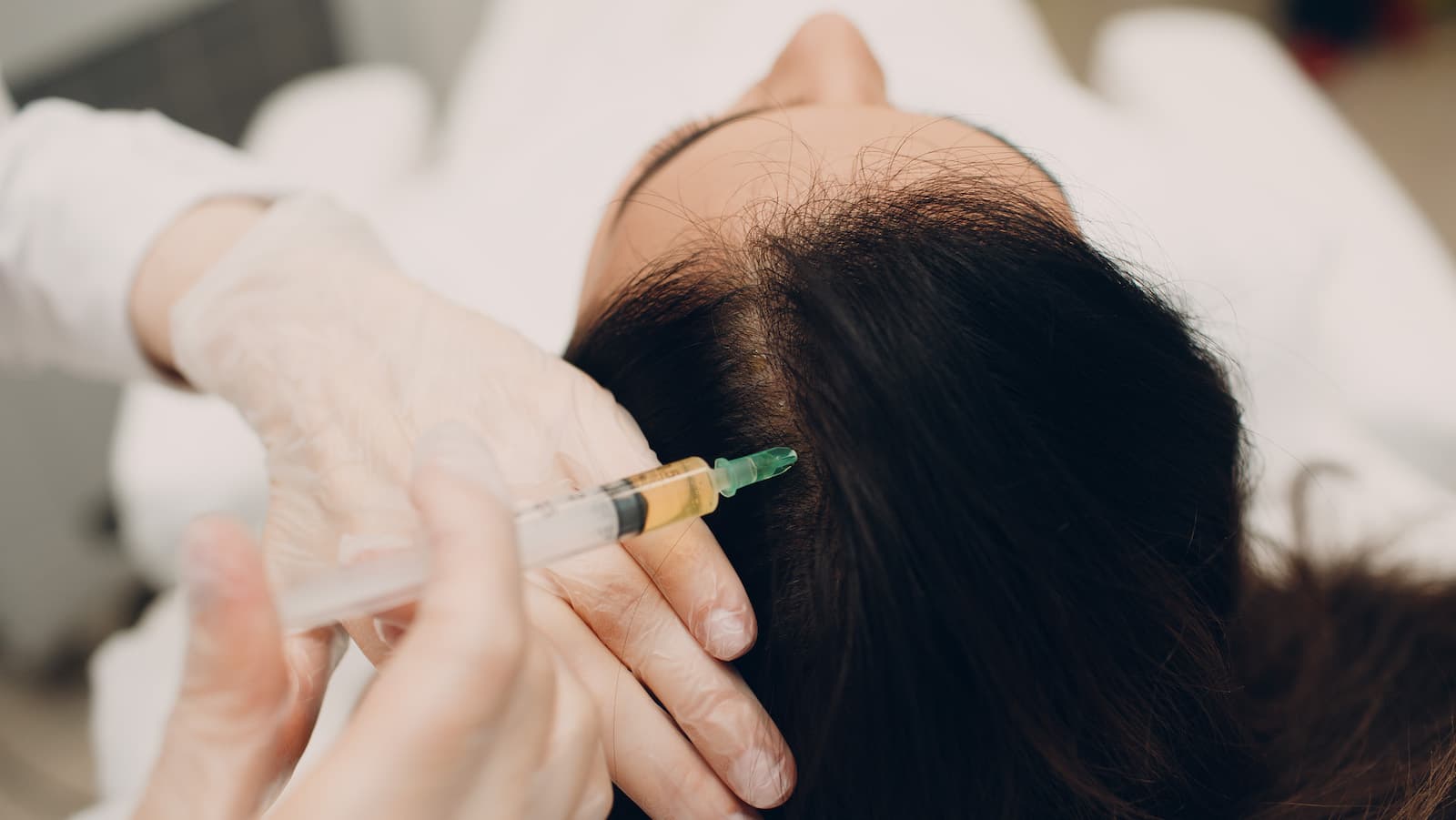
Exosome hair treatment delivers lab-prepared exosomes — tiny vesicles carrying growth factors and signalling molecules — into the scalp through fine micro-injections, to signal follicles that are thinning but still active. There is no blood draw, because the preparation is made in a laboratory rather than from you. A course is typically three to four sessions, around four weeks apart.
What is an exosome actually made of?
A membrane, and a payload of chemical messages. Nothing more exotic than that, and importantly, no cells.
Cells communicate constantly by releasing small packets into the space around them. An exosome is one of those packets: a bundle of growth factors and signalling molecules wrapped in a membrane, small enough to move between cells and be read by whatever picks it up. The preparations used in exosome hair treatment are made in a laboratory, most commonly from stem-cell culture lines, then processed and screened by their manufacturer.
The distinction that matters clinically is that nothing is being transplanted and nothing is being grown on your scalp. What is delivered is the instruction set — the signal a healthy cell would send — placed where thinning follicles can receive it.
What happens in a session, start to finish?
Roughly 45 to 60 minutes, most of which is waiting for numbing cream to work.
Anaesthetic cream is applied and left for 30 to 45 minutes while the lab-prepared vial is readied. The exosome preparation is then delivered across the thinning areas with fine needles, which takes about 20 to 30 minutes in total. Every session is performed by a doctor.
Most patients describe pressure rather than pain, given the numbing. Afterwards there is no downtime — you can go back to normal activity the same day, with strenuous exercise, swimming and direct sun avoided for two days and hair products for six hours.
Why is there no blood draw?
Because the source is a laboratory rather than your own circulation, and that is the practical difference patients notice most.
Other in-clinic regrowth treatments begin by taking a small sample of your blood and processing it. PRP concentrates platelets from that sample; GFC prepares a growth factor concentrate from it. Both are then returned to your scalp. Exosomes skip that step entirely: there is no sample, no centrifuge stage, and the session is correspondingly shorter and simpler.
There is a second difference worth stating honestly, because it cuts both ways. Exosome preparations carry growth factors and signalling molecules at a higher concentration than a blood-derived preparation typically reaches. Against that, PRP and GFC have been in clinical use for longer, and the research base behind exosomes is newer and still growing. Neither of those facts settles which is right for you. That is decided at consultation, after somebody has looked at your scalp.
What can it realistically do, and what can it not?
It signals follicles that still exist. It cannot rebuild ones that are gone, and no honest description of it should imply otherwise.
Exosome signalling acts on follicles that are weakened but still active, in both men and women, which is why earlier and moderate thinning is where it makes most sense. If your parting has widened but there is still hair there — finer than it was, but present — that is the situation this treatment is designed for. Areas that have been fully bare or scarred for years are not, and a doctor should tell you that at assessment rather than after you have paid for a course.
Regrowth cannot be promised where too little active follicle remains. That is a plain limit of the biology, not a caveat added by a legal department.
How long before anything shows?
Reduced shedding usually comes first. Visible density takes months, and there is a physical reason for that.
Hair grows at roughly a centimetre a month regardless of what the follicle is signalled with. Nothing injected into a scalp changes that rate, so no clinic can honestly promise a visible difference in 30 days. Scalp photographs are taken before the first session and compared at a review at around three months — which is when there is genuinely something to compare, and which is also why the photographs matter more than anyone's recollection of how things looked in January.
The course itself is three to four sessions spaced about four weeks apart. That number is a starting plan rather than a fixed commitment; it is reviewed against your baseline photographs and adjusted from there.
What are the side effects?
Mild and short-lived, and they are all local to where the needles went.
Redness and tenderness at the injection points are the most common, settling within a day or two. Some patients notice scalp itching or a feeling of tightness for a couple of days — avoid scratching, and a gentle shampoo helps. Small bruises are uncommon with fine needles, and more likely if blood-thinning medication was not paused as instructed; they fade within days.
The one that is not a physical effect belongs here anyway, because burying it would be dishonest: exosome therapy is newer than blood-derived scalp treatments, and long-term outcome data is still accumulating. This clinic treats that as a reason for a careful candidacy assessment, not as a detail to leave off the page.
Who should not have it?
Anyone whose thinning areas have been bald or scarred for years, for the reason above. It is also not carried out during pregnancy or breastfeeding, where there is an active scalp infection, or alongside certain medications.
And there is a broader point that applies before any of those. Hair thinning has many causes — some medical, some nutritional, some hormonal, some inherited — and which one is driving yours is established by a doctor examining your scalp and taking your history. It cannot be worked out from an article, a photograph or a family resemblance. That examination is the first step of the treatment, not a sales formality preceding it.
What does it cost, and what should you ask?
There is no single published figure, because there is no single course. The number of sessions your scalp actually needs, and the area being treated, are what set the cost, and both come out of the assessment.
Worth asking in the room: which specific exosome product is being used, where it is sourced from and how it is screened — all of which the clinic discusses openly — and whether your scalp assessment supports exosomes over the alternatives at all. Exosome sessions can often sit alongside prescribed medication or other in-clinic regrowth treatments, sequenced so the scalp is not overloaded, so bring whatever you currently use, including anything bought over the counter.
Consultations are ₹500, waived against treatment. Book an appointment if you want a straight answer about whether your follicles are still in a position to respond.