
Mesotherapy for Hair: What Is Actually in It, and How It Differs
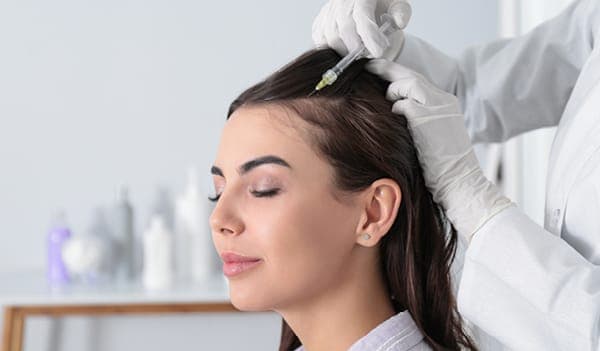
Scalp mesotherapy delivers a customised blend of vitamins, minerals and amino acids directly into the layer of skin where the hair follicles sit, using very fine microinjections. The blend is mixed for your scalp based on what your examination and blood work show, rather than taken off a shelf. That is the whole proposition, and it is what separates it from the other scalp injectables people compare it against.
If you have been reading about several of these treatments and they have started to blur together, the useful question is not which is better. It is what each one actually puts into your scalp, and which of those your examination points to.
What is in the blend, and can I know?
Vitamins, minerals and amino acids, combined according to what your assessment picks up. And yes — you can ask to be told exactly what is being used before the session, which is a reasonable question and worth asking.
That customisation is the point rather than a flourish. Mesotherapy for Hair is built around the idea that the blend follows the findings. Two patients with similar-looking thinning can have different deficiencies behind it, and the cocktail is meant to reflect that rather than being identical for everyone who walks in.
This is also why blood work tends to come up before the first session. If something correctable is showing in your results, that belongs in the plan rather than being treated around.
Why inject it rather than apply something to the scalp?
Because of where it needs to land. The microinjections place the solution into the layer of skin around the hair root — which a topical serum applied to the surface cannot reliably reach.
That is the mechanical argument for the treatment, and it is a narrow one worth understanding on its own terms. The delivery is what the injections are buying you. Fine needles or a mesotherapy gun are used, a session runs around 20 to 30 minutes, and it is performed by a doctor, always.
So how does it differ from the other scalp injectables?
By what is being delivered. Mesotherapy delivers a nutrient blend compounded for you. The treatments it gets compared with work on a different principle altogether — they are not nutrient cocktails, and each has its own page setting out how it actually works.
GFC Hair Loss Treatment and PRP Hair Regrowth Treatment are worth reading on their own terms rather than through a comparison table. What matters for your decision is that they are not interchangeable with mesotherapy, and the choice between them is made at examination rather than from a description online.
The genuinely useful framing is that these are different answers to different findings. A scalp where deficiency is part of the picture points somewhere different from one where it is not — and that is a question your assessment answers, not an article.
Is mesotherapy a complete answer on its own?
No, and the treatment page says so plainly. Mesotherapy is often used to support a broader hair fall plan that also includes topical or oral medical therapy, rather than as a standalone answer.
That is worth taking at face value. If someone offers you a course of scalp injections as the entire solution without a wider plan around it, that is a reason to ask more questions rather than fewer.
There is also a scalp-condition benefit that gets overlooked. Patients frequently report a less dry, less irritable scalp after a course, which matters more than it sounds — scalp health limits how far any hair treatment can go. An inflamed or irritated scalp is working against whatever else you are doing.
For a lot of our patients in Bangalore, that side of it lands. A helmet worn twice a day through a humid commute, the dust on the arterial roads, and hard water in a great many buildings all get mentioned in consultations. Whether any of them bears on your particular case is something the examination settles — but scalp comfort is a real complaint, not a cosmetic afterthought.
How many sessions, and how is progress judged?
A short course, spaced by your doctor. It depends on what is driving your hair fall and how you respond, so a fixed number is not promised at the outset.
Scalp photographs are taken before the first session, so change at review is measured rather than estimated. Protocols are reviewed at the three-month mark against those baseline photographs, and adjusted from there.
That review is the part to hold your clinic to. Hair grows slowly enough that memory is a poor witness, and a plan nobody ever re-examines is not a plan.
Does it hurt, and what happens afterwards?
The needles are very fine and most patients describe a brief stinging or prickling rather than pain. Numbing cream can be applied beforehand if you would prefer it.
Downtime is little to none. Mild redness, tightness or irritation of the scalp is common and typically subsides within a few days, and most patients go straight back to their day. Both our Indiranagar and Bellandur branches run it, so pick whichever you can reach repeatedly — a short course means several visits, and the branch you will actually keep returning to matters more than the one that sounds more convenient on paper.
What to ask at the consultation
Ask what is in the blend and why those ingredients for you. Ask what your blood work showed and whether anything in it needs correcting alongside this. Ask what else is in the plan besides the injections. And ask what happens at the three-month review if the photographs show little change.
To get those answered against your own scalp rather than in general terms, book an appointment at our Indiranagar or Bellandur branch. Bring any recent blood reports — they are genuinely part of how the blend is decided.