
What Changes the Cost of Bridges & Crowns in India
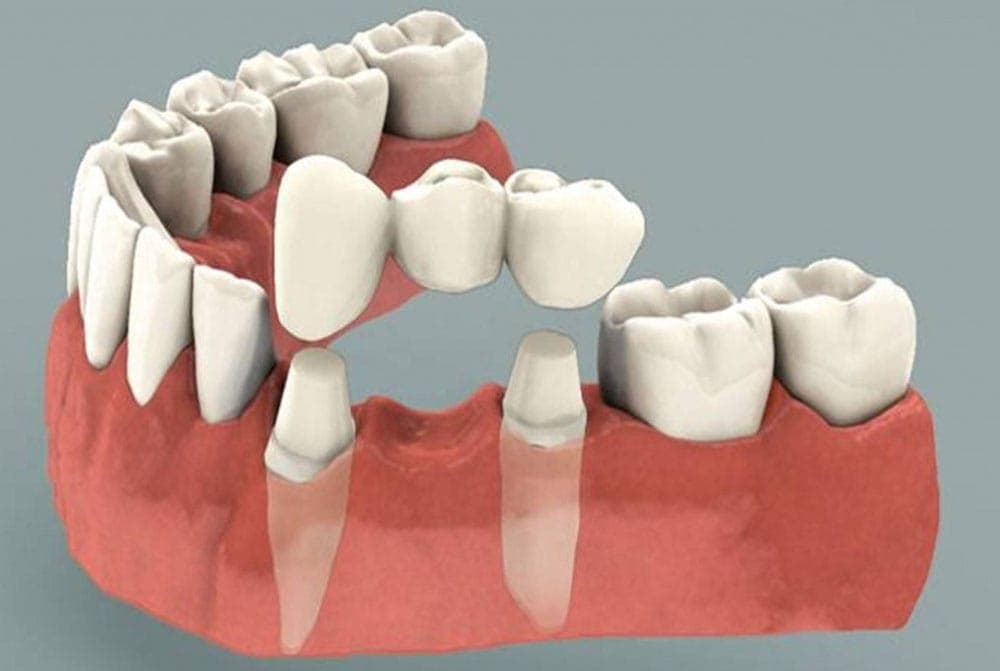
The largest single variable in what bridges and crowns cost is how many units are being made. A crown covers one tooth. A bridge for one missing tooth is normally three units — the replacement tooth plus a crown on each of the teeth either side, which carry it. After unit count, the material and any preparatory treatment the tooth needs first are what move the figure most.
That is why two people quoted for "a bridge" can be quoted very different numbers without either quote being unreasonable. They are not buying the same amount of work.
Why is one missing tooth usually three units?
Because of how a bridge is built. The replacement tooth does not stand on its own — it is carried by crowns cemented onto the teeth on either side of the gap. Those two teeth have to be reshaped, impressions taken, and crowns fabricated for them in the laboratory, exactly as if each were being crowned in its own right.
So the laboratory work, the chair time and the material for a single-gap bridge are roughly three times that of a single crown. If two adjacent teeth are missing, the span grows again. This is the arithmetic that sits underneath most of the difference between one quote and another, and it is worth establishing early in any conversation: how many units, and which teeth.
It is also the reason the choice between a bridge and an implant is not only a clinical one. A bridge involves reshaping two healthy neighbours; an implant leaves them untouched. That is a real trade-off in tooth structure as well as in cost, and it is covered below.
Does the material change the price?
Yes, and it is the second-largest driver. Crowns and bridges are made in different materials, and the choice is discussed at planning; tooth-coloured options are available. Material affects the laboratory fee, and it also affects where in the mouth a restoration is appropriate — a back molar taking heavy chewing load and a front tooth in the smile line are not the same problem.
What is worth knowing is that this is a discussion to have rather than a box to tick. The right material for your case depends on which tooth it is, how much of the natural tooth remains, how visible it is when you smile, and whether you grind your teeth. A dentist should explain what is being recommended for your specific tooth and why, and what the alternatives would mean.
How many appointments am I paying for?
Usually two: one to prepare the tooth and take an impression or digital scan, and one to fit the finished restoration once the laboratory has made it. A temporary crown or bridge protects the prepared tooth in between.
This is worth stating because crowns and bridges are often compared against treatments that are priced per session and run over a course. They are not that shape. The fee reflects a fabricated object plus the appointments to prepare and fit it, rather than a number of repeat visits — so "how many sessions" is a smaller lever here than it is elsewhere in dentistry.
Review appointments after fitting are part of getting the restoration settled and the bite adjusted, and it is fair to ask whether they are included.
What is usually included in a quote, and what is not?
Included, in most cases: the examination and X-rays needed to confirm the tooth can carry the restoration, the preparation appointment under local anaesthesia, the impression or scan, the temporary, the laboratory work, the fitting, and the bite adjustment.
Frequently quoted separately, because they are separate treatments:
- Any preparatory work the tooth needs first. A tooth with active decay, or gums that are not stable, has to be dealt with before a crown goes on it.
- Root canal treatment, where the tooth needs it. A crown is often recommended after a root canal to protect the tooth, but the root canal itself is its own procedure with its own fee.
- Extraction, where a tooth is being removed before a bridge replaces it.
- The cleaning tools you will need afterwards. Plaque collects beneath the false tooth of a bridge and cannot be reached by ordinary flossing — a floss threader, superfloss or an interdental brush is not optional maintenance, and it is worth knowing that from the start.
The gap between "the crown costs X" and what a patient actually pays is very often one of these, and the fix is to ask for the plan in full rather than the headline item.
Does needing a root canal first change what I pay?
It adds a treatment, so yes. A tooth that has been root-treated is more brittle than it was and is at real risk of fracturing, which is why a crown is commonly advised to hold it together and take chewing force off the remaining structure. Those are two procedures, sequenced, and both belong in the costed plan.
The same applies in reverse: a tooth that only needs a crown does not need a root canal added to it. If one is being recommended, ask what the X-ray and the examination showed.
Is a bridge cheaper than an implant?
That is the wrong first question, and the honest answer is that it depends on the specific gap. A bridge is quicker and involves no surgery, but it requires reshaping the teeth on either side — teeth that may be entirely healthy. A dental implant leaves those teeth untouched but takes longer and needs sufficient bone to place into.
Both the clinical picture and the figures should be set out for your own case rather than compared in the abstract. What is worth resisting is choosing on the headline number alone, because the two options are doing different things to the teeth around the gap, and that difference outlasts the invoice.
Why do prices differ between cities and clinics?
The mechanisms are unremarkable and worth naming plainly. The laboratory a practice works with, and the material specified, both carry different costs. Premises in a metro command higher rent than the same practice would elsewhere, and that sits inside every fee. Practitioner experience and the time allotted to each appointment vary. And the amount of diagnosis and planning built into a quote varies — a figure that assumes everything is straightforward is not comparable with one given after X-rays.
Which is the practical point: a quoted number means very little until you know what it covers, how many units it is for, and what has been ruled out. Two figures are only comparable if both were given after an examination.
What does it cost at The Aesthetic Edge?
We do not publish a figure for crowns and bridges, because unit count and material change it enough that any single number would be misleading for most people who read it. Your figure is given after examination and X-rays, as part of a written plan that says how many units are involved, what material is proposed, and what preparatory treatment — if any — is needed first.
The consultation is ₹500, waived off against treatment.
What is worth asking before you accept a quote?
- How many units is this, and which teeth are involved?
- What material is proposed, and why that one for this tooth?
- Is any preparatory treatment needed first, and is it in this figure?
- Are the temporary, the fitting and the review appointments included?
- What are the alternatives for this gap, and what do they cost?
- What maintenance will this need, and what will I be shown at the fitting?
If you have been given a number without a plan behind it, that is the thing to fix before comparing it with anything else. Book a consultation and you will get the examination, the X-rays and the costed plan together rather than a figure on its own.