
MNRF or Q-Switch Laser? Colour and Contour Are Different Problems
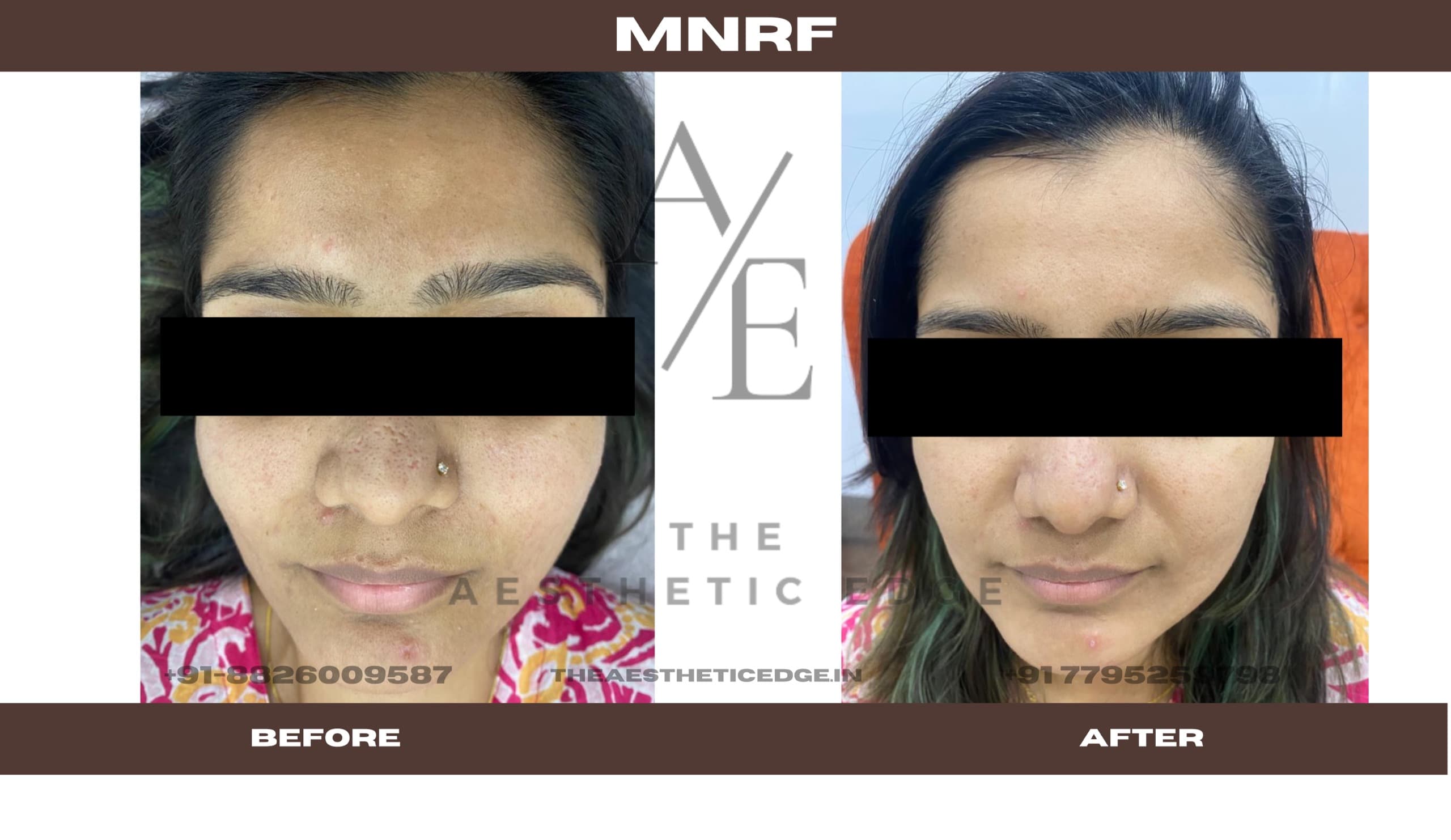
MNRF and the Q-Switch laser aim at different targets. MNRF rebuilds collagen in the deeper skin, which is what indented acne scars, open pores, rough texture and early laxity require. The Q-Switch laser shatters pigment — freckles, sun spots, melasma, flat brown post-acne marks and tattoo ink. If what bothers you is a brown mark, the laser is the relevant tool. If it is a dent, it is not.
Post-acne skin is where this matters most, because acne routinely leaves both at once: brown discolouration where a spot healed flat, and depressions where it did not. Those two things look like one problem in the mirror and are two entirely separate jobs.
How can I tell which kind of mark I have?
Look at your face in raking light — a lamp to one side rather than straight on — and see whether the marks throw a shadow.
A mark that has colour but no shadow is pigment sitting in the skin. A mark that casts a shadow, or that you can feel as a dip when you run a finger over it, is a change in the surface's shape. Many people have both, in the same area, from the same acne.
This is not a self-assessment that replaces an examination. It is a way of arriving at a consultation with the right question — "which of these is discolouration and which is scarring?" — instead of asking for a named treatment and hoping it fits.
What is each device actually doing?
One puts heat under the skin to remodel tissue; the other puts extremely brief pulses of energy into pigment particles to break them apart.
In an MNRF session, fine needles carry radiofrequency into the deeper skin layers, stimulating collagen at the depth where scarring, pore size and early laxity are determined. Surface treatments cannot reach that level, which is the whole argument for the needles.
The Q-Switch laser delivers pulses short enough to shatter pigment into particles small enough for your body to carry away, while the surrounding skin barely heats. That precision is what makes it usable on melasma and dermal pigment sitting below the level a peel can reach, and on tattoo ink.
Neither mechanism substitutes for the other. Collagen remodelling does not disperse pigment, and shattering pigment does not fill a depression.
Which one suits Indian skin?
Both are used here on deeper skin tones, for reasons that are worth understanding separately rather than treating as the same claim.
MNRF delivers its energy below the surface rather than across it, which is why it carries a lower pigmentation risk than many surface lasers. The Q-Switch's very short pulse duration targets pigment while sparing surrounding tissue, which is what makes it appropriate for melanin-rich skin that burns easily with other lasers.
In both cases the settings are chosen by a doctor for your skin type. The technology narrows the risk; it does not remove the need for judgement, and neither treatment should be performed outside medical supervision.
What does each course involve?
MNRF runs to fewer sessions but each has visible recovery. The Q-Switch runs to more sessions with essentially no downtime.
Most MNRF plans run to three or four sessions, spaced by the doctor, each around sixty minutes. Q-Switch courses run to around six sessions for overall rejuvenation and pigmentation, with tattoos usually needing more depending on the ink.
The recovery difference is the practical one. After MNRF, expect redness and mild swelling settling within hours, tiny crusts at the needle points for a few days, and skin that burns easily for a couple of weeks. After a Q-Switch session there is no downtime in the sense of needing time off — most people return to normal activity the same day, and the treated skin settles fully over about a week.
One Q-Switch quirk catches people out and is entirely expected: treated pigment often looks darker before it lifts. That is the fragmented pigment on its way out, not a sign the session went wrong.
What does each ask of me beforehand?
The Q-Switch has the stricter run-up, and one of its rules cannot be worked around.
Before a Q-Switch session you stop harsh exfoliants, bleaching creams and retinoids three days ahead, and avoid direct sunlight or tanning for two weeks — tanned skin cannot be treated safely, so a recent holiday genuinely postpones an appointment. You should also flag any history of cold sores or keloid scarring. MNRF's preparation is set at the assessment, where the doctor maps what is being treated and chooses the depth and energy for your skin.
Aftercare differs too. MNRF closes with written instructions and strict sun protection — SPF 30 or higher and shade. Q-Switch aftercare starts a prescribed depigmenting or anti-acne cream from day three, asks for SPF 50 or higher reapplied through the day, moisturiser twice daily, no retinol for at least five days, and no sun, hot baths, steam, saunas, swimming or exfoliating treatments for a week.
Which is more likely to need repeating later?
Pigmentation is the one with a documented tendency to return.
The Q-Switch page is candid about this: pigmentation can come back, particularly melasma, and particularly with sun exposure. Melasma is described as a chronic, relapsing condition — laser toning manages it well, but maintenance sessions, daily sunscreen and topical treatment are part of holding the result rather than optional additions.
Structural scarring does not behave that way, though ordinary ageing continues regardless of what has been treated. Neither treatment stops the clock.
Who is ruled out?
MNRF is avoided in pregnancy and breastfeeding, where there is a keloid tendency, and where an active skin condition such as psoriasis or eczema affects the treatment area.
The Q-Switch laser is avoided where there is an active bacterial, fungal or viral skin infection including herpes simplex, psoriasis in the area, skin cancer, and in pregnancy or breastfeeding.
Both consultations screen for all of this.
What do they cost?
MNRF starts from ₹6,999 per session. No per-session figure for the Q-Switch is published here, because its sessions vary considerably with what is being treated — a small pigmented patch and a multi-coloured tattoo are not the same piece of work — so it is quoted after the area has been seen. The consultation is ₹500, waived off against treatment.
Can both be part of one plan?
Frequently, because most post-acne faces have both problems, and each treatment carries its own preparation rules and its own spacing.
What that plan should not be is two courses booked in parallel on the assumption they will fit around each other. Sequencing energy treatments is a doctor's decision — the clinic's own microneedling protocol, for instance, requires a gap of six to twelve weeks after any laser procedure, which shows how seriously those intervals are taken here.
If your marks are a mixture and you are not sure where to start, book a consultation at Indiranagar or Bellandur and ask for them to be separated into colour and contour before any treatment is recommended.