
MNRF for Acne Scars: Why Depth Decides What You Can Expect
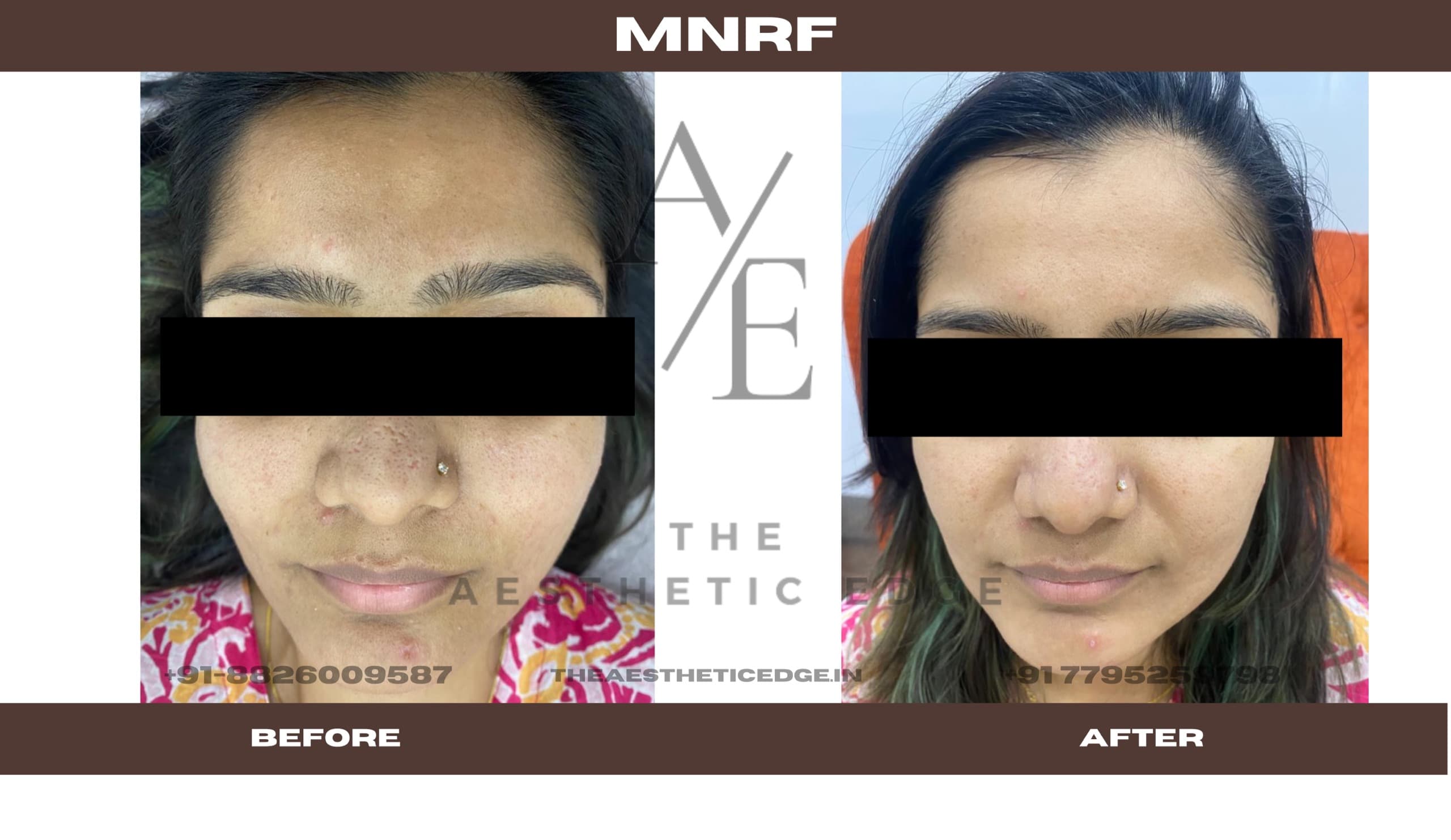
MNRF combines microneedling with radiofrequency: fine needles carry RF energy into the deeper skin layers, remodelling collagen underneath a scar rather than working on the surface above it. How much that achieves for you depends on the depth of your scarring — which is why the number of sessions is set after an examination rather than quoted in advance.
That is the honest shape of the answer. Acne scars are not a single uniform problem, and anyone offering the same promise for all of them is not looking at your face.
Why does going deeper matter?
Because that is where acne scars live. MNRF Treatment delivers RF energy through microneedles to remodel collagen under the scar, working where surface treatments cannot reach.
The distinction is mechanical rather than marketing. A treatment acting on the skin's surface is addressing a different layer from the one where a depressed scar is anchored. Carrying energy below the surface is what MNRF is for, and it is the reason the same technology also addresses early sagging, fine lines and enlarged pores — all of which sit deeper than a surface product reaches.
The collagen response builds over weeks rather than appearing at once, which is also why sessions are deliberately spaced apart.
Does it work equally well on every acne scar?
No, and this is the part worth being clear-eyed about. Plans run to roughly three or four sessions depending on scar depth and the concern, and your doctor confirms yours at consultation.
That phrase is doing real work. Depth is the variable, so two people who both describe themselves as having acne scars can receive genuinely different plans and should hold genuinely different expectations. Scarring that sits shallower is a different proposition from scarring that runs deep, and a consultation that does not distinguish between them is not much of a consultation.
The practical implication: ask specifically what your scarring looks like on examination, what this treatment is expected to change about it, and what it is not expected to change. A doctor willing to answer the third part is the one worth listening to. If some of your scarring needs a different approach, you want to hear that at the start rather than after four sessions.
Progress is tracked with photographs, which matters because gradual collagen change over weeks is exactly the kind of thing memory judges badly.
Is it suitable for Indian skin?
This is one of the genuine advantages, and the reason is structural. Because the needles deliver energy below the surface, MNRF carries a lower pigmentation risk than many surface lasers. Settings are chosen for your skin type by the doctor.
For a patient group where post-treatment pigmentation is a real and recurring worry, that is a meaningful distinction rather than a reassurance. It is worth asking directly how the settings are being chosen for your skin, and a doctor who explains the reasoning is telling you something useful about how carefully the treatment is being run.
It is performed by a doctor, always.
What is the session actually like?
Around 60 minutes. Numbing cream is applied first, and most patients describe warmth and pressure rather than pain, with brief discomfort at the more sensitive spots.
Afterwards: redness and mild swelling, usually settling within hours. That is a short recovery by the standards of anything that works at this depth, and it makes the appointment reasonably easy to fit around a working week. Still, book it on a day when you are not heading straight into something where you would rather not be slightly flushed, and give yourself the evening at home rather than out.
Both our Indiranagar and Bellandur branches run it. With three or four spaced sessions, choose the branch you can actually get back to on a weekday without a fight through traffic — a course you attend fully beats a course you start at the more convenient-sounding address.
When will I see something?
Early change can be visible after the first session, but the real result builds over weeks as collagen remodels. That is the whole reason sessions are spaced rather than stacked.
Judge it against your photographs at review rather than in the mirror at week one. Scar treatment is slow by nature, and a fair assessment needs the comparison. The mirror is also an unreliable witness for another reason: you see your own face every day, which makes gradual change almost impossible to notice from memory alone, and easy to underestimate when it is genuinely happening.
What if MNRF is not the right answer for me?
Then you should be told so. Other treatments work on different principles and at different depths.
Microneedling with Dermapen and Chemical Peel each have their own pages, their own indications and their own assessments. Whether either belongs in your plan, instead of or alongside this, is a judgement made on your skin rather than something to settle from reading — and a clinic that recommends one of those over its own more expensive option is behaving well, not losing an argument.
The questions worth bringing
What does my scarring look like on examination, and how deep is it? What will this treatment change, and what will it not? How many sessions, and why that number? How are the settings being chosen for my skin type? And will we compare photographs at review?
Those five turn a generic consultation into a specific one. To get them answered against your own skin, book an appointment at our Indiranagar or Bellandur branch. If you have older photographs from when your acne was active, bring those too — they add useful context to what is left behind.