
IV Drip Therapy vs Skin Boosters: How to Choose
They are not alternatives to each other. An IV drip puts fluids, electrolytes, vitamins and minerals into your bloodstream; skin boosters put hyaluronic acid into your skin. One is aimed at depletion in the body, the other at the quality of the skin itself. Choosing between them is less a comparison than working out which of those two problems you actually have.
This gets asked as a versus question because the two are often sold side by side under the same "glow" heading, and because both are given by injection. But the route is the whole difference. Everything below follows from it — what each can plausibly change, what neither can, how they are screened for, and why one of them is a more serious medical undertaking than the other.
Are these even the same kind of treatment?
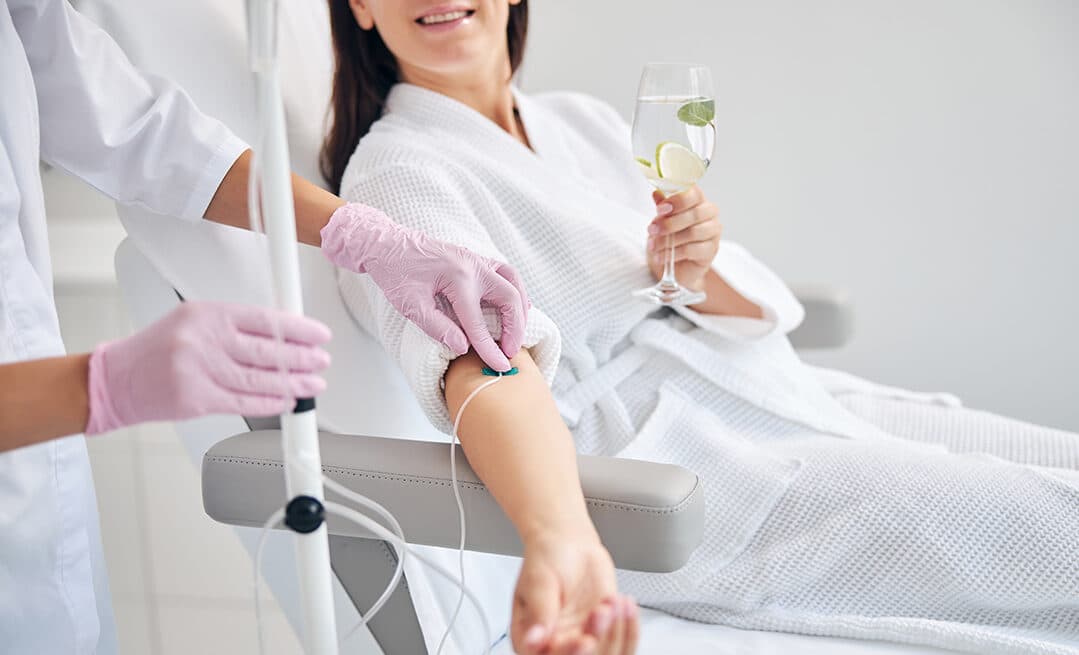
No, and it is worth being blunt about it. IV drip therapy is an intravenous infusion: a catheter is placed in an arm vein and fluids, electrolytes, vitamins and minerals run in over roughly twenty to thirty minutes, bypassing the digestive system so the dose given is the dose absorbed. It is a systemic treatment — whatever goes in circulates everywhere.
Skin boosters are hyaluronic acid injected into the skin itself rather than under it, across the treatment area, through fine needles or a cannula. It is a local treatment. The product is placed where you want the effect and stays in that tissue, hydrating from within and prompting collagen production.
A drip cannot place hyaluronic acid in your dermis. A booster cannot correct an electrolyte imbalance. Neither of those is a shortcoming; they are just different tools.
What does an IV drip actually do for skin — honestly?
Here is where we would rather understate than oversell. Our own treatment page puts it as supporting skin health from within: the formulations include nutrients involved in skin repair and hydration, which is why patients treating dullness and dehydration are often sent for infusions alongside their topical plan rather than instead of it.
That is a support role, and it is a real one — but it is not a claim that an infusion resurfaces your skin, softens a line or changes your texture directly. If you have read something promising that, it was not us. What IV therapy is used for, on its own page, is rehydration and electrolyte replacement, nutrient supplementation, immune support, recovery from physical exertion, and supporting skin health from within. What it can sensibly do for you is decided at consultation, not in an advertisement.
What do skin boosters actually do?
They work on the skin as an organ. Hyaluronic acid holds many times its weight in water; placed inside the skin it raises moisture at a depth no topical serum reaches. Boosters also stimulate your own collagen production, which is what firms the skin over the weeks following treatment rather than immediately.
The concerns they are written for are specific: skin that looks dehydrated and dull however much water you drink or serum you use, fine lines starting to show around the eyes and cheeks, texture that has gone rough or crepey. What they explicitly do not do is change your face shape — unlike a filler, they are not placed to add volume or contour.
Note the "however much water you drink" in that list. It is there because patients arrive having already tried the systemic route at home, and it has not worked. That is a genuine clue about which of these two treatments the problem belongs to.
So which problem do I actually have?
The quickest test is to read both patient descriptions and notice which one you recognise.
The IV drip patients say: I am constantly depleted and oral supplements have not changed anything. I want hydration and nutrients that actually reach me, not a tablet I hope works. My skin has looked dull and dehydrated for months.
The skin booster patients say: My skin looks dehydrated and dull however much water I drink or serum I use. I do not want fillers or any change to my face shape, just better skin. Fine lines are starting to show, especially around my eyes and cheeks.
The overlap is the dullness, which is why the confusion exists. The divergence is everything either side of it — one group is describing how their whole body feels, the other is describing what they see in a mirror.
How do they compare in practice?
| IV drip therapy | Skin boosters | |
|---|---|---|
| Route | Into a vein — systemic | Into the skin — local |
| What is given | Fluids, electrolytes, vitamins and minerals, made up per patient | Hyaluronic acid, a substance the skin already produces |
| Session | Around 20 to 30 minutes for the infusion | A short session; topical anaesthetic first if needed |
| Aimed at | Depletion, hydration, electrolytes, nutrient supplementation, immune and recovery support | Skin hydration, texture, elasticity, fine lines |
| Downtime | None; the site may be tender or bruised for a day or two | Redness, small bumps, possible light bruising for a few days |
| When you notice it | Sooner than the equivalent taken by mouth, since there is no digestive delay | Gradually over the weeks, as part of the effect is your own collagen response |
| Repeat interval | Set at consultation, based on what is being addressed | Long-lasting rather than permanent, with maintenance sessions |
| Changes face shape | No | No |
Can I have both?
Yes, and for some patients that is the sensible plan rather than a compromise — the two act at different levels and do not overlap. Our IV page describes exactly that arrangement for dullness and dehydration: infusions supporting the skin from within while a topical or in-clinic plan works on the skin directly.
What we would not do is sell you both because you asked for "glow". The doctor's job at consultation is to work out whether your dullness is a depletion issue, a skin-quality issue, both, or something neither treatment addresses.
Which one carries more risk?
This is the row that most comparisons leave out, and it is not symmetrical.
An infusion is a real fluid and mineral load on the body. Significant kidney or heart disease materially changes what is safe to give, and known allergy to any component, pregnancy and breastfeeding are all reasons an infusion may be unsuitable or need modifying. That is precisely why history, medication and any kidney or heart condition are reviewed before anything is given, and why you are observed while the infusion runs. The medical assessment is not a formality. During the drip, a mild metallic taste, warmth or a flushed face are common and typically pass quickly.
Skin boosters carry local risks instead: redness, small bumps and bruising at the injection points, temporary tightness, and a low but real infection risk because any injection breaks the skin. Treatment is ruled out with active skin infection, open wounds, skin cancer or melanoma in the area, known allergy to any ingredient, and in pregnancy or breastfeeding.
With either treatment, increasing pain, heat or spreading redness at the site should be reported to the clinic rather than watched at home.
Can either of them replace water, food or skincare?
No, and we would not present them that way. IV therapy is a supplement to a reasonable diet and a working skincare plan — useful where absorption or depletion is a genuine issue, not a substitute for either. Skin boosters improve skin quality; they do not remove the need for sun protection or a sensible routine.
Anyone selling you either as a replacement for the basics is selling you something other than medicine.
What do they cost, and where do I start?
Neither treatment publishes a starting price on our site, because in both cases the plan is individual: an infusion is formulated after an assessment rather than picked from a menu, and a booster course depends on the areas and how your skin responds. Both figures are given at consultation, which is ₹500 and is waived against treatment.
If you are not sure which of the two questions is yours, that is a completely reasonable reason to come in — it is the question the assessment exists to answer. You can book an appointment at either of our Bangalore clinics.