
Hydra Medi Facial vs Chemical Peel: How to Choose Between Them
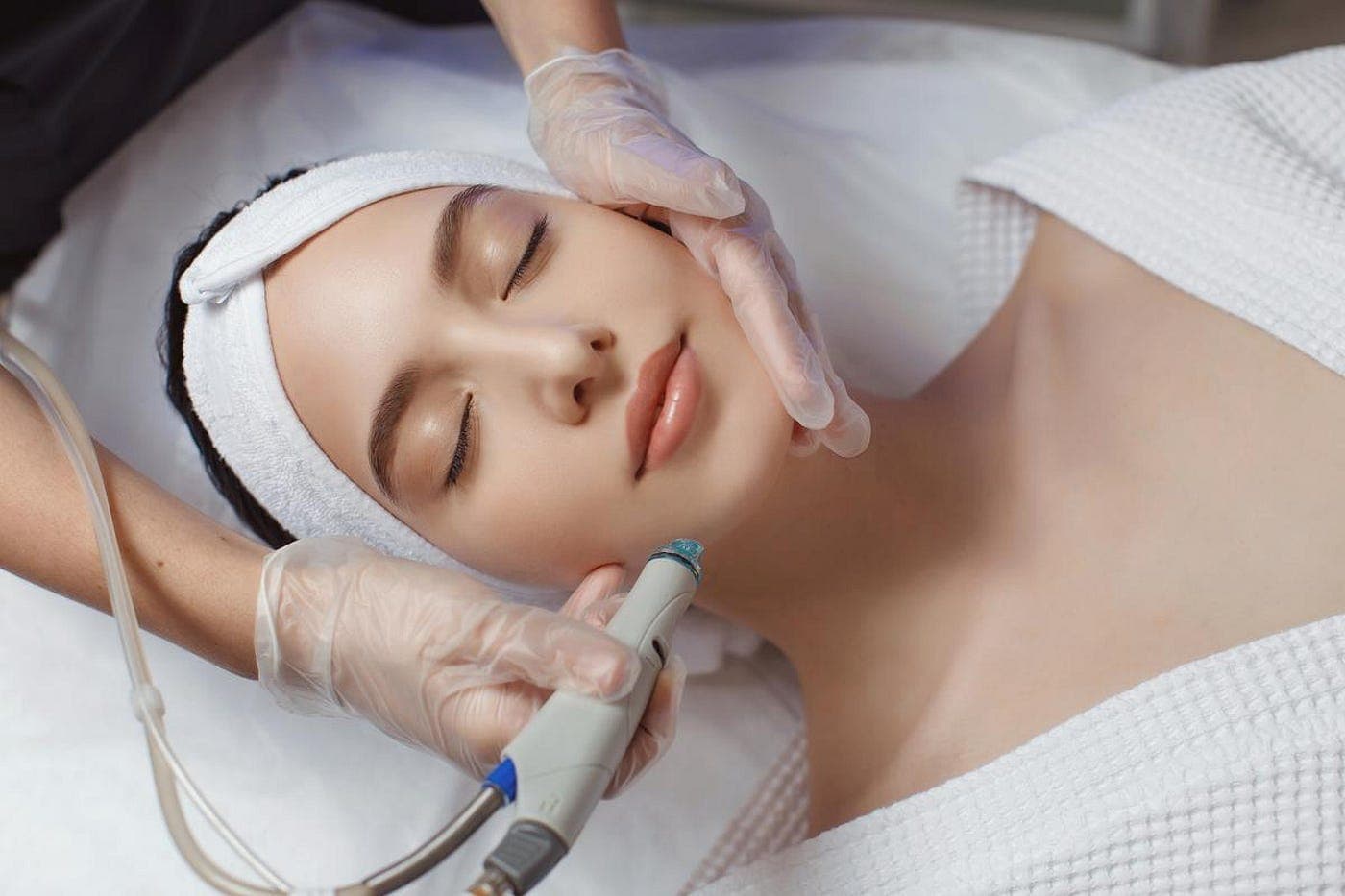
Choose a Hydra Medi Facial when the goal is upkeep — congested, tired-looking skin that you want cleared, hydrated and brightened with no recovery time. Choose a chemical peel when the goal is correction — dullness that survives home exfoliation, post-acne marks, shallow discolouration or fine lines, worked as a course. They operate at different depths, so in most cases the honest answer is not "which is better" but "which problem are you solving".
Plenty of clinics will push you toward whichever they would rather sell. What follows is what separates the two, laid out so you can arrive at the consultation already knowing which conversation you want to have.
What is the core difference between them?
Depth, and therefore ambition.
The Hydra Medi Facial works at the surface. It cleanses and infuses actives, exfoliates dead cells, and oxygenates so the actives absorb. There is an acid pass in the protocol, but it is facial-strength — it softens what is blocking pores and nothing is left on long enough to cause flaking.
The chemical peel uses a controlled solution, brushed on and left for roughly three to five minutes before being neutralised, to lift away dead surface cells so fresher skin comes through. Depth is a medical decision: superficial, medium or deep, matched to your skin type and concern after a patch test. A peel that is too strong for your skin type causes pigmentation rather than clearing it, which is precisely why the choice is not made from a menu.
How do they compare side by side?
| Hydra Medi Facial | Chemical peel | |
|---|---|---|
| Main job | Maintenance — cleansing, hydration, brightness | Correction — texture, marks, tone, fine lines |
| Depth | Surface; a facial-strength acid pass only | Superficial, medium or deep, chosen by a doctor |
| Downtime | None to speak of; mild redness settles quickly | Slight redness or flaking for a few days after a superficial peel; longer for deeper ones |
| Schedule | One session a month, ongoing | A course over several months for superficial peels; fewer sessions for deeper ones |
| Before the first session | Doctor reviews skin type and rules out active conditions | Doctor assesses skin, plus a patch test every time |
| How long the result holds | Several weeks, longer with good home care | Long-lasting rather than permanent — months to years, depending on depth |
| Starting price | From ₹2,999 per treatment | From ₹2,999 per session |
Both are performed under medical supervision at both our clinics, and the consultation is ₹500, waived against treatment either way.
When does the facial genuinely win?
Four situations, and they are common ones.
You have an event and no spare days. There is nothing to recover from, so skin can look clearer and brighter the same day. Leave a few days rather than booking for the morning of, so any transient redness has settled — but you are not gambling with a week of flaking, which is the real risk of timing a peel badly.
Your skin is sensitive and reacts to everything. The facial suits all skin types, sensitive included, and the protocol carries anti-inflammatory and anti-bacterial elements, which is why breakout-prone skin tends to tolerate it.
Your problem is congestion rather than colour. Suction extraction lifts softened blackheads out, and it does that without the squeezing and bruising that has probably put you off extractions before.
You want a rhythm, not a project. Monthly upkeep with no recovery fits a working life in a way a peel course does not always.
When does the peel genuinely win?
Also four, and these are the ones a facial cannot answer.
Post-acne marks that faded and then stalled. Peels lift pigmented surface cells and encourage turnover underneath, so shallow discolouration reads as lighter across a course. No facial reaches that.
Texture that survives everything you do at home. Removing built-up dead layers is what makes skin feel and photograph smoother, and patients often notice that after a single peel.
Oil-prone, congested skin that keeps breaking out. Salicylic and other keratolytic peels clear the pore lining, which helps congested skin settle between sessions.
Fine lines and shallow age spots. Medium-depth peels prompt new collagen as the skin repairs, softening their appearance over several treatments. That is structural work, and it is outside a facial's remit entirely.
Do I have to pick one?
Not really, and this is where the comparison stops being a competition. Every Hydra Medi Facial session here includes a complimentary chemical peel — a ₹1,999 session on its own — so the two are already delivered together as a matter of course rather than as an offer.
Think of it as maintenance with a corrective element included, and a full peel course as a separate, deliberate piece of work when your skin needs it.
What would rule either of them out?
This is the half comparisons usually skip, and both treatments have real limits.
For the facial: an active rosacea flare, sunburn or an infected breakout means rescheduling rather than pushing through, and the protocol is not performed during pregnancy at all.
For peels: pregnancy and breastfeeding, diabetes for certain peels, recent isotretinoin or other acne medication, and recent cosmetic surgery that has left skin sensitive are all reasons to postpone or choose differently. Deeper pigmented skin is more prone to post-inflammatory pigmentation, which is exactly why the depth is selected for you rather than picked off a price list. Scarring, infection and prolonged swelling are uncommon after peels but genuinely possible.
Neither treatment's aftercare is negotiable. Both leave skin that burns more easily, and daily broad-spectrum sunscreen is the single instruction we ask nobody to skip.
How do I settle it?
Bring the concern rather than the treatment name. "My skin looks flat by Wednesday" and "these marks have not moved in two years" lead to different answers, and a doctor looking at your skin will tell you which one you are describing — including when the answer is neither of these two.
Book a consultation at Indiranagar or Bellandur. It is ₹500, waived against whatever you go ahead with.