
How Many Sessions Does Tattoo Removal Actually Take?
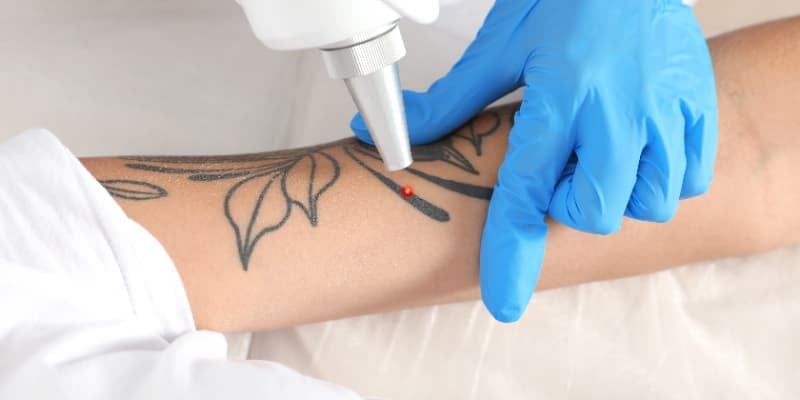
Typically six to ten sessions, spaced several weeks apart — so a full course usually runs across months rather than weeks. The number depends on three things about your particular tattoo: its size, its colours, and how deep the ink was placed. Anyone who quotes you a session count without looking at the tattoo is guessing.
That variability is not evasion, it is the nature of the process. Laser Tattoo Removal does not lift ink out of the skin; it breaks the ink into fragments small enough for your own body to absorb and clear. Each session fragments a further share, the tattoo lightens step by step, and the settings are adjusted next time based on how your skin and your ink actually responded. It is a course of treatment, not a procedure with a before and an after.
Why does black ink clear faster than green and blue?
Because different inks absorb laser energy differently, and black absorbs most readily. Black and dark inks clear fastest; greens and blues are the stubborn ones and generally need more sessions.
This is the single largest source of frustrated expectations, and it is avoidable. A patient with a small black outline and a patient with a multi-coloured piece of the same size are on genuinely different timelines, and if nobody says so at the start, the second patient reaches session six believing something has gone wrong. Nothing has: their ink is simply harder to fragment.
The practical consequence is worth knowing before you begin. On a mixed-colour tattoo you will often watch the black lines fade early while a green fill or a blue shadow lingers well past the point where the rest has gone quiet. That is the expected sequence, not a failure of the earlier sessions. Your doctor should tell you which parts of your tattoo are likely to be stubborn before you start rather than after — ask for that specifically at the consultation, and ask them to point at the areas on the tattoo itself.
What else moves the number, apart from colour?
Depth and size, and both are visible to an experienced eye before the first pulse.
Ink placed deep in the skin has further to travel out and generally needs more sessions than shallow work. Size matters in a more mundane way: it changes how long each appointment takes rather than the underlying biology, with sessions running from a few minutes for something small to about an hour for a large piece. Older or poorly done work can sit unevenly in the skin — patchy depth across one tattoo — which is one reason two areas of the same tattoo can fade at noticeably different rates.
There is also a category of tattoo where removal is about more than appearance. Older or badly placed work can occasionally cause reactions, and removal addresses that alongside how it looks.
All of this is why the assessment happens before the first session, not during it. Ink type, depth, skin tone and any history of keloid scarring each change the plan, and the same laser platform that handles pigmentation — the Q-Switch Laser — is set very differently for a shoulder tattoo than for freckles. A patch test is done at consultation before the first full session.
Do I have to remove it completely?
No, and a surprising share of patients should not be aiming for that.
Partial fading is a legitimate goal and takes fewer sessions than full clearance. Many people are not removing a tattoo so much as making room for one they actually want, and a cover-up artist needs the old work quiet, not gone. If that is your situation, say so at the consultation: it changes the target, the session count and what you spend.
If full clearance is the goal, the honest position is that a tattoo often fades to the point of being unnoticeable, but complete clearance cannot be promised for every tattoo. Deep or multi-coloured ink can leave a faint shadow. That is discussed openly at consultation, and it is far better to hear it then than to arrive at session nine expecting something the ink was never going to give.
Does it hurt, and is there downtime?
Some discomfort is expected. Most patients describe it as similar to a rubber band snapping against the skin. Cooling is used throughout, and numbing can be discussed for larger or more sensitive areas — raise it in advance rather than mid-session if you know the area is a tender one.
Downtime is minimal; normal activities can usually be resumed immediately. The part that genuinely cannot be rushed is the gap between sessions: several weeks, because that is how long your body needs to clear the fragments from the last one. Treating sooner does not accelerate anything, and the wait is doing real work even though nothing appears to be happening.
On scarring: modern laser removal targets the ink rather than the surrounding tissue, and performed under medical supervision with correct settings and aftercare, the risk of scarring is small. Every session here is assessed and performed by a doctor.
The Bangalore timing problem, and how to plan around it
Two things about this city shape a removal course more than anything clinical.
The first is the calendar. Six to ten sessions at several weeks apart means a course measured in months, and it is almost always booked against a fixed date — a wedding, a job that expects covered forearms, a cover-up appointment already paid for. Start the conversation early. The one lever nobody has is the interval between sessions; if the date is four months away, the assessment needs to happen now so the plan can be honest about what is reachable by then.
The second is sun. Freshly treated skin is doing repair work, and Bangalore's sun arrives in small relentless instalments — the walk to the cab, the wait at the signal, the terrace lunch — rather than in obvious beach-day doses. Your doctor's aftercare instructions will cover it; the practical point is that a treated forearm on a two-wheeler commute needs covering rather than good intentions.
Because the appointments are short and downtime is minimal, the sessions themselves fit a working week easily. We see patients at both our Indiranagar and Bellandur clinics, and for a course this long the sensible choice is whichever sits closer to your ordinary route — a plan that stalls at session four usually stalls over traffic, not medicine.
Start with an assessment, not a number
The number you want is the one produced by someone looking at your tattoo: its colours, its depth, its age, and your skin. That is a ten-minute conversation that saves months of misaligned expectations.
Book an appointment at The Aesthetic Edge — Indiranagar or Bellandur — for an assessment, a patch test, an honest session estimate, and a straight answer about which parts of your tattoo will be the slow ones.