
How Dermaplaning Actually Works
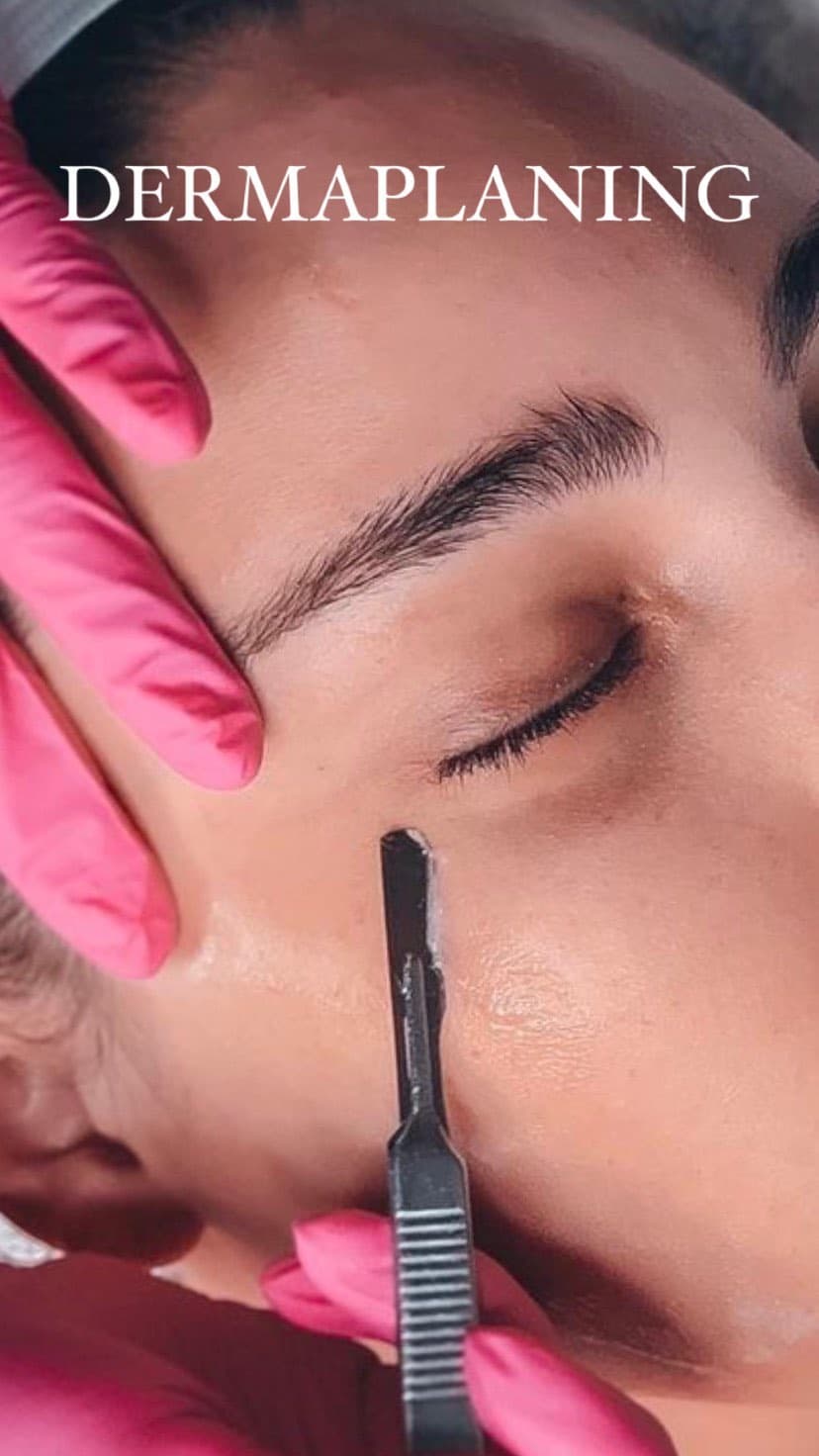
Dermaplaning works mechanically, not chemically. A sterile single-use blade held flat against dry skin shears off two things in one pass: the layer of dead cells sitting on the surface, and the fine vellus hair growing through it. Nothing penetrates, nothing is injected, and nothing is asked of the skin except to carry on renewing as it already was.
Understanding the mechanism is worth more than a list of benefits, because almost every rule around the treatment — dry skin, a specific angle, a three- to four-week gap, sunscreen for a week — follows directly from it. Here is what Dermaplaning is doing at the surface, and why each of those rules exists.
What is the blade actually removing?
Two things, and they are quite different from each other. The first is the dead surface cell layer. Skin cells are produced deeper down, migrate upward, flatten, lose their nuclei and end up as a compacted sheet of dead material on the outside — a layer that does a real protective job but that, once it builds up unevenly, is what makes skin look dull and feel rough.
The second is vellus hair: the fine, short, usually pale hair covering most of the face. It is not the coarse terminal hair of the scalp or beard. It is soft, it catches light, and it is what foundation snags on.
The blade takes both in the same stroke. That is the entire treatment — no solution is left on the skin, no device delivers energy, no needle crosses the surface.
Why does the angle matter more than the blade itself?
Because the angle is what separates exfoliation from shaving. A razor is built to meet hair at the surface and cut it. A surgical blade held at a specific shallow angle, with the skin pulled taut, travels along the surface and lifts the dead cell layer with it as well as the hair.
Change the angle and you get one job instead of two — or, worse, you catch skin rather than glide over it. This is precisely why the same instinct applied at home tends to produce nicks, uneven patches and irritation. The tool is doing what it was designed for; the hand is not holding it where the technique needs it.
Why must the skin be completely dry?
Water changes what the blade meets. Damp skin softens and swells the dead surface layer, and a swollen, slippery surface does not shear cleanly — the blade drags or skips instead of gliding. That is why the face is cleansed and then dried fully before anything begins, and why "cleanse and dry" is a separate step in the protocol rather than an afterthought.
Why does the surface read differently immediately afterwards?
Because you have changed what light meets. A face covered in fine hair and loose, unevenly shed dead cells is an interrupted surface: light scatters off it in many directions, which the eye reads as dullness. Take both away and the surface is flatter and more uniform, so light reflects more evenly.
The same geometry explains the makeup result, which is the outcome most patients actually book for. Foundation catches on fine hair and on flaking skin — it collects around each obstruction. With both lifted, there is nothing for it to catch on, so it sits flat rather than patchy or cakey. Nothing has been added to your skin to achieve that. Something has been taken away.
Why does cutting vellus hair not make it thicker?
Because thickness and colour are decided in the follicle, and a blade never reaches the follicle. It cuts the hair shaft — the part that has already been produced and is, biologically speaking, no longer living tissue. Cutting it gives the follicle no instruction to behave differently, so vellus hair regrows exactly as it was: same texture, same colour.
The myth persists because there is a genuine sensation behind it. An uncut vellus hair tapers to a fine point. Cut across, the regrowing hair presents a blunt end, and a blunt end feels different against a fingertip for a few days until it grows out again. That is a change in the shape of the tip, not in the hair.
Why do serums absorb better afterwards?
Because the compacted dead layer was the obstacle. Actives applied over a built-up surface largely sit on top of it. Remove that layer and the same products reach living skin more readily — which is why the routine you already own tends to do more for a few weeks, without you buying anything new.
It is also the reason dermaplaning is often used as a preparation step. Clearing the surface first helps a facial or a peel reach the skin more evenly, so the treatment that follows works on skin rather than on what was sitting over it.
Why three to four weeks, and not sooner?
Because that is roughly how long the skin takes to rebuild what was removed. The dead surface layer is continuously replenished from below on its own renewal cycle, and the treatment interval is set to match it. Going more often means exfoliating skin that has not finished rebuilding — you are taking away a protective layer the skin has not yet finished making.
The visible result holds for about that same three to four weeks, so the sensible interval and the useful interval turn out to be the same one.
Why is active acne a mechanical problem here?
Because the mechanism cuts both ways. A blade travelling across inflamed spots, pustules or cysts can carry bacteria along the surface and irritate the lesions it crosses. That is not a theoretical caution — it is the same physical action that makes the treatment work, applied to skin that is in no state to receive it.
So active inflammatory acne is a reason to postpone. Settled acne, where the concern is texture or residual marks, is often fine. That distinction is made at assessment, by someone examining your skin.
Why is skin more sun-sensitive for about a week?
Because you have removed part of what was shielding it. The dead surface layer contributes to the skin's own defence against ultraviolet light, and it takes days to rebuild. In the meantime the skin burns more easily, which is why sunscreen is applied before you leave the clinic and is treated as part of the treatment rather than as advice.
What should prompt a call to the clinic?
Do not try to judge for yourself whether something is expected. Contact the clinic that treated you if pinkness lasts beyond a day or two, if a graze does not appear to be healing, if the skin turns genuinely painful rather than mildly sensitive, or if a cold sore appears afterwards. Telephone the clinic or arrange a review appointment — early is always easier than late, and no one minds being asked.
Where the mechanism runs out
Dermaplaning works at the surface and only at the surface. It cannot reach pigment or texture that sits deeper, and it makes no attempt to. A chemical peel works chemically, at a depth a doctor selects for your skin type; a Hydra Medi Facial combines cleansing, exfoliation and infusion in one protocol. Knowing which layer your concern actually lives in is what decides between them, and that is a judgement made in person.
Book an appointment and someone will assess your skin before recommending anything. The consultation is ₹500, waived off against treatment; dermaplaning itself starts from ₹1,999 per treatment.