
Fine Lines & Wrinkles: What Actually Works, and What Only Sounds Like It Does
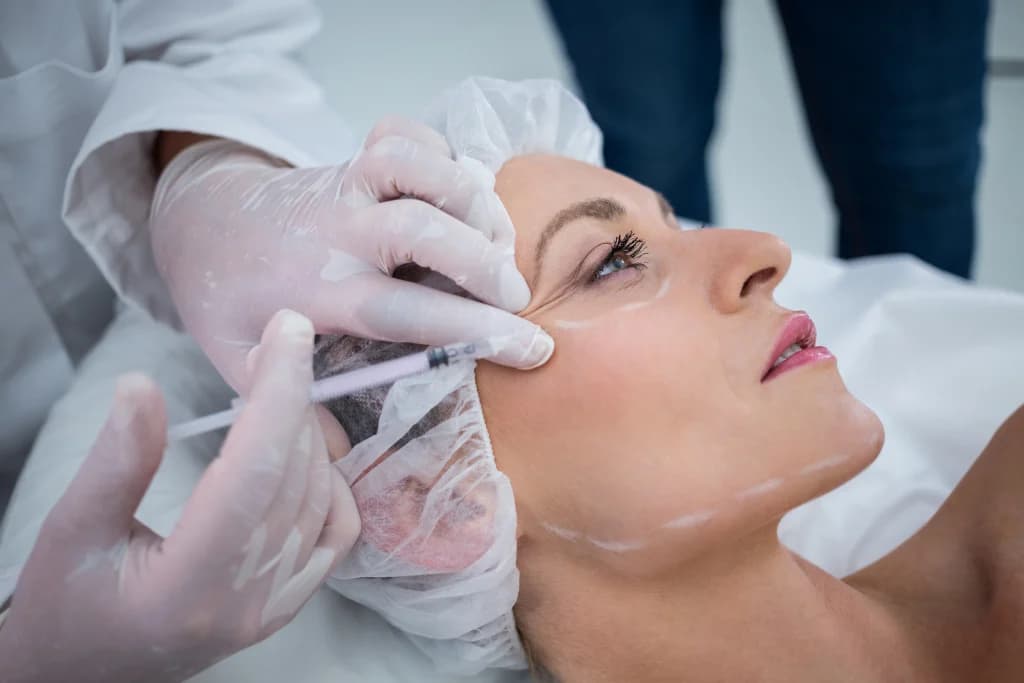
Lines on the face come from more than one cause, and the treatments that help differ accordingly. Creases produced by repeated muscle movement respond to a wrinkle-relaxing injectable. Skin that has become dry, thin and crepey responds to treatments that improve skin quality. Creases that sit there when your face is completely still belong to a third category again. Working out which you have is the whole job.
Nothing on this page can tell you which kind you have — that needs someone looking at your face while it moves. What it can do is stop you buying the wrong answer.
Why do lines appear at all?
Skin creases where it is repeatedly folded, and it creases more readily as it loses hydration and elasticity. Those are two separate processes running at the same time on the same face, which is why two people the same age can have very different-looking foreheads.
There is a third contributor most people underestimate: the surface itself. Skin that is dehydrated and dull catches the light unevenly, and unevenly-lit skin reads as more lined than it is. Some of what people describe as "wrinkles appearing overnight" is a change in surface quality rather than a change in the crease.
What is the difference between a line that moves and a line that stays?
This is the distinction that decides everything else, and it takes about ten seconds to demonstrate in a mirror.
Relax your face completely. Now look at the crease you dislike. If it disappears or nearly disappears at rest and only shows when you raise your brows, frown or smile, it is a dynamic line — a fold produced by the muscle underneath pulling the skin. If it is still clearly there with your face still, it is a static one.
At an assessment for an injectable, this is exactly what the doctor is doing: examining your face at rest and in movement, and sorting the lines into those two groups. Only the dynamic group responds well to a wrinkle-relaxing injectable. That sentence saves a lot of money and disappointment.
Which treatment does the moving kind call for?
Botox temporarily relaxes the muscles behind those movements. Less contraction means the skin above creases less — which is why it is aimed at horizontal forehead lines, the vertical frown lines between the brows, and crow's feet at the outer corners of the eyes.
Practically: the appointment runs about 15 to 30 minutes; changes usually begin around four to seven days and settle by two weeks; the effect typically lasts three to six months. Downtime is minimal and most people return to work the same day. You come back at two weeks so the settled result can be reviewed and a point adjusted if it needs it.
The same injection has a wider medical use as well. If your lower face has squared off because you clench or grind your jaw, or if underarm sweating is the thing actually bothering you, a wrinkle relaxer plan addresses those directly.
What helps skin that is simply dehydrated and crepey?
A different tool entirely, because there is no muscle to relax. Skin boosters are injectable hyaluronic acid placed into the skin rather than under it. They hydrate at a depth no topical serum reaches, and prompt the skin's own collagen production, which firms it over the weeks afterwards rather than immediately.
The effect that follows is on skin quality — texture, elasticity, hydration — and better-hydrated, more elastic skin makes fine lines less visible, particularly in areas prone to crepiness such as under the eyes and around the mouth. Importantly, boosters are not placed to add volume or contour, so your face shape is left alone.
That is a genuinely different promise from a wrinkle relaxer, and the two are often confused because both arrive by needle.
What about the lines that stay put?
If a crease is fully present at rest — the folds running from the nose to the corners of the mouth are the usual example — relaxing the muscle will not lift it. Deep creases of that sort are generally a question of lost volume and support rather than movement, and that is a separate conversation with a separate injectable. Say so at consultation and you will be told honestly which category your line falls into.
What are the things that sound like they should work?
A few patterns come up often enough to be worth naming.
Applying more serum, more often, to a dynamic line. A topical cannot reach the muscle producing the fold, and hydration works at the surface — useful for how skin reads, irrelevant to the crease's cause.
Exfoliating harder because the skin looks textured. Over-exfoliating an already compromised barrier tends to make skin more reactive, not smoother.
Asking for whatever a friend had. Two people with visually similar foreheads can have completely different muscle patterns, and dosing here is planned for your own pattern rather than from a fixed template — which is precisely why copying someone's plan is a poor shortcut.
Judging any of it too early. Four to seven days before anything shows, two weeks before it has settled, is the honest timeline for an injectable. Boosters build over weeks.
And one that is not a treatment at all: sun. Daily broad-spectrum sunscreen is the least glamorous item on any plan for lined skin, and it is the one item that quietly decides how much of your result you keep.
How soon would you see anything?
It depends on which problem you actually have, which is the recurring theme of this page. A wrinkle-relaxing injectable begins to show at four to seven days and is settled at two weeks. Skin boosters work through hydration and collagen production, so the change accrues across the weeks after the session and is sustained with top-ups. Neither is an overnight result and neither is permanent.
If either treatment leaves you with redness or small bumps at the injection points, that is common and usually settles quickly. Contact the clinic rather than waiting if swelling or redness at a point increases after the first day, if a bruise spreads instead of fading, or if heaviness or unevenness appears in the weeks after an injectable — and if something changes in your breathing or swallowing, treat that as urgent and go to the nearest emergency department if you cannot reach us. It is not for you to judge what any of it means.
Where to start
Book an assessment rather than a treatment. Bring the specific complaint — which line, when you notice it, and what you have already tried — and be prepared for the answer to be a different treatment from the one you had in mind, or a combination, or a recommendation to wait.
A consultation is ₹500, waived against treatment. Botox is priced from ₹299 per unit, which is a per-unit rate rather than a treatment price, so the number only becomes meaningful once your points have been mapped.
Book a consultation and start with the diagnosis rather than the shopping list.