
HydraFacial and a Chemical Peel: Both, or Just One?
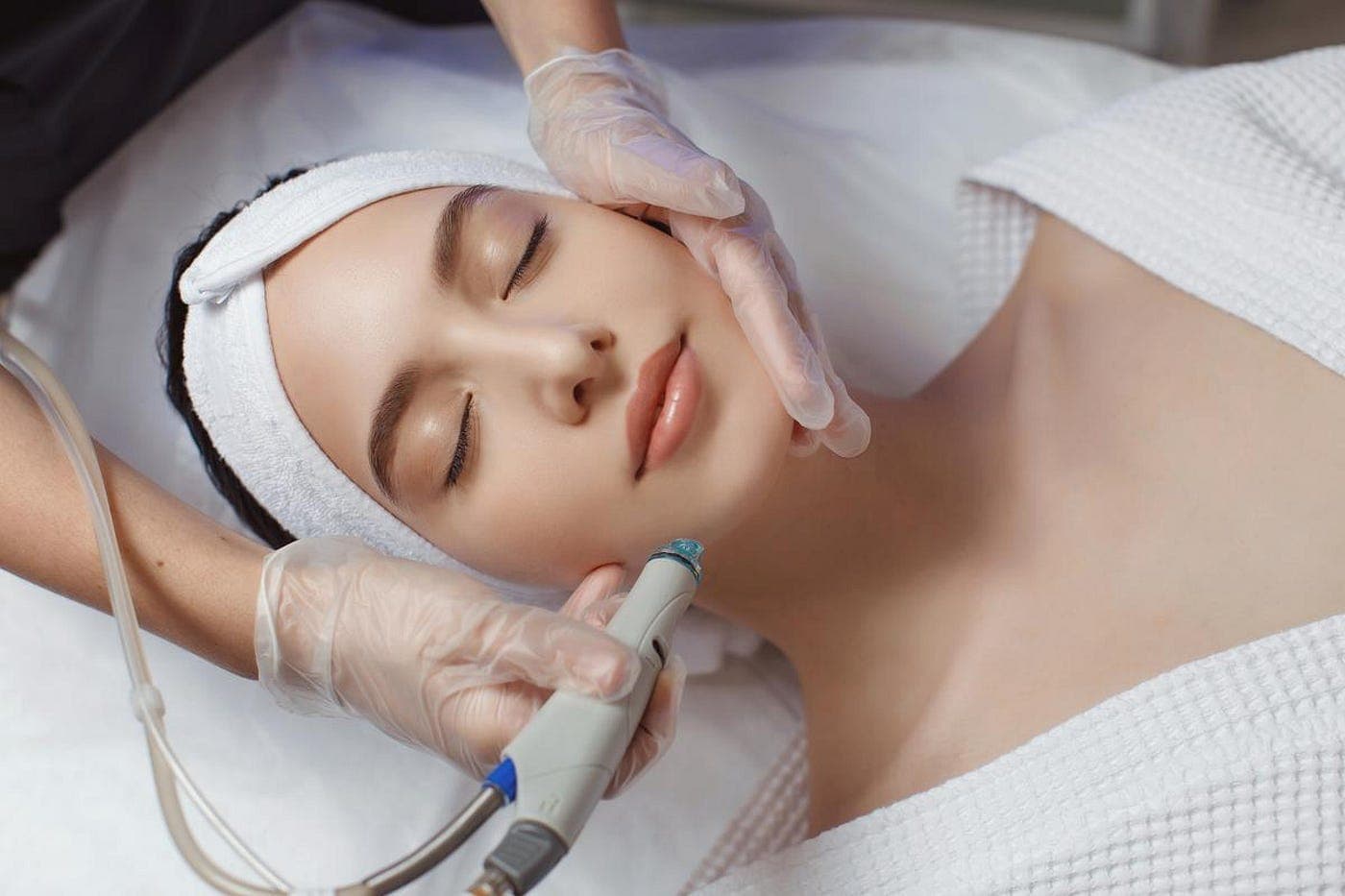
These two are not alternatives and they are not a stack. A Hydra Medi Facial is a maintenance treatment; a chemical peel is a corrective one that works across a course. They overlap at exactly one step — exfoliation — and that overlap is the whole reason "both, together" is a question for a doctor rather than an obviously better choice.
So the useful question is not whether they can be combined. It is what you are trying to fix, and whether the thing you want needs correcting or maintaining.
What does each one actually do?
A Hydra Medi Facial is a three-in-one medical facial: it cleanses and infuses the skin with active ingredients, exfoliates away dead cells, and finishes by oxygenating so those actives absorb properly rather than sitting on the surface. Congestion and surface build-up are lifted while the actives go in at the same time, so skin is cleared rather than left tight and stripped. It suits most skin types including sensitive skin, and the protocol has anti-inflammatory and anti-bacterial elements, which is why breakout-prone skin generally tolerates it.
A chemical peel uses a controlled solution to lift away dead surface cells so fresher skin comes through, improving texture and the look of marks and fine lines. Depths run superficial, medium and deep, and the depth and solution are chosen by a doctor for your skin type — which is the part that decides whether a peel helps or backfires.
Read those two descriptions side by side and the overlap is obvious: both remove dead surface cells. One does it as a third of a maintenance protocol. The other does it as the entire point, at a depth selected for your skin.
Does the overlap actually matter?
Yes, and it is the reason a doctor decides the spacing rather than you stacking appointments.
The peel's own safety rule is the clearest way to see why: a peel that is too strong for your skin type causes pigmentation rather than clearing it. Deeper pigmented skin is more prone to post-inflammatory pigmentation, which is precisely why the peel is selected after an assessment and a patch test rather than picked off a menu. Exfoliation is not a quantity where more is automatically better — it is a dose.
The aftercare points the same way. After a superficial peel you can expect slight redness or flaking for a few days, and the instructions are sunscreen daily, no picking and no scrubs while the skin settles. A treatment whose second stage is exfoliation is not something to put on top of skin that has been told to avoid scrubs. That is not a rule against combining the two; it is the reason the interval between them is a clinical decision.
What that interval is in your case depends on the depth of peel you had and how your skin responded to it, so it is set at the appointment rather than in advance — and it is a fair thing to ask for explicitly, along with which comes first.
So is having both overkill?
Sometimes, and the honest test is what you want changed.
If the goal is upkeep — skin that looks tired, congestion, roots of dullness, a tone that photographs flat — the facial is the plan on its own. It is a maintenance treatment rather than a corrective one, most patients see refined texture and a more even tone from the first treatment, and one session a month is what produces consistent results. The benefit comes from regularity, not from adding a second treatment to a single visit.
If the goal is correcting something — post-acne marks, shallow discolouration, texture that has not responded to anything topical — that is the peel's job, and it is a course: superficial peels are usually repeated several times over a few months to build a result. One peel bolted onto a facial is not that course.
Where both genuinely belong in one plan is when you have something to correct and you want the months in between to be maintained. That is a sequencing decision with a reason behind it. "I booked both because more seemed better" is not a reason, and a doctor should say so.
What is actually included with a HydraFacial?
Complimentary LED light therapy with every session. A peel is a separate treatment with its own assessment, patch test and course.
This is worth stating plainly because the two get conflated. If you have read anywhere that a peel comes free with the facial, check it against what the clinic tells you when you book: the current inclusion is the LED, and the peel is priced and planned in its own right.
What does this mean for a Bangalore skin routine?
Two practical things, and the second is the one people get wrong.
The facial has no real downtime — mild redness or itching, if it happens at all, settles quickly, and you can go straight back to your day, though you are asked to hold off on exercise for a couple of days while the skin regenerates. The peel does have downtime, measured in days of flaking, which is what makes it the item to plan around rather than slot in.
And the peel's result is long-lasting rather than permanent — months to years depending on depth — with sun protection the main thing that decides where in that range you land. In this city that is the instruction most reliably dropped, because an overcast afternoon does not feel like a sun risk and a two-wheeler commute does not feel like exposure. If you are going to spend a course of peels on your skin, the sunscreen is not the optional part of the plan; it is the part that determines whether you keep what you paid for.
When should either be postponed?
For the facial: active rosacea, sunburn or an infected breakout are reasons to postpone rather than push through, and that gets checked before anything starts.
For the peel: the assessment covers your skin type, any glycolic acid allergy, and what you have used recently, and a patch test is always done before the first full treatment. Being told "not today" after that check is the assessment working, not a wasted visit.
If you are weighing the two and would rather be told which one your skin actually needs — or that one of them is enough — book a consultation at our Bellandur or Indiranagar clinic. Say what you want changed rather than which treatment you want; the first answer decides the second.