
Why Bangalore Has No 'Sunscreen Season'
Bangalore sits at roughly thirteen degrees north, inside the tropics, so the midday sun stays high overhead all twelve months instead of sinking into a weak winter arc. There is no genuinely low-sun stretch to take a break in. What the city has instead is a dry season and a wet one, and grey weather feels like protection while doing considerably less of it than people assume.
That mismatch — between what the sky looks like and what it is letting through — is the single most useful thing to understand about skincare here.
Why doesn't Bangalore get a low-sun winter?
Latitude. Temperate cities swing between long summer days with the sun high overhead and short winter days with it low on the horizon, and sunscreen seasonality follows that swing. Sitting well inside the tropics, Bangalore never makes that trip. December's noon sun is closer to June's than a Londoner would find believable.
What changes across our year is temperature, rainfall and how pleasant it is to be outside — not the geometry. A cool January morning in Indiranagar and a warm April one are far more alike, in the terms that matter to pigmented skin, than they feel.
This is why advice written elsewhere translates badly. "Wear sunscreen in summer" is reasonable guidance in a place with a real winter. Here it quietly gives you permission to stop for most of the year.
The monsoon is grey for months. Surely that counts?
Less than you would hope, and this is where most people are genuinely caught out rather than careless. Cloud cover cuts the heat and the glare much more than it cuts ultraviolet, so the two cues you instinctively use — brightness and warmth — both drop away while a meaningful amount of UV keeps arriving.
The practical result is a season in which it is easy to be outdoors for long stretches, feel entirely comfortable, and quietly accumulate exposure. Add a commute in the open and the effect is not theoretical.
None of that requires you to feel your skin burning. Pigment responds well below the threshold of anything you would notice at the time.
Why does this matter more after a treatment than before one?
Because a treated surface is temporarily far more reactive than an untreated one, and every aftercare sheet in the clinic says so in its own words.
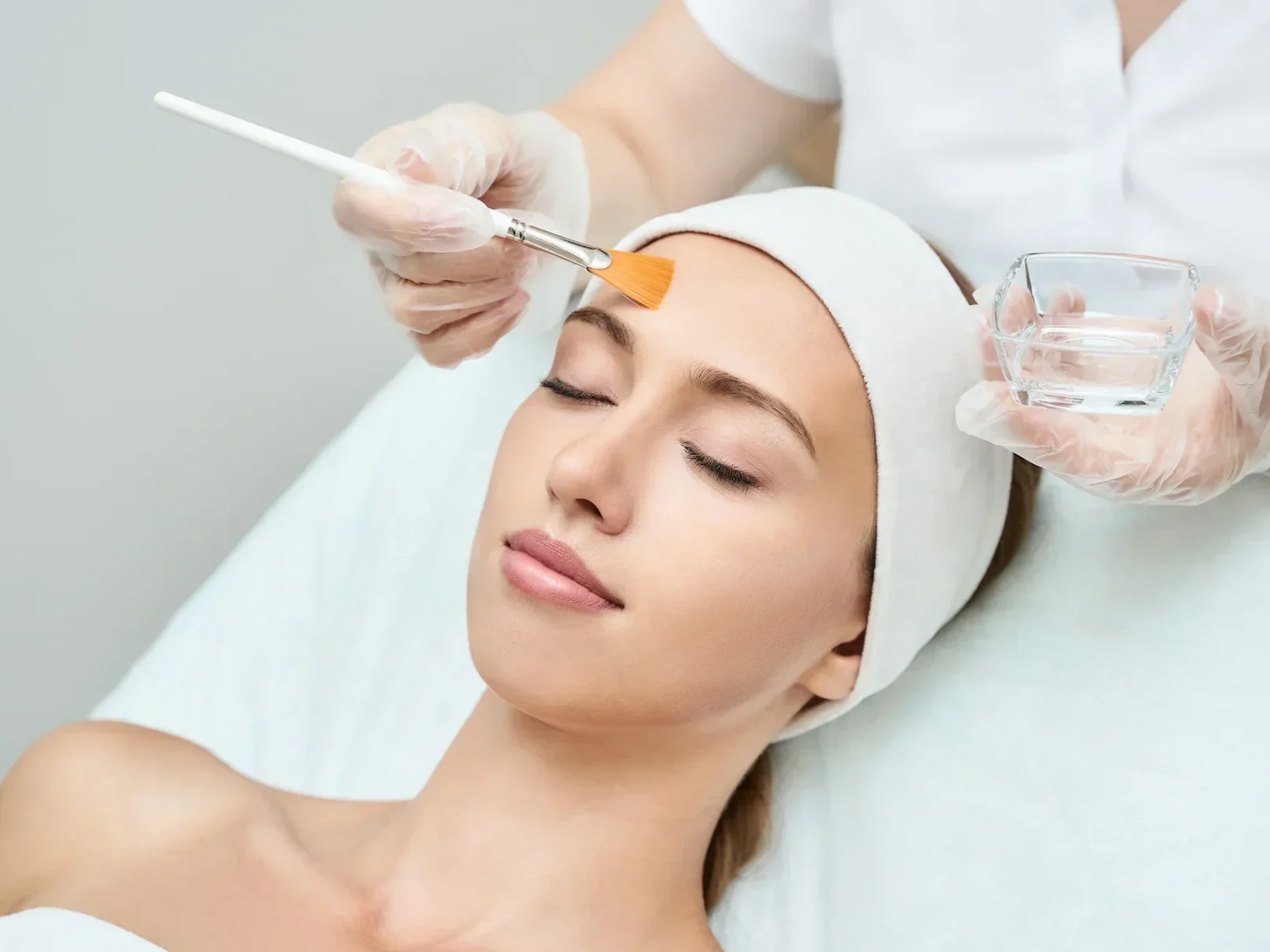
After a chemical peel, the instruction is broad-spectrum sunscreen every day, and staying out of direct sun and heat while the skin settles — with direct sunlight avoided for about a week. Beyond comfort, there is a specific reason: the treated area can look lighter or darker than the skin around it for a while, and how cleanly that resolves depends more on daily protection than on anything else you do.
There is a longer-run version of the same point. Peel results are described as long-lasting rather than permanent, ranging from months to years depending on depth — and where you land inside that range is decided largely by sun exposure afterwards. A peel improves the surface you have today. It has no opinion about the exposure you accumulate next March.
Do the other treatments ask for something different?
The same principle, on different clocks, which is worth knowing if you are planning a course.
BB Glow leaves skin more reactive to UV, and the instruction is to avoid sun, steam rooms and saunas for two weeks, with daily sunscreen described as not optional. A course runs to four to six sessions about two weeks apart, so in practice that window is more or less continuous from the first appointment to the last.
Microneedling is the strictest of the three: freshly needled skin burns easily and pigments easily, and SPF 50 or higher every day is named as the most important part of the aftercare. With courses typically running six to eight sessions, that is a months-long commitment rather than a fortnight's caution.
Read together, these are not three separate rules. They are one rule with three different recovery windows.
Does skin tone change how much this matters?
It changes the consequence of getting it wrong. Deeper pigmented skin is more prone to post-inflammatory pigmentation — the discolouration that follows irritation, a spot, or a treatment — which means the same lapse in protection that leaves one person slightly pink can leave another with a mark that takes months to settle.
That is not an argument for avoiding treatment. It is an argument for taking the boring half of it seriously, and it is part of why depth and solution are chosen after an assessment and a patch test rather than picked off a list. The protection afterwards is doing as much work as the appointment itself.
What does "daily, broad-spectrum" actually look like here?
Undramatically: applied in the morning as a matter of routine, on days you are not planning to be outside, and through the monsoon as much as through April. Reapplied if you are genuinely out for hours. Worn on the commute, which for a lot of Bangalore is the largest single block of exposure in an ordinary day and is rarely counted as sun exposure at all.
The habit is the point rather than the product. Sunscreen bought in March and abandoned by July is the pattern we see most, and it lines up almost exactly with treatment results that plateau or slide backwards in the second half of a course.
Where does this leave a treatment plan?
Somewhere quite reasonable, provided the aftercare is treated as part of the treatment rather than an appendix to it.
Peel sessions start from ₹2,999 per session, and what a course adds up to depends on depth, area and how many your skin genuinely needs — settled after an assessment rather than quoted from a page. The consultation is ₹500, waived against treatment.
If you have had pigmentation come back after a course somewhere else, the sun protection question is one worth raising explicitly when you book a consultation, because it changes both the plan and how it is scheduled around your year.