
What Is Vaginal Tightening? A Plain-English Explanation
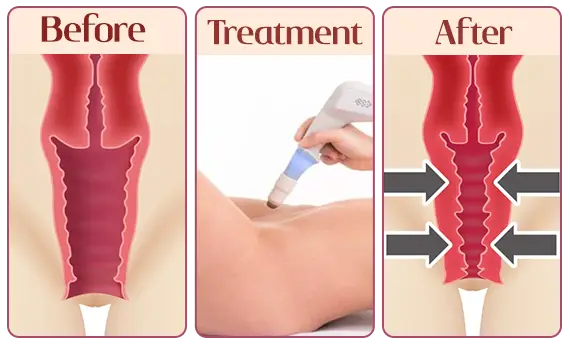
Non-surgical vaginal tightening uses laser or radiofrequency energy to warm the vaginal tissue and prompt a collagen response, with the aim of improving tone, elasticity and dryness. It is a short in-clinic treatment, typically 20 to 30 minutes, carried out by a doctor in a private consulting room. There is no incision and no general anaesthetic.
This page sets out what is documented about the treatment and what is not. It is deliberately plain. This is a subject where a lot of what is written online is written to sell something, and the more useful thing to publish is what actually happens in the appointment.
Is this surgery?
No. The treatment described here is the non-surgical one, and it is the only version offered at this clinic. Energy is delivered to the tissue through a slim probe. Nothing is cut, nothing is stitched, and you are awake throughout.
Surgical options do exist. They involve anaesthesia and a real recovery period, and they are the right answer for some patients. If that is what your case calls for, your doctor will say so and refer you rather than treat you here. That is worth knowing before you book, because it means the assessment can legitimately end in "this is not the treatment for you", and that is a normal outcome rather than a failed appointment.
What does the appointment actually involve?
Four stages, in order.
Assessment. Your symptoms and history are reviewed and the cause is established. You are told plainly whether this treatment is the right answer for it. This is the step that matters most, and it is the one most often skipped elsewhere — patients are commonly sold a course before anyone has worked out what is producing their symptoms.
Preparation. You are positioned for the treatment and a topical anaesthetic is applied where needed.
The treatment itself. Energy is delivered evenly along the vaginal wall through a slim probe, over roughly 20 to 30 minutes.
Aftercare and review. You are given written aftercare, and the result is reviewed at follow-up before any further session is planned.
What is the energy actually doing?
Warming the tissue enough to prompt a collagen response in the vaginal wall. Collagen is what gives tissue its tone and elasticity, and that response is the mechanism behind any change in laxity that follows childbirth or the hormonal changes of menopause. The same general principle — controlled energy used to prompt the body's own collagen response — underlies tightening treatments used elsewhere on the body, such as HIFU and Evolve.
The response builds over the weeks after treatment rather than appearing on the day, which is why the follow-up exists and why a single session is not usually the whole plan.
What do people come in for?
Three reasons come up repeatedly, and they are worth naming without euphemism.
Changes after childbirth, often years afterwards, with nobody having set out what the options were at the time. Dryness and discomfort following menopause, which for many patients is the symptom that actually affects daily life more than laxity does. And, frequently, simply wanting to ask about it properly, in private, without being rushed.
Dryness is worth singling out. A good number of patients come in for dryness rather than tightness, and improving the moisture and quality of the tissue is often the change that matters most to them day to day.
Does it hurt?
Most patients describe warmth and pressure rather than pain, and a topical anaesthetic is used where needed. The settings can be adjusted during the appointment, so telling the doctor if something is uncomfortable is useful information rather than an interruption.
How many sessions will I need, and how long does it last?
A short course is usual rather than a single session, with maintenance discussed afterwards. The specific number is given after you have been assessed, not before — an honest figure depends on what is causing your symptoms, and anyone quoting one over the phone is guessing.
On duration: improvement typically develops over the weeks after treatment and commonly lasts several months to about a year, after which a maintenance session may be suggested. Your own result depends on the cause of your symptoms, and no one can promise a particular degree of change in advance.
What is recovery like?
Little to none for ordinary activity — most patients resume their normal day almost immediately.
There are short-term restrictions. Intercourse, tampons, swimming and hot baths are avoided for a period, which your doctor specifies for you rather than as a general rule. The reason for the restriction is straightforward: the tissue is tender for the first days and should be left undisturbed while it settles.
Expect some mild swelling, warmth or redness immediately afterwards, usually settling within one to two days. Light spotting or discharge in the days after treatment can also occur.
Who should not have this treatment?
It is not appropriate:
- during pregnancy;
- with an active vaginal or urinary infection;
- with unexplained bleeding;
- where symptoms have a cause that needs gynaecological investigation first.
A full history is taken before anything is booked, which is what these exclusions are for. Unexplained bleeding in particular is a reason to be seen and investigated rather than a symptom to treat cosmetically.
Will it help with urinary leakage?
Some patients report improvement in mild stress incontinence. That is not the same as the treatment being an answer for leakage, and leakage has several possible causes that deserve proper assessment before any of them is treated as a cosmetic concern. Raise it at consultation and expect it to be examined as a symptom in its own right.
What should I contact the clinic about afterwards?
Written aftercare is provided, and these are the things not to sit on:
- Bleeding that is heavy or persistent — contact the clinic rather than waiting for your follow-up appointment.
- Increasing pain, fever, or an unusual discharge — report these promptly. Infection after this treatment is uncommon, but it is treatable and worth catching early.
- Tenderness that is not settling in the way you were told to expect.
None of these are things to research at home. The clinic that treated you is the right place to take them.
What this page cannot tell you
Three things, deliberately left open because they are decided by examination:
Whether this treatment is the right answer for your symptoms. How many sessions your case needs. How much change you personally should expect. Any page that answers those without having assessed you is answering a different person's question.
If the core reason for your symptoms turns out to need gynaecological investigation, or a surgical option, the appropriate outcome of the consultation is a referral — not a course of treatment.
What the consultation involves
A private consulting room, a full history, and a straight answer about whether this is appropriate for you. The consultation is ₹500, waived off against treatment.
There is no obligation to proceed on the day, and it is entirely reasonable to book the consultation purely to get the question answered. Book a consultation if you would like to discuss it with a doctor in private.