
What Is PRP Hair Regrowth Treatment? A Plain-English Explanation
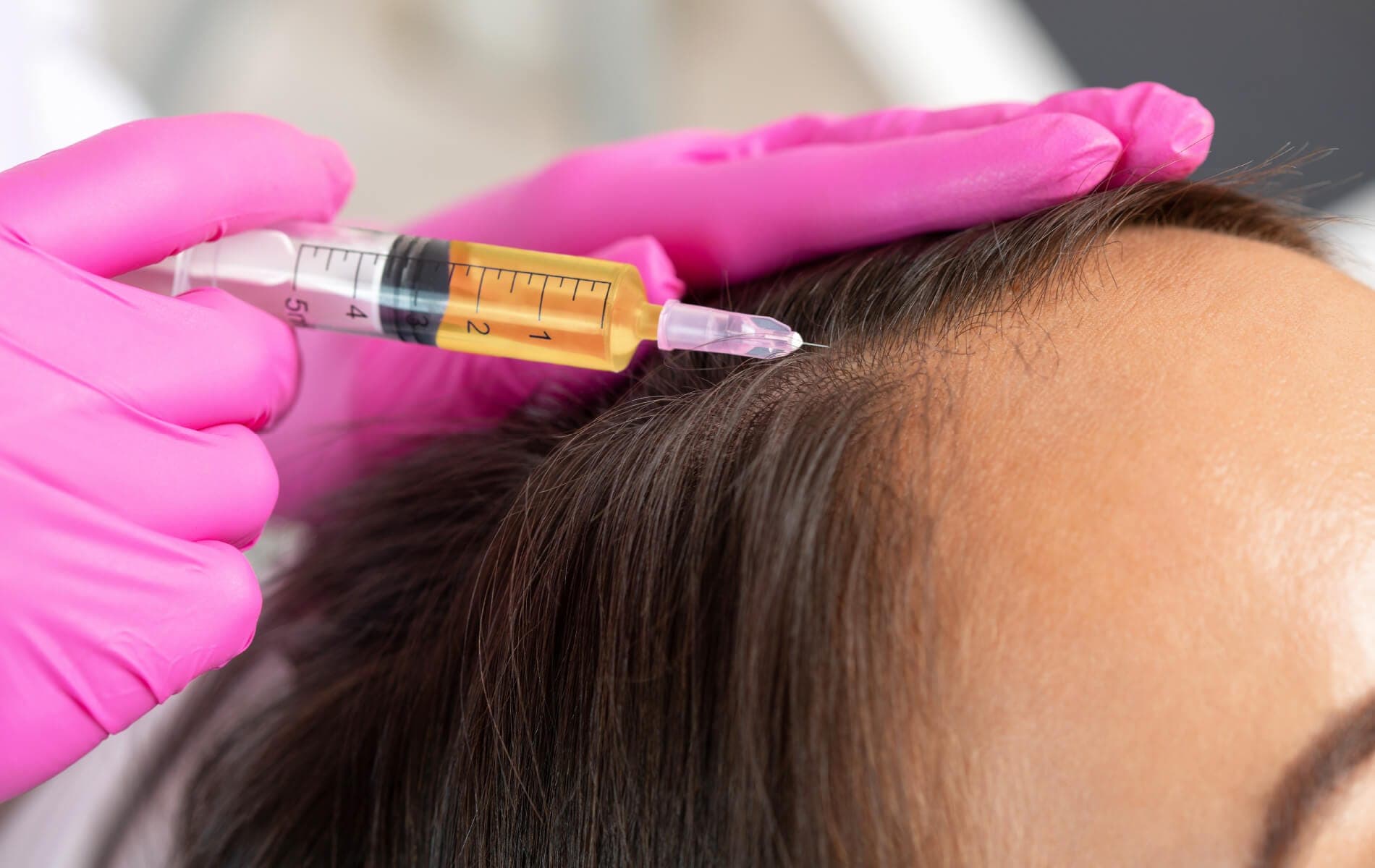
PRP stands for platelet-rich plasma. A small sample of your blood is drawn, spun in a centrifuge to concentrate the platelets, and injected into the thinning areas of your scalp with fine needles. It is non-surgical, takes about twenty minutes, and is intended to support follicles that are weakened but still alive.
Where does the material come from?
From you, on the day, in the room.
There is no product to order and nothing synthetic to introduce. A small sample of blood is drawn at the start of your appointment and placed in a centrifuge, which spins it fast enough to separate its components by weight. The platelet-rich fraction is drawn off and that is what goes back into your scalp.
For a lot of people this is the appeal on its own. One of the reasons patients give for choosing PRP is simply that they would rather use something from their own body than begin a medication they may be on for years.
It also means each session's material is prepared fresh for that session. There is no shared vial and nothing kept for next time.
What is PRP supposed to do to a follicle?
Support it, rather than replace it.
Injecting into the scalp is intended to improve circulation around the follicle and support the hair shaft it produces. That is the mechanism, and it explains the order in which people notice change: reduced shedding tends to come before any added density, because a follicle that is better supported holds onto the hair it has before it starts producing thicker hair.
Which is also why PRP is discussed for hair that is thinning rather than hair that is gone. It acts on follicles that are still present and still active. A weakened follicle can be supported. An area that has been fully bare for a long period has nothing left there to support, and it is unlikely to respond.
A doctor should say so at the consultation rather than sell you a course that cannot work. If nobody has looked at your scalp and told you which category you are in, you do not yet know whether this treatment applies to you.
Who is PRP actually for?
The pattern that fits it well is early to moderate thinning, in men and women. In practice the people it suits tend to describe their situation in one of these ways:
- Hair has been thinning gradually and they want to slow it down before it gets worse.
- They would rather use something from their own body than start a lifelong medication.
- The parting is widening but there is still hair there — it is just finer than it used to be.
That last one is the clearest signal. Finer hair in a widening parting is a follicle that is struggling, not one that has stopped. That is the situation PRP is designed around.
PRP is also not meant to be the whole plan. It is designed to sit alongside topical and oral medical therapy rather than replace it, and your doctor decides that combination at the consultation. Two other injectable options exist here too — GFC and QR678 — and which of the three is appropriate for your pattern of loss is a clinical decision, not a shopping one.
What happens at an appointment?
Four stages, in this order.
Consultation and screening. A doctor examines the scalp, reviews your history and your medication, and confirms PRP is appropriate for your pattern of loss. Scalp photographs are taken before the first session, so that when you come back to ask whether anything has changed, there is something to measure against rather than a memory to argue with.
Blood draw and preparation. A small sample is drawn and centrifuged to concentrate the platelet-rich fraction. Numbing cream goes on your scalp while that is being prepared, and sits for thirty to forty-five minutes.
Scalp injection. The concentrate is injected across the thinning areas with fine needles. This part takes about twenty minutes.
Course and review. Sessions are usually monthly across three to five months. Density is reassessed against your baseline photographs at the three-month mark, and maintenance sessions are spaced out once that initial course is complete.
Note that the number of sessions is reviewed at three months rather than fixed on day one. That is deliberate — how much thinning there is and how you respond both feed into it.
Does it hurt?
Numbing cream is applied for thirty to forty-five minutes beforehand, so most patients describe the injections as pressure rather than pain. Some tenderness or a heavy feeling in the scalp for a day or two afterwards is normal.
Every session here is performed by a doctor. That matters for comfort as much as for safety — the settings, the depth and the areas covered are adjusted by someone who examined your scalp, not applied to a template.
When would I see anything?
Reduced shedding usually comes first, within the first few weeks. It is often noticed in the shower drain or on a pillow before it is visible in a mirror.
Visible density takes longer, because hair grows slowly. That is the entire reason review photographs are taken at three months instead of asking you at week six whether it looks better. Results vary with the cause and the stage of your hair loss, and no one can promise an outcome in advance — a clinic that does is telling you something it cannot know.
What PRP is not
It is not surgery. There are no incisions and no stitches, and nothing is moved from one part of the scalp to another. It is an injectable treatment that supports the follicles you still have.
It is also not a one-off. A single session is not a course, and a course is followed by spaced maintenance, because the underlying pattern of loss does not stop when the initial sessions end.
Is there downtime?
No. Most patients return to work the same day.
You are asked to skip hair washing for about forty-eight hours, and to avoid exercise, swimming, steam and direct sun for two days. That is the whole aftercare list.
Who should not have PRP?
It is not carried out during pregnancy or breastfeeding, while you are taking antibiotics or blood-thinning medication, or where there is an active scalp infection or a platelet disorder. Disclose all medication at the consultation — including anything over the counter, which people routinely forget to mention.
Mild tenderness for a day or two afterwards is expected. If the scalp instead becomes increasingly painful, swollen or inflamed rather than settling, contact the clinic and have it looked at rather than waiting for your next scheduled session.
What is the first step?
Finding out whether your follicles are in the state PRP can act on. That is an examination, not a decision you can make from reading.
A consultation is ₹500, waived off against treatment. A doctor looks at the scalp, identifies the pattern of loss, and tells you whether PRP is appropriate — and if it is, what a realistic course looks like for your scalp specifically.
Book an appointment at Indiranagar or Bellandur, and bring any medication you take and any hair treatments you have already tried. Both change the plan.