
How Many PRP Sessions Before You Actually See Hair Regrowth?
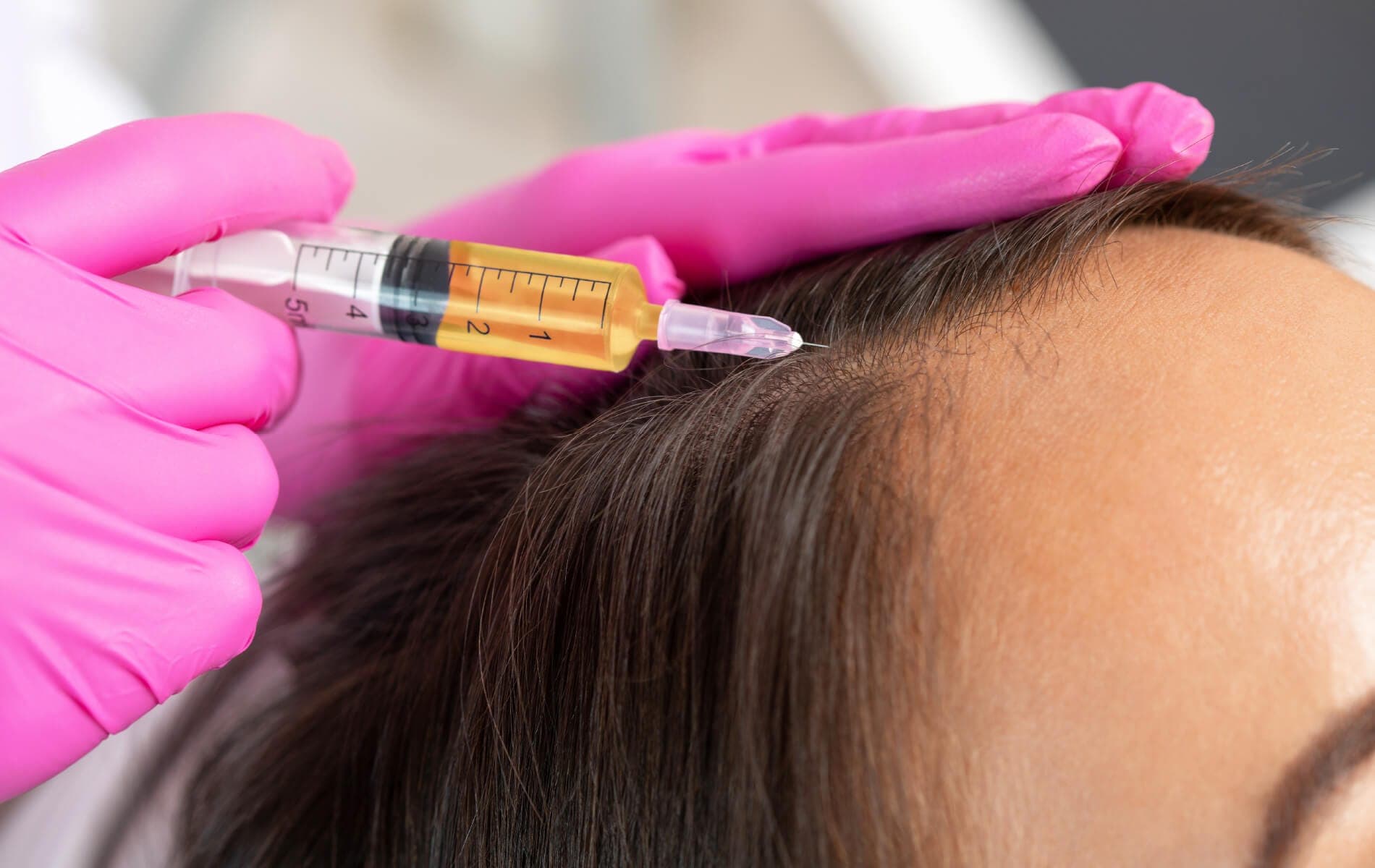
Most patients are advised a session roughly once a month over three to five months, followed by spaced maintenance sessions. Reduced shedding is usually noticed first, within the first few weeks. Visible density takes considerably longer, which is why review photographs are taken at the three-month mark rather than after one or two visits.
That sequence is the thing to fix in your head before you start. People who are disappointed by PRP are often disappointed at week three, judging a treatment against a timeline it never claimed.
What actually happens in a session?
A small sample of your blood is drawn and spun in a centrifuge to concentrate the platelets, which are then injected into the scalp through fine needles after numbing cream. Nothing foreign is introduced — it is your own blood, concentrated.
PRP Hair Regrowth Treatment is performed by a doctor, always. The injections themselves take about 20 minutes, with 30 to 45 minutes of numbing beforehand. There are no incisions, no stitches and no recovery period; most patients go straight back to their day.
The intent is to improve circulation around the follicle and support the hair shaft. That mechanism is worth knowing because it explains the order in which things change: supporting existing follicles shows up as less shedding before it shows up as more hair.
Why does it take months rather than weeks?
Because you are supporting follicles rather than installing anything. The change builds across a course, which is exactly why the course exists.
Set against your own timeline: expect reduced shedding in the early weeks — fewer hairs on the pillow and in the drain — and hold your judgement about density until the three-month comparison. Scalp photographs are taken before the first session so that comparison is measured rather than estimated, and that matters more than it sounds. You look at your own scalp daily, which makes gradual change almost impossible to assess from memory.
The plan is also not fixed at the start. The exact number of sessions depends on how much thinning there is and how you respond, and it is reviewed at the three-month mark. A clinic that quotes you a final number before seeing how you respond is guessing.
Results cannot be promised, and they vary with the cause and the stage of your hair loss.
Who actually responds, and who should look elsewhere?
This is the most useful question in the article and the facts answer it directly.
PRP acts on follicles that are weakened but still alive. That makes it most useful for men and women in the earlier and moderate stages of pattern hair loss — where there is something left to support.
Areas that have been fully bare for a long period are unlikely to respond, because there is no active follicle there for the treatment to work on. A doctor should tell you that at consultation rather than selling you a course that cannot work. If you are told everything will respond regardless of stage, that is the moment to be sceptical.
So the honest self-assessment before you book: is your concern thinning and widening, or is it an area that has been bare for years? The first is what this treatment is for. The second needs a different conversation.
Is PRP the whole plan?
No. PRP sits alongside topical and oral medical therapy rather than replacing it, and your doctor decides the combination at consultation.
If someone offers you injections as the entire answer with nothing else around them, ask what else should be in the plan. The treatment is designed to be one component.
Other routes exist too. GFC Hair Loss Treatment and QR678 Hair Growth Treatment each have their own pages, their own protocols and their own assessments. Which suits your scalp is a decision made at examination rather than by reading and choosing — and a doctor who steers you toward one of those instead is doing the job properly.
What should I expect afterwards?
No downtime. Most patients return to work the same day.
Some tenderness or a heavy feeling in the scalp for a day or two afterwards is normal, so it is worth knowing in advance rather than wondering. Most patients describe the injections themselves as pressure rather than pain, thanks to the numbing.
The scheduling reality nobody mentions
Add up the visit properly: 30 to 45 minutes of numbing plus about 20 minutes of treatment means the better part of an hour and a half in clinic, once a month, for three to five months. That is the actual commitment, and it is worth looking at your calendar honestly before you begin.
Pick the branch you can realistically reach on a weekday — both Indiranagar and Bellandur run it — because a course you attend fully beats a course you start at the address that sounded more convenient. A monthly appointment abandoned at session two has cost you money and told you nothing.
Worth mentioning at the consultation, too: the daily realities that come up in almost every hair consultation here, like a helmet worn twice a day through a humid commute, the dust on the arterial roads, or hard water at home. Whether any of it bears on your case is for the examination to settle, but it belongs in the conversation rather than being left out.
What to ask before you commit
Are my follicles still active in the areas that concern me? What is the initial course, and what happens at the three-month review if the photographs show little change? What else belongs in my plan besides the injections? And what would make you recommend stopping?
To get those answered against your own scalp, book an appointment at our Indiranagar or Bellandur branch. Bring older photographs of your hairline if you have them — they are more useful than any description from memory.