
What Is Mesotherapy for Hair? A Plain-English Explanation
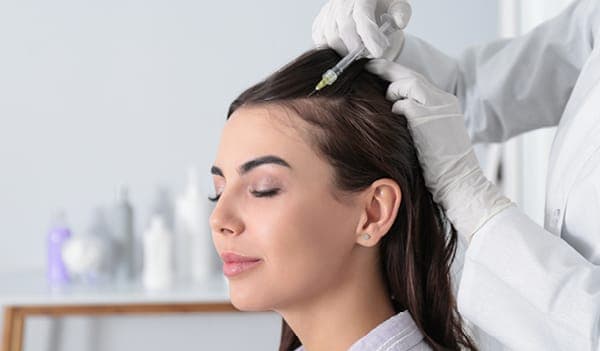
Scalp mesotherapy is a course of very fine microinjections that place a customised blend of vitamins, minerals and amino acids into the layer of skin where the hair follicles sit. A doctor mixes the blend for your scalp based on your examination and blood work. Each session takes around 20 to 30 minutes, with little to no downtime.
The name gets used loosely, which is part of why it is confusing. What follows is what scalp mesotherapy is at this clinic — what is in it, why it is delivered by needle rather than bottle, what a session actually feels like, and, importantly, where its limits are.
What is actually in the injection?
A blend of vitamins, minerals and amino acids — chosen by your doctor for your scalp and for any deficiencies your assessment picks up, rather than every patient receiving the same cocktail off a shelf.
That customisation is not a marketing flourish; it is the reason the consultation comes first. Your scalp, hair density, history and any blood work are reviewed, and the composition of the blend is decided from what that review shows. Two people with what looks like the same thinning can leave with different blends.
You are also entitled to know what is going into your scalp. Ask to be told exactly what is being used before the session — a reasonable question, and one a doctor should answer plainly rather than describe as a proprietary formula.
Why inject it instead of just applying a serum?
Because of where the follicle sits.
A topical applied to the surface of the scalp has to get through the skin to reach the layer around the hair root, and it cannot reliably do so. Microinjection skips that problem entirely: the solution is placed directly into the layer of skin where the follicles are. It is the same reasoning behind a great many in-clinic treatments — not that the ingredients are exotic, but that the delivery gets them to the depth that matters.
This is worth being clear-eyed about in both directions. It does not make the blend more powerful than it is. It makes the delivery more certain than a bottle can promise.
What happens during a session?
Four stages, and none of them takes long.
First, consultation — scalp, hair density, history and blood work reviewed, and the blend decided. Second, preparation: the scalp is cleansed and, where needed, a numbing cream is applied beforehand. Third, the microinjection itself — the solution is delivered across the scalp in a grid of very fine injections, either by needle or with a mesotherapy gun, taking around 20 to 30 minutes. Fourth, review, where your response is assessed and the course and blend are adjusted.
The grid matters more than it sounds. The solution is distributed across the scalp rather than concentrated in one place, which is what makes it a treatment of an area rather than a spot.
It is performed by a doctor, always.
Does it hurt, and will I need time off?
The needles are very fine, and most patients describe a brief stinging or prickling rather than pain. If you would rather not feel it at all, numbing cream can be applied first — say so at booking rather than on the day.
Downtime is little to none. Mild redness, tightness or irritation of the scalp afterwards is common and typically subsides within a few days, and most patients go straight back to their day. For anyone fitting appointments between work and a commute, that is often the practical reason this comes up as a starting point at all.
How many sessions will I need?
A short course, spaced by your doctor — and deliberately not a fixed number quoted upfront.
That is not evasiveness. How many sessions you need depends on what is actually driving your hair fall and on how you respond to the first few, neither of which is knowable on day one. Your doctor sets an initial course, and the protocol is reviewed at the three-month mark against your baseline photographs.
Be a little wary of any hair treatment sold as a fixed package with a promised session count before anyone has seen how your scalp responds.
How will I know whether it is working?
Because scalp photographs are taken before the first session.
This is a small procedural detail that does more work than almost anything else in the plan. Hair change is slow, incremental and almost impossible to judge from memory — you see your own scalp every day, which makes you the least reliable observer of it. A baseline photograph means change at review is measured rather than estimated, in either direction. It is also how a treatment that is not working gets identified as such instead of being continued out of hope.
Will it regrow hair I have already lost?
Here is the honest limit. Mesotherapy is used to support follicles that are still active. It cannot be relied on to bring back areas that have been bare for a long period, and a doctor should say so plainly rather than sell you a course that cannot deliver on it.
That distinction — supporting what is still there versus restoring what is gone — is the single thing most worth understanding before you book anything for hair, whatever the treatment name.
Is mesotherapy enough on its own?
Usually it is one component rather than the whole answer.
It is often used to support a broader hair fall plan that also includes topical or oral medical therapy, rather than as a standalone treatment. Many patients arrive already on medication and want something to work alongside it — that is a common and entirely reasonable use of it, and the one many of the clinic's mesotherapy patients describe.
There is a second thing it contributes that is easy to overlook. Patients frequently report a less dry and less irritable scalp afterwards, and scalp condition is not a side issue: it limits how far any hair treatment can go. In Bangalore, where a change of water supply after a move gets blamed for almost every case of thinning, the useful move is not to settle the water argument but to have the scalp actually examined and the blood work actually read. The consultation is where that happens.
If your doctor thinks another approach fits your case better, they should say so. Other options are covered on their own pages — PRP and QR678 among them — and which of these belongs in your plan is a clinical decision, not a shopping one.
Who should not have scalp mesotherapy?
It is not suitable during pregnancy or breastfeeding, where there is an active scalp infection or open wound, or where you are allergic to any component of the blend. Disclose your full medical history at consultation, including anything you are already taking for your hair.
Afterwards, mild redness, tightness or irritation is expected and settles within a few days. If irritation is worsening rather than easing, or you develop signs of infection at the scalp, contact the clinic rather than waiting for your next scheduled session.
Where to start
If you have been reading treatment names without knowing which one your hair fall actually calls for, the sequence is the wrong way round — the diagnosis comes before the technique. A consultation is ₹500, waived against treatment, and covers the scalp examination, the history and the blood work that decide whether mesotherapy is the right component for you at all. Book an appointment and bring any recent blood tests with you.