
What Is GFC Hair Loss Treatment? A Plain-English Explanation
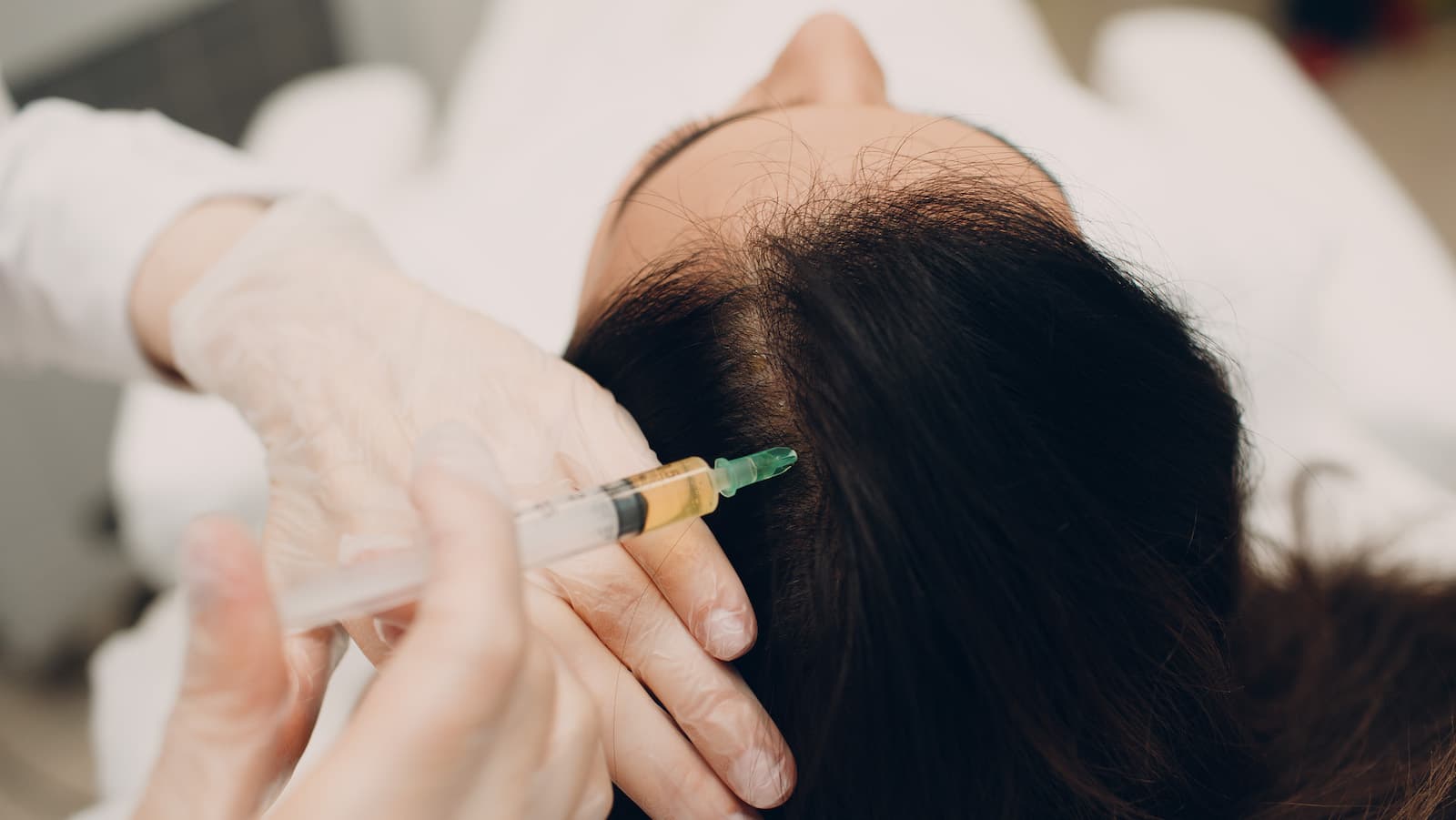
GFC stands for Growth Factor Concentrate. It is a scalp treatment prepared from a small sample of your own blood: around 10ml is drawn, processed in the clinic to isolate the growth factors your platelets release, and roughly 4 to 5ml of the resulting concentrate is injected into the thinning areas of the scalp with fine needles. A doctor performs every session, and there is no downtime.
What do the three words in the name actually mean?
Taken one at a time, the acronym describes the whole treatment.
Growth factor. These are what your platelets release. The treatment does not add anything foreign to the scalp — it takes something your own blood already produces and puts it where thinning follicles are.
Concentrate. The blood sample is processed so that what goes back in is a concentrated preparation rather than whole blood. This is the step that gives GFC its name, and it is also what separates it from standard PRP: PRP injects the concentrated platelet fraction, while GFC processes that fraction further to isolate the growth factors those platelets release. Because GFC is the more concentrated preparation, a GFC course is usually shorter than a comparable PRP course.
One more word is worth knowing even though it is not in the acronym: autologous, meaning from your own body. GFC is autologous. Nothing synthetic is introduced, which for a lot of patients is the reason they ask about GFC rather than something else.
What actually happens during an appointment?
Chronologically, it is short and undramatic.
Consultation and screening first. Before any session is booked, a doctor examines the scalp, reviews your medication and history, and confirms GFC is appropriate for your stage of hair loss. Scalp photographs are taken before the first session so that any change later is measured rather than remembered. The consultation is ₹500, waived off against treatment.
Numbing and preparation. Anaesthetic cream goes on the scalp for 30 to 45 minutes. While it is working, around 10ml of blood is drawn and processed.
The injections. Roughly 4 to 5ml of growth factor concentrate is delivered across the thinning areas through fine needles. Most patients describe pressure rather than pain.
Out the door. The procedure itself takes around 30 minutes including preparation, and you return to normal activity the same day. Exercise, swimming, steam and direct sun are avoided for two days, and hair products for six hours.
What is it doing inside the scalp?
GFC acts on follicles that are weakened but still active. That single sentence carries most of the useful information about the treatment, in both directions — it explains who it is likely to help and who it is not.
A follicle that has thinned but is still producing hair is the thing being supported. A patch that has been bare for years has nothing left to support, and the treatment cannot manufacture a follicle where one is no longer there. This is why the earlier and moderate stages of pattern loss, in both men and women, are the strongest candidates.
Who is it usually suggested for?
Three descriptions cover most people who end up having it:
- Someone who has already tried PRP elsewhere and wants to know what else is available.
- Someone whose crown is thinning who wants to act while there is still hair there to work with.
- Someone who specifically wants a treatment made from their own blood rather than a synthetic product.
If none of those sounds like you, that is not a disqualification — it is a reason to have the scalp examined before deciding anything. QR678 is a different route again, and which of the available options suits you is a finding from an examination, not something to settle by reading.
Does it hurt, and is there any recovery?
Anaesthetic cream is applied for 30 to 45 minutes beforehand, so most patients describe pressure rather than pain during the injections. Mild soreness, redness or itching for a couple of days afterwards is normal.
There is no recovery period in the ordinary sense. There is nothing surgical involved, and most patients go straight back to work.
How long before anything changes?
Longer than most people expect, and the reason is simply how hair grows.
Reduced shedding is usually the first change patients notice — fewer hairs on the pillow and in the shower drain before anything looks different in the mirror. Visible density takes months, because hair grows slowly. This is exactly why the photographs taken before the first session matter: comparison photographs are taken at around three months, so the assessment is measured against a picture instead of against a memory of what your hair used to look like.
Four to six sessions is typical, spaced by your doctor, with maintenance roughly one session every two to three months afterwards. That number is not fixed at the start. The protocol is reviewed at the three-month mark against your baseline photographs and adjusted from there.
What will GFC not do?
Three honest limits, worth having in front of you before you start.
It will not work on a completely bald area. GFC supports follicles that are still present and active. Areas bare for years are unlikely to respond, and your doctor should tell you so at consultation rather than after four sessions.
It cannot promise regrowth. How much you see depends on how much active follicle remains, and no one can promise a particular result in advance.
It is not a one-off. The typical course runs to several sessions, and maintenance continues afterwards. A single session is not the treatment.
Who should not have GFC?
It is not carried out during pregnancy or breastfeeding, while you are on antibiotics or blood-thinning medication, or where there is an active scalp infection.
Disclose all medication at consultation, including anything over-the-counter and anything you start between sessions. That is the point of the screening step, and it only works if the information is complete.
What should I watch for after a session?
Mild soreness, redness or itching for a couple of days is expected and settles by itself. If it runs on well past that, worsens rather than improves, or the scalp looks or feels infected, contact the clinic rather than waiting for the next scheduled session.
Finding out whether it applies to you
The question a definition cannot answer is whether your own follicles are still active enough for this to be worth doing — and that takes an examination. Book an appointment at Indiranagar or Bellandur, ₹500 and waived off against treatment, and ask for a straight answer on candidacy before any course is discussed.