
A Korean HydraFacial, Step by Step: What the Fourteen Stages Actually Do
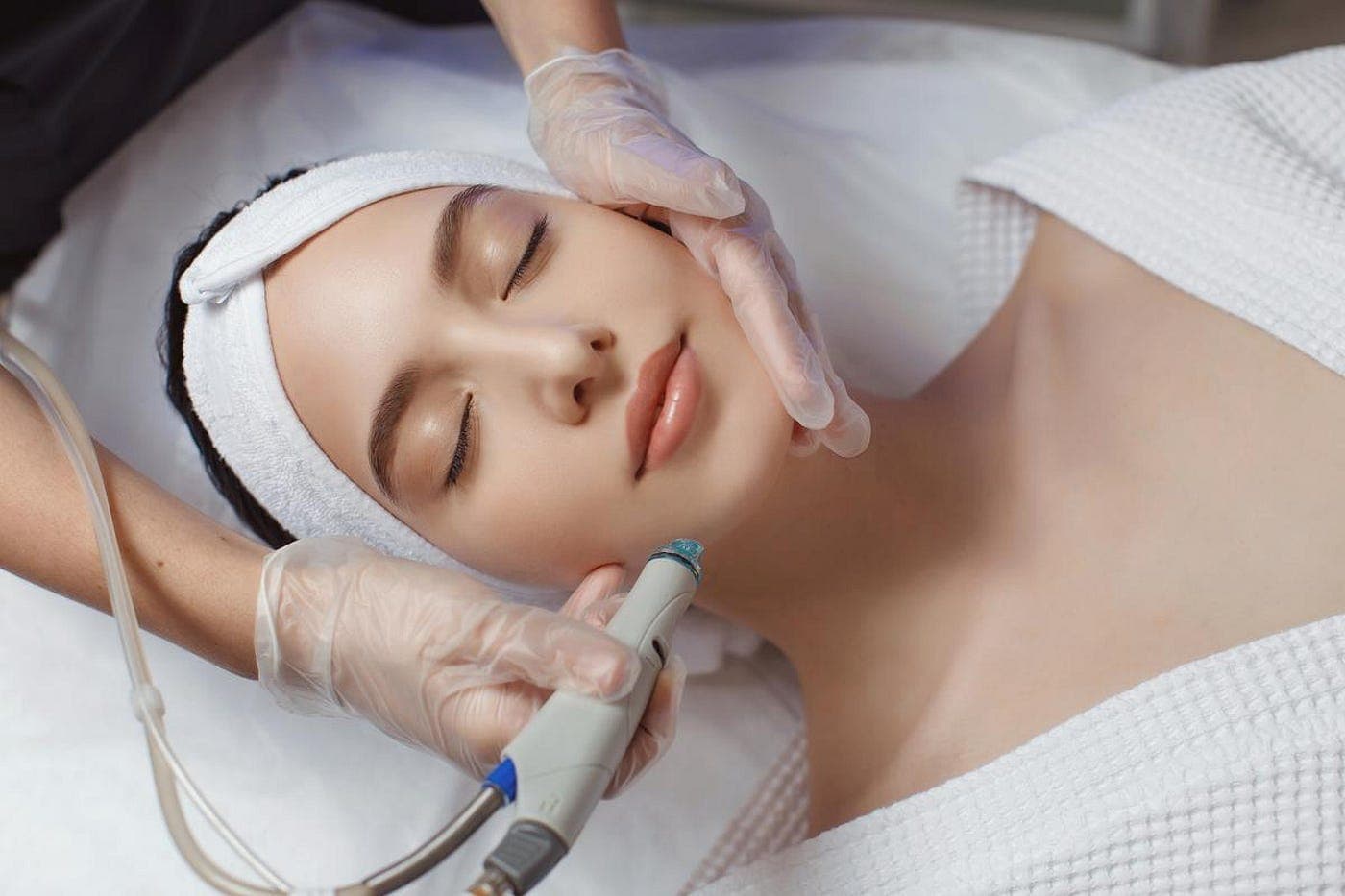
A Korean HydraFacial is our Hydra Medi Facial run as a longer, fourteen-step glass-skin protocol — the same medical-grade device and the same doctor supervision, with layered serum infusion, a cooling mask, LED and lymphatic massage added around it. It runs 75 to 90 minutes, nothing is injected, and there is no downtime at all.
If you have seen the name on a treatment menu and could not tell whether it meant a new machine, a new technology or simply a marketing label, the short answer is that it is none of those. It is a sequence, and the sequence is the product. What follows is what happens in the room, in order, and what each part of it is for.
What does the "Korean" part actually mean?
It describes a method, not a place of manufacture. Korean skincare is built around one central idea — that a healthy barrier and thin, repeated layers do more than one strong treatment. Translated into a facial, that means the exfoliation is deliberately kept gentle, the serums go on in thin sequential layers rather than as a single rich product, and the session finishes by supporting the barrier instead of stripping it.
That is the entire difference. The device is the same one used for a standard Hydra Medi Facial, and the doctor supervision is the same. What you are booking is a longer appointment with more steps in it, not different hardware.
What happens across the fourteen steps?
It opens with an assessment and closes with sunscreen, and everything in between runs in a fixed order. Broadly, the session moves through four phases.
Clearing. A doctor first checks your skin type, your barrier condition and anything active that would mean rescheduling rather than proceeding today. Then two cleanses: an oil-based one to lift makeup, sunscreen and sebum, followed by a gentle water-based one to clear what the first loosened. Two rather than one, because water-based products cannot fully remove oil-bound residue on their own, and the point is skin that is genuinely clean without being stripped.
Exfoliation and extraction. A mild acid loosens dead surface cells — deliberately gentler than a peel, because the aim is smoothness rather than shedding. The device's spiral tip then uses suction to lift blackheads and surface build-up out of pores, with no squeezing and no manual pressure. A second pass covers the nose, chin and any congested area, where build-up is heaviest and one pass rarely finishes the job.
Layering. Three serums follow in sequence, thinnest first. A hyaluronic-based hydrating infusion into the freshly cleared surface; then an antioxidant and brightening blend aimed at dullness and uneven tone; then peptide and ceramide barrier support last, because barrier repair is what makes a result hold between sessions rather than fading in a day.
Settling. A cooling sheet mask calms any flush from extraction and lets the layered serums settle rather than evaporate. Red LED follows — it generates no heat, and you feel nothing beyond the light itself. A short lymphatic massage along the drainage lines helps reduce puffiness, particularly around the eyes and jawline. Moisturiser then seals the serums in, which is what stops the hydration lifting off over the next few hours, and broad-spectrum sunscreen finishes every session.
Does it hurt, and can I go straight back to work?
No, and yes. The extraction step feels like firm, cool suction; the acid step can tingle briefly; the LED registers only as light. There is no downtime — you can put makeup on and return to work the same day, and any mild redness usually settles within an hour or two.
The real constraint is the clock rather than recovery. At 75 to 90 minutes this is a longer appointment than a standard facial, so it sits better at the end of a working day, or across a generous midday gap, than squeezed into an hour.
What does it cost, and what is included?
We do not publish a single figure for this protocol, because the fee is settled at the consultation once a doctor has seen your skin and you have decided whether you are booking one session or a monthly course. What we can be specific about is everything around it. A standard Hydra Medi Facial starts from ₹2,999 per treatment. Every Korean HydraFacial session includes a complimentary chemical peel, which is a ₹1,999 session on its own. The consultation is ₹500, and that ₹500 is waived against treatment.
Who should wait rather than book?
Some skin should be rescheduled rather than treated, and the assessment at the start of the session exists to catch precisely this. Active rosacea, sunburn, infected breakouts or broken skin can all be made worse by a treatment that exfoliates and extracts, so those are reasons to come back another week.
Tell the doctor about anything you are taking or have recently had done. Recent isotretinoin, strong retinoids or a recent peel change how the exfoliation step is set, and sometimes mean deferring the session altogether. This is not a box-ticking question — it is the single piece of information that most often changes what happens in the room.
Please do not make that judgement at home. If you are unsure whether something on your skin counts as active, ask the clinic before your appointment rather than deciding for yourself from a search result.
How many sessions will I need?
One session gives a visible same-day result, which is why it is a common pre-event booking — leave three to five days before the event rather than going the day before, so any transient redness has settled and the skin has taken up the hydration. For skin quality that holds, once a month is the schedule, the same as any maintenance facial, and each session builds on the last.
It is worth being plain about what that implies. This is a maintenance treatment, not a corrective procedure, and the benefit comes from regularity rather than from any single visit. It cannot be promised that a facial will resolve a concern sitting deeper than the surface — if that is what you are hoping for, say so at the consultation and you will be pointed towards something more appropriate.
What should I do afterwards?
Sunscreen daily without exception. Exfoliated skin burns more easily for several days, which is exactly why the session itself ends with it. Skip the gym, sauna and steam for about 48 hours, and hold off on retinoids or acids at home for a few days. Keep the rest of your routine simple — layering strong actives straight on top undoes the barrier work the protocol just did.
Two things are worth telling us about rather than managing alone. Mild redness is common straight after extraction and is usually gone within an hour or two; if it is still there a day later, contact the clinic rather than treating it at home. Small breakouts occasionally surface in the first week where congestion was already forming — that settles on its own, but if it spreads, becomes painful, or has not settled, call us. Neither is something to self-assess.
Have a doctor look first
If you are unsure whether the fourteen-step protocol or the shorter session suits your skin, the sensible next step is an assessment rather than a guess. Book a consultation at our Indiranagar or Bellandur clinic — ₹500, waived against treatment — and we will talk through what your skin actually needs. The full protocol is set out on the Korean HydraFacial page.