
What Actually Happens During an MNRF Session, Start to Finish
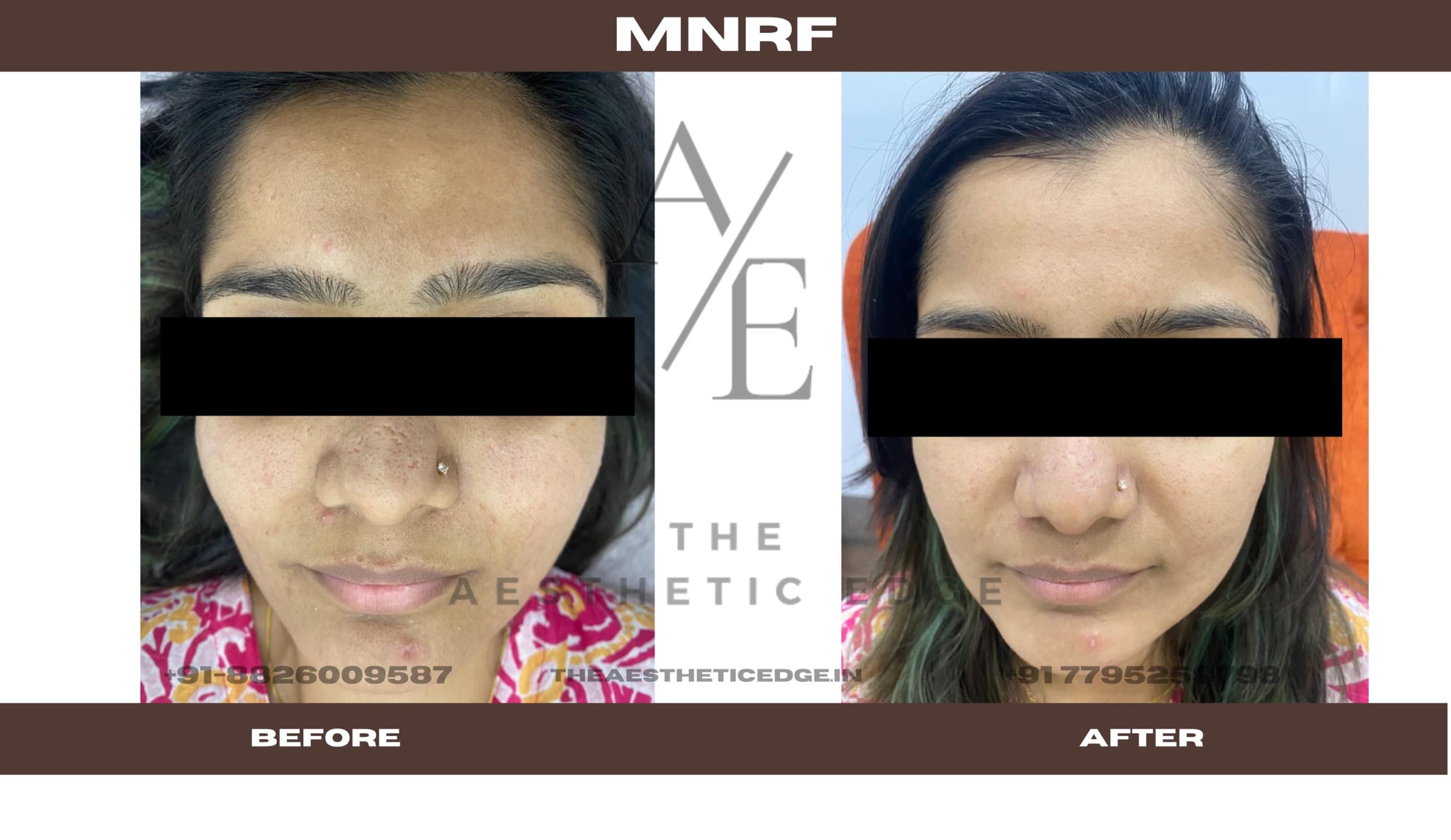
An MNRF appointment has four stages: an assessment where the doctor sets the depth and energy for your skin, cleansing and numbing, the treatment pass itself worked zone by zone, and then aftercare with a progress photograph. The whole visit runs to about an hour.
The part worth knowing in advance is that the decisions that matter are made before the device is switched on. If you are nervous about this appointment, you are probably picturing the middle stage — and the middle stage is the one that has been set up by the stage before it.
What happens before the device is switched on?
An assessment, and it is doing real work rather than filling time. MNRF Treatment combines microneedling with radiofrequency: fine needles carry RF energy into the deeper skin layers, where acne scars, open pores and early laxity actually live. The doctor maps your scars, pores or laxity and sets the treatment depth and energy for your skin — deeper for scars, shallower for texture.
That single decision is why two people can have the same treatment on the same device and have quite different sessions. It is also what the appointment is screening for: the assessment confirms MNRF suits your concern and rules out the things that make it inadvisable — pregnancy, a tendency to keloid scarring, and active skin conditions.
So if you arrive expecting to be handed a standard setting, that is not what happens, and that is the point.
Is there anything I need to have already done?
Yes, and it is small. You will have been asked to pause retinoids and exfoliants for a few days beforehand, and to avoid recent waxing or laser on the area being treated.
If either of those has slipped, say so when you arrive rather than hoping it will not matter. It is the kind of thing that changes what the doctor does on the day, and it is a much better conversation before the session than after it.
Does the numbing actually work?
The skin is cleansed and numbing cream is applied so the session stays comfortable — that is the second of the four stages, and it is not a formality either.
What most patients report is warmth and pressure rather than pain, with brief discomfort at the more sensitive spots. That is the honest description: not nothing, but not the thing people arrive braced for. "Warmth and pressure" is also a useful phrase to hold onto, because it tells you what is normal and therefore what is worth mentioning if what you feel is something else.
Say so during the session if it is more than that. The depth and energy are settings, not a fixed prescription, and the person holding the device would rather adjust than have you endure it quietly.
What does the hour itself involve?
The microneedles deliver radiofrequency into the deeper layers zone by zone, for about sixty minutes.
Zone by zone is the part first-timers find reassuring once they know it. This is not one continuous pass across your whole face — the area is worked through in sections, which means there are natural pauses built into the structure of the treatment rather than you having to ask for one. It also means the sixty minutes is mostly made up of short, repeated passes.
The needles are what carries the energy below the surface, and that is the whole mechanism: the RF is not being applied to the top of your skin and asked to travel down. It is being placed at the depth that was chosen for you.
What do I look like when I walk out?
Red, and slightly swollen, and that typically settles within hours. Some people also get light crusting for a few days.
Worth planning for rather than being surprised by: nobody looks untouched walking out of this, and the redness is the expected outcome rather than a sign something went wrong. Light crusting, if it appears, belongs to the following days rather than the same evening.
The session finishes with written aftercare, so you leave with the rules in your hand rather than in your memory.
Why does the appointment end with a photograph?
Because the result is not something you can see on the day, and a photograph is the only honest way to track it. Progress is photographed session by session across a course of typically three to four sessions.
Collagen keeps building for weeks after each session — the change is remodelling under the skin rather than anything visible at the surface immediately. Early change can show after the first session, but the real result accumulates, which is precisely why the sessions are spaced out and why judging MNRF on how you look in the mirror that night tells you nothing.
The photographs are what let you compare session three against session one rather than against your memory of session one, which is a notoriously unreliable baseline.
What is the one rule that matters most afterwards?
Strict sunscreen and no sun exposure for two weeks after each session.
In Bangalore that is the instruction that actually constrains your diary, and it is worth building the booking around. This city has no low-UV season to wait for — monsoon cloud cover is not an absence of UV, and the agreeable weather is exactly what has people outdoors far more than they account for. Two weeks of genuine sun avoidance after each of three or four spaced sessions is a real commitment, and it is better understood before the course starts than discovered during it.
Everything else is on the written aftercare sheet you leave with.
What if this turns out not to be the right treatment?
That is a normal outcome of the assessment rather than a wasted appointment, and it is worth arriving open to it. If your concern is colour rather than contour, or if the depth MNRF works at is not what your skin needs, Microneedling with Dermapen and Q-Switch Laser each have their own page and their own cases where they fit better.
The screening happens first for a reason, and being redirected at the assessment is the system working.
Booking the first one
Come with your actual concern described plainly — scars, pores, texture, loosening — and let the assessment set the depth, the energy and the number of sessions. Those three things are what your course is, and none of them can be decided from a page.
Book an appointment at either branch, and bring the two-week sun rule into the conversation when you are choosing dates. The consultation fee is waived against treatment if you go ahead.