
How MNRF Works: Two Inputs, One Collagen Response
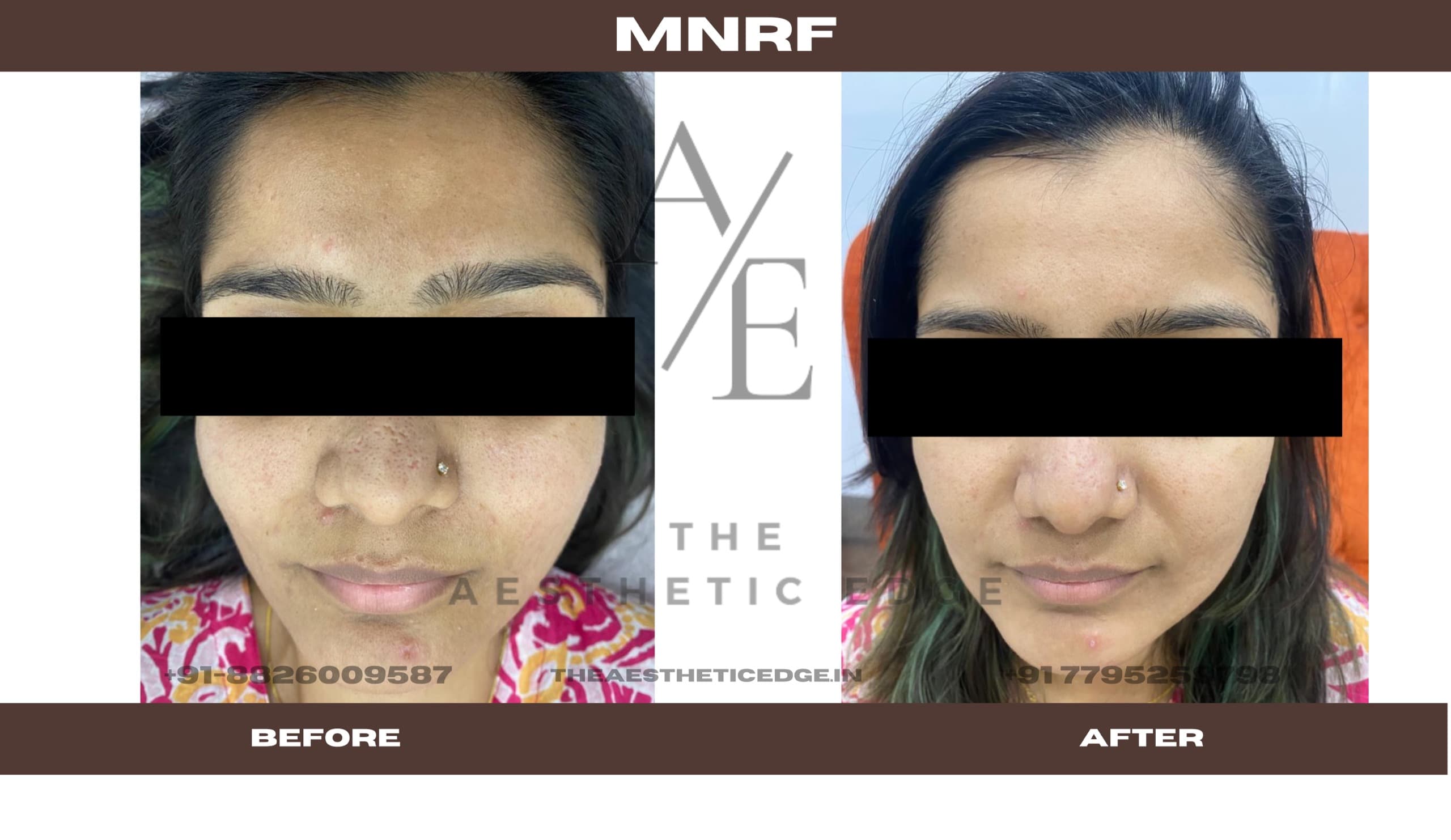
MNRF works by doing two things in the same pass. Fine needles create controlled micro-injury in the skin, and they carry radiofrequency energy down into the deeper layers and deliver it below the surface. Both inputs prompt the same response — collagen production at the depth where acne scars, open pores and early laxity actually sit — and that response takes weeks to play out.
If you like to understand a procedure before agreeing to it, that is the whole mechanism in four sentences. The rest of this piece takes each part of it apart, because the details are what explain the session length, the spacing, the recovery and, more than anything, why the treatment is set up as a doctor's decision rather than a device's.
What are the two inputs, and why not just one?
Micro-injury alone is a proven prompt. Adding radiofrequency lets you place a second, thermal prompt at a chosen depth.
The clinic's own description of MNRF names both: controlled micro-injury plus radiofrequency. The needling component is the same principle behind microneedling with a Dermapen, where controlled micro-channels prompt the skin to repair itself with new collagen and elastin. The radiofrequency component is the addition — energy delivered through those needles into the deeper layers rather than applied across the top of the skin.
The practical consequence is reach. Radiofrequency delivered through microneedles remodels collagen under a scar, which is described plainly on the treatment page as working where surface treatments cannot. That single sentence explains why creams, and even careful surface work, plateau on established scarring.
Why does it matter that the energy goes in below the surface?
Because on melanin-rich skin, what happens at the surface is where trouble comes from.
Many energy treatments deposit their energy across the top of the skin. MNRF places it underneath instead, and that is the stated basis for it carrying a lower pigmentation risk than many surface lasers — a genuinely important point for Indian skin tones, where the concern is not just whether a treatment works but whether it leaves marks darker than the ones you came in for.
It is worth being precise about what this does and does not mean. It is a lower risk, not an absent one, and the settings are still chosen for your skin type by the doctor. The route the energy takes reduces the hazard; the person choosing the depth and energy manages what remains.
What does "remodelling collagen" mean in practice?
It means the skin rebuilds the tissue under a depression rather than laying something over it.
A depressed scar exists because the tissue beneath the surface is deficient or tethered. Filling in from above cannot correct that. Prompting new collagen at the level of the deficit can, gradually, which is why the same mechanism turns up across four different-looking concerns on the treatment page:
Acne scars — remodelled collagen beneath the scar itself.
Open pores — collagen stimulation tightens the skin around an enlarged pore, softening how visible it is across the course.
Early laxity and fine lines — the same collagen response produces a non-surgical tightening effect that builds over weeks.
Texture and stretch marks — the combination of controlled micro-injury and radiofrequency softens rough texture and reduces the visibility of stretch marks over multiple sessions.
Four concerns, one biological answer, applied at different depths and energies. That is the underlying logic of the treatment.
Why is depth the variable everyone talks about?
Because the same device produces entirely different work depending on how far in the energy is placed, and because your face is not uniform.
The first step of an MNRF course is an assessment in which the doctor maps your scars, pores or laxity and sets the treatment depth and energy for your skin. The procedure is then carried out zone by zone across roughly sixty minutes. Zone by zone is not a stylistic detail — it is an acknowledgement that a tethered scar on the cheek and thinner skin near the temple are not the same target.
This is also why the machine's brand name tells you very little. The device offers a range; the clinician selects from it.
Why does the result take weeks rather than days?
Because the session delivers the stimulus, and your skin performs the construction afterwards.
Early change can be visible after the first session. But the treatment page is explicit that the real result builds over weeks as collagen remodels, and that this is the reason sessions are spaced apart rather than run close together. New collagen is laid down and reorganised over that period; there is no version of the process in which it happens on the day.
Most plans run to three or four sessions, with the number depending on scar depth and the concern being treated, and with progress photographed session by session so the response can be judged on evidence rather than recollection.
What is MNRF not doing?
It is not treating pigment, and it is not repositioning anything.
Flat brown marks — sun spots, freckles, melasma, the discolouration acne leaves behind when it heals level — are a pigment problem, and pigment is what the Q-Switch laser is built for: very short, high-energy pulses that shatter pigment particles small enough for the body to clear. Collagen remodelling does not disperse pigment.
Nor is MNRF a lift. It addresses early sagging and fine lines through tightening that develops over weeks. Tissue that has genuinely descended is a structural problem and a different conversation entirely, which your doctor should have with you honestly rather than selling you a course that cannot deliver it.
How will I know it is working?
Through photographs taken at each session, compared side by side, rather than by daily inspection.
Change of this kind is slow and you see your own face constantly, which makes you the least reliable judge of it. The photographic record built through the course exists for exactly that reason, and it is the thing to ask to see.
What makes someone unsuitable?
Pregnancy and breastfeeding, a keloid tendency, and any active skin condition such as psoriasis or eczema in the area being treated.
Those are the documented exclusions, and the consultation screens for all of them before anything is booked. The treatment is performed by a doctor in every case here, which is less a selling point than a description of what the procedure requires: someone qualified to decide what depth is appropriate for the skin in front of them.
What a session involves, briefly
Numbing cream first, so the session stays comfortable — most patients describe warmth and pressure rather than pain, with brief discomfort over sensitive spots. Around an hour of treatment, zone by zone. Afterwards, redness and mild swelling usually settling within hours, small crusts at the needle points for a few days that should be left alone, and strict sun protection for a couple of weeks because treated skin burns easily.
MNRF is priced from ₹6,999 per session, and the consultation is ₹500, waived off against treatment. If you want the mechanism explained against your own skin rather than in the abstract, book a consultation at Indiranagar or Bellandur and ask what depth is being planned, and why.