
Teeth Whitening for Men: What men ask that the marketing never addresses
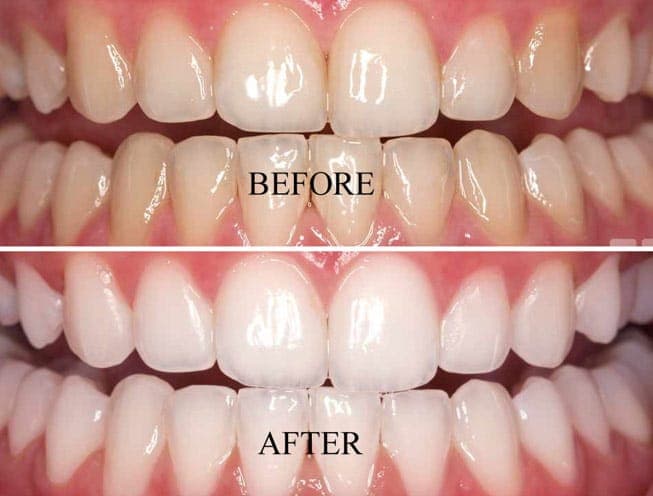
Professional whitening for men is the same procedure as for anyone else — a peroxide-based gel applied by a dentist to lighten natural enamel, usually in one in-clinic session and sometimes two, after a scaling and polishing appointment. There is no separate male protocol. What differs is the set of questions men tend to arrive with, and nearly all of them have plain answers.
Will it look obvious?
That is settled before any gel touches a tooth, because the target shade is agreed with you at assessment. The point of that conversation is to land on a result that reads as a healthy version of your own teeth rather than an obviously artificial white — and it is yours to steer. If what you want is to look like you have been sleeping properly rather than like you have had something done, say exactly that, in those words. A dentist can work to it.
It is worth knowing what whitening physically does, because it explains why the change is a colour change and nothing else. Nothing is drilled and no enamel is removed. The shape of your teeth, their length and the way they sit are untouched. That makes this one of the few cosmetic dental options that is purely additive, and it is also why it will not fix anything that is not about colour.
I have been on filter coffee and chai for twenty years. Is there any point?
Yes — that is precisely the staining the gel is formulated to lift. The bleaching agent works into the enamel and breaks down pigment left by tea, coffee, tobacco and pigmented foods, rather than scrubbing at the surface the way an abrasive paste does.
The honest caveat is on the back end rather than the front. A result lasts anywhere from several months to a few years, and where you land in that range depends heavily on diet, smoking and oral hygiene. Heavy tea, coffee or tobacco use shortens it considerably. That is not an argument against having it done. It is an argument for knowing in advance that if the intake does not change, you are likely at the shorter end of that span, and for asking at your appointment what maintenance would look like for someone with your habits.
How many appointments is this, realistically?
Two, at a minimum. A scaling and polishing appointment comes first so that the gel meets clean enamel, and then the whitening itself is usually a single in-clinic session, occasionally two. Before either of those there is an assessment, where your teeth and gums are examined, the cause of the staining is identified and the shade target is agreed.
That cleaning appointment is not an upsell tacked onto the front. Polishing lifts surface discolouration in its own right, and a fair number of men find the deposit coming off accounts for more of what was bothering them than they expected.
Will anyone be able to tell the next day?
There is no downtime, so there is nothing visible to explain — no swelling, no marks, nothing that keeps you off work. The two practical consequences are smaller than that. Strongly staining food and drink are avoided for a couple of days afterwards, and teeth may react to cold for a day or two. So the only thing a colleague is likely to notice is that you have gone quiet on the coffee.
I chipped a front tooth years ago and had it filled. Does that change things?
It does, and it is the single most useful thing to raise before you book. Crowns, veneers and tooth-coloured fillings do not bleach. They were colour matched to your teeth on the day they were made, and they stay exactly where they are while everything around them lightens — so a repaired front tooth that currently blends in can finish up looking darker than its neighbours.
This is a sequencing question, not a reason to abandon the idea. Your dentist will discuss the order at assessment, and the usual answer is to whiten, let the shade settle, then replace the visible restoration to match. Where several things bother you at once — the colour, plus a chip, plus old work that has never matched — that is the point at which a planned smile makeover becomes the more sensible conversation, because it sequences the whole set deliberately instead of one piece at a time.
I used a whitening toothpaste for a year and nothing happened. Why?
Because those pastes are mildly abrasive and act on surface stain only. They do not carry enough active agent to change the underlying shade of the enamel, which is the thing a professional treatment actually does. A year of brushing with one is not evidence that your teeth will not respond; it is evidence that you were using a product that was never going to shift the shade.
My teeth already twinge with cold water. Am I ruled out?
Often not, but say so before rather than after. Existing sensitivity can usually be managed with a desensitising regimen before and after treatment, or by using a gentler protocol spread over more sessions. What makes that possible is being told about it at assessment, so it is planned for.
Sensitivity is also the most common effect afterwards, in men who had none beforehand. Teeth may react to cold for a day or two, it typically resolves on its own, and a desensitising toothpaste helps.
What if the colour is not stain at all?
Then whitening may not be the answer, and you should hear that at assessment rather than afterwards. Discolouration from tetracycline, from fluorosis, from an old injury or from a tooth whose nerve has died responds poorly or unevenly to external bleaching. Only an examination can establish which kind of discolouration you have — it is not something to work out from a photograph or from what someone at the gym told you. That examination is also what catches decay, a crack or an exposed root, and bleaching over any of those causes real pain, which is why the check is not a formality.
When to ring the clinic rather than wait it out
Some sensitivity to cold for a day or two is expected and usually settles by itself. Brief gum soreness, or a whitened patch at the gum margin where gel has touched soft tissue, also settles quickly.
Contact the clinic rather than sitting it out if sensitivity is still there after a few days or is getting worse, if gum soreness is not settling, if one tooth in particular is sharply painful, or if anything is interfering with eating or sleeping. Do not try to work out what it means yourself and do not push on through it — ring Indiranagar or Bellandur and describe what you are feeling, and let the person who examined you decide whether you need to be seen.
What it costs
The consultation is ₹500, waived off against treatment. The treatment figure itself is quoted after the examination, because what it depends on is genuinely individual: whether one session or two are needed to reach the agreed shade, whether a cleaning appointment comes first, and whether any visible restoration will need replacing afterwards to match. Anyone giving you a number before looking in your mouth is guessing at those three things.
If this has been on the list for a while, the useful next step is the examination rather than the treatment. Read what the procedure involves, then book an appointment at Indiranagar or Bellandur — an hour there settles what is staining your teeth, what your existing dental work will do, and whether whitening is the thing you need at all.